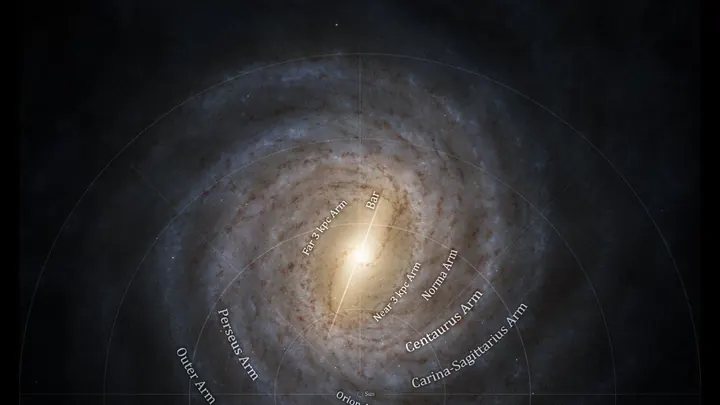
A stellar orbit is the gravitational path a star follows around the center of its galaxy, determined by the distribution of mass—both visible and dark—within that galaxy. Unlike the simple elliptical orbits of planets around a star, stellar orbits in galaxies are often complex, influenced by the collective gravitational field of billions of other stars, gas clouds, and dark matter. These orbits can be roughly circular, highly eccentric, or even chaotic, and they encode the history of the galaxy's formation and evolution.
History
The concept of stellar orbits dates back to the early 20th century, when astronomers like Jacobus Kapteyn and Bertil Lindblad began modeling the motions of stars in the Milky Way. The discovery of dark matter in the 1970s by Vera Rubin and others showed that stellar orbits in the outer parts of galaxies require additional unseen mass.
How it works
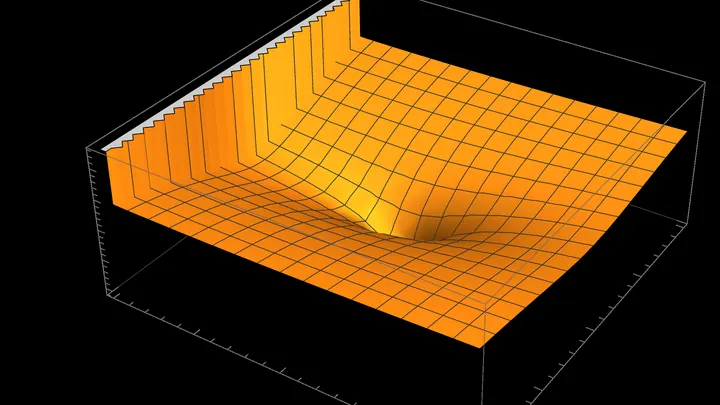
The orbit of a star is governed by Newton's law of gravitation, but in a galaxy, the mass distribution is extended and often not spherically symmetric. The star moves through a gravitational potential that is the sum of contributions from all other matter. In disk galaxies, stars typically follow nearly circular orbits in the plane, while in elliptical galaxies, orbits are more random. Dark matter, which dominates the outer regions, significantly affects the orbital speeds and shapes, often making them faster than expected from visible matter alone.
Some stars in the Milky Way, known as hypervelocity stars, travel on orbits that are so extreme they are escaping the galaxy entirely, likely ejected by interactions with the supermassive black hole at the galactic center.
The night sky looks serene, but it is actually pierced by an invisible rain of charged particles: cosmic rays. Scientists have long tried to figure out where the most energetic ones are born. Until recently, it was thought that our Galaxy supplies particles up to about 4 EeV, the so-called "ankle" in the spectrum.
An old city gains new suburbs. In the center, narrow streets where life has nearly stopped, while on the outskirts construction is booming. That is what a spiral galaxy looks like when its core stars have long aged and new stars are still being born in the outer disk.
A million orbits: the same score. Nine dark matter halos: nine orchestras without a conductor. All musicians play from the same notes, but in each hall the music sounds different: sometimes in tune, sometimes out of sync. Likewise, satellite galaxies falling into a host halo follow orbits that depend not only on mass but also on the shape of the invisible stage.
A stellarator fusion reactor resembles an intricately twisted magnetic cocoon. Its job is to confine superheated plasma so that hydrogen nuclei fuse and release energy. But the cocoon's three-dimensional shape creates gaps: some particles escape, especially the fastest ones, which carry most of the heat.
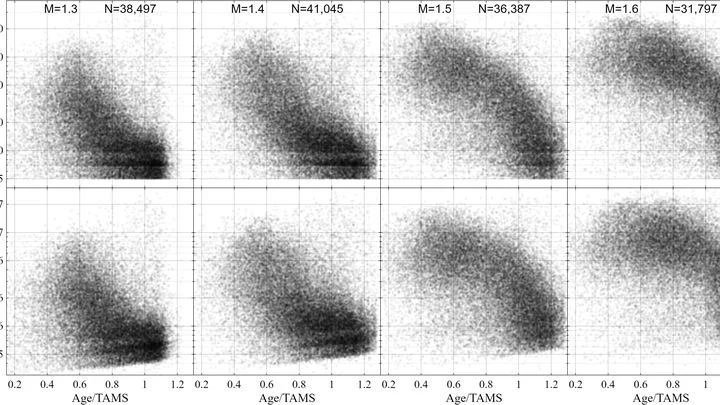
The most massive stars are like overinflated balloons: their envelope stops stretching and instead begins to furiously vent material. At a certain stage, the mass loss becomes so intense that the star stops growing in size. Astronomers see this moment as a kink in the diagram where stars are sorted by luminosity and temperature.
At the very heart of the Milky Way, stars whirl around an invisible supermassive black hole. One of them, S301, completes an orbit in just 8.7 years. Its path is a highly squashed ellipse: sometimes it grazes the black hole, sometimes it shoots far away. At closest approach, the distance to the black hole is tiny by cosmic standards.
A gas disk with a mass of four hundred thousand suns encircles the black hole at the center of the Milky Way. Its gravity works like a gravitational rudder: slowly but inexorably turning the orbits of binary stars, driving them into the region where tidal forces tear the pair apart.
A weather forecaster draws a thick black line across Europe: north of it, frost; south, a thaw. That boundary, the zero isotherm, won't tell you the temperature in Stockholm or Rome, but it honestly marks where winter ends. In recent cosmology, a map has emerged where a similar frontier can be drawn.
1799 kilometers per second — that's the speed at which star S5-HVS1 is permanently leaving the galaxy. 4.8 million years ago, it was ejected from the center of the Milky Way during a close encounter with the supermassive black hole Sgr A*.
Tabby's Star, a beacon in the cosmic sea, has baffled astronomers since 2015. Its light flickered not in the rhythm of planets, but as if scattered by a storm — deep dips, sharp spikes. But amid this chaos, a smooth, nearly perfect dip was found. The eye of the storm.
For over a century, astronomers puzzled over the capricious behavior of RR Lyrae stars: their brightness periodically waxed and waned with unpredictable amplitude, like a lighthouse with a faulty mechanism. The Blazhko effect, discovered in 1907, taunted scientists for decades.
At the center of the Milky Way, shrouded in dust and glare, lurks a supermassive black hole — Sagittarius A*. Around it, like moths around a flame, swarm dozens of guide stars. Two of them, S2 and S38, with eccentric orbits and periods of just a few years, have become the protagonists in testing the fundamental laws of the cosmos.
At the center of the Milky Way, where the supermassive black hole Sagittarius A* reigns supreme (its metric first derived by Karl Schwarzschild), star S4714 makes a dizzying voyage.
At the center of a tiny galaxy lies a dense clump of stars and dark matter. This clump, called a soliton, is not frozen in place: it quivers and oscillates like jelly on a plate.
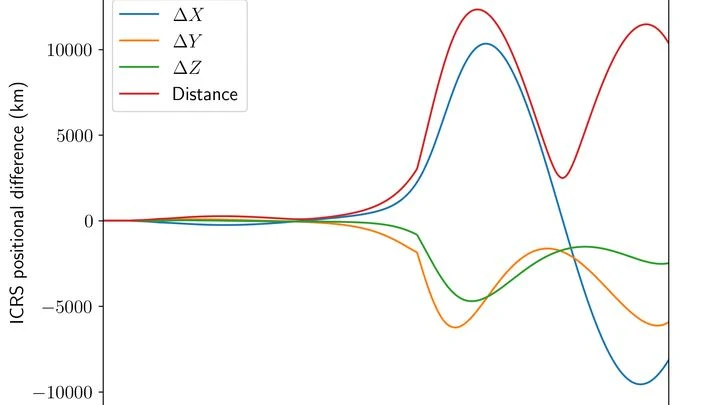
In 5 billion years, the Sun, having exhausted its fuel, will start to swell, turning into a red giant. Like a balloon losing air, the star will weaken its gravitational grip, and Earth — a grain of sand on an invisible thread — will drift to a more distant orbit.
At the center of a distant galaxy, a supermassive black hole is surrounded by a flat, rotating disk of gas and dust — a giant cosmic funnel of matter. A small compact object, such as another stellar-mass black hole, may find itself in this disk.
A planet the size of Neptune wandered too close to its star. The star begins to pull the planet's outer layers onto itself — gas streams off the planet like water from an overflowing bucket. This process is called Roche-lobe overflow (astronomers use this term for the boundary beyond which a star can tear material away from a planet).
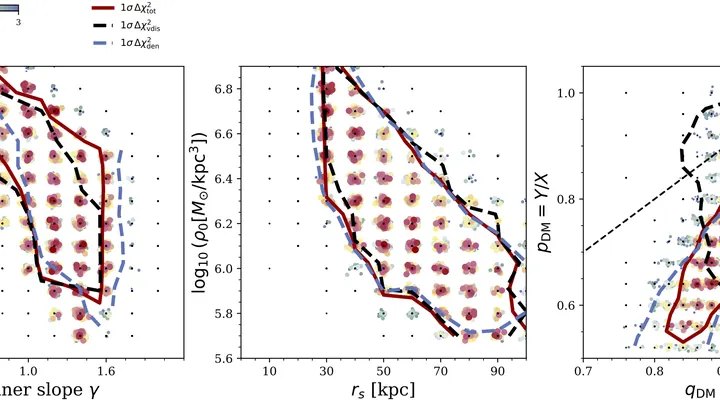
A stellar river winds around the center of a distant galaxy like a glowing ribbon on an invisible frame. That frame is the dark halo: a vast cloud of invisible dark matter whose gravity holds stars and gas in place. If the halo is squashed like a pumpkin or stretched like a melon, the stellar stream will bend differently.
Strike a bell, and it hums at a single pitch. But if you place a second clapper inside, and they ring without touching each other, the sound becomes more complex. That's roughly how the neutron star from the new study is built. It's not just a hot sphere: inside, two immiscible fluids can flow — for instance, superfluid neutrons and ordinary plasma.
The binary star TIC 287869463 is a close pair: one star pulsates like a bell, while the other's gravity stretches it like an ocean tide. Usually, pulsations travel across a star as waves, but here one wave has frozen in place.
Astronomers sifted through three years of data from the TESS telescope — light from 50,000 stellar pairs.
In a large gas cloud where stars are born, the magnetic field lines are roughly aligned in one direction, like the fibers in a piece of felt. But look inside, into the dense clumps that will eventually become stars, and the picture changes: there the lines are twisted every which way, like a ball of yarn after a kitten has played with it.
A guitar string only sounds at certain notes, when pressed at the frets. So it is with the gas-dust disk around a young star: it's shot through with standing waves, but only chosen oscillations survive. Where the wave crests, cosmic dust and hydrogen collect, and later exoplanets are born.
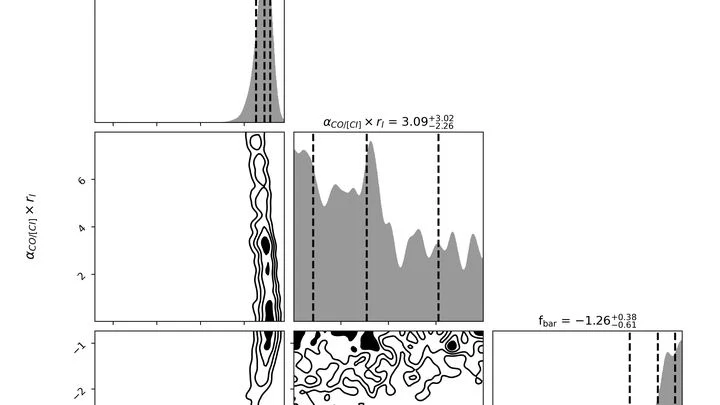
Previously, astronomers calculated galaxy mass as if they were perfect spheres. But a galaxy is a flat pancake. The new 'Lost and Found' model takes the actual shape into account: it sums up the gravitational pull from all parts of the disk, not just the central bulge. The result is stunning: many galaxies need a third less invisible dark matter than previously thought.
Stars on the outskirts of galaxies rotate unexpectedly fast. According to Newton, the farther from the center, the slower the motion should be, like in a round dance, where the outer dancers move more slowly. But in reality, stellar outskirts race along almost as fast as the core, resembling a giant carousel: on it, the outer horses fly faster so as not to fall behind the inner ones.
Light from a distant quasar, the bright core of a galaxy, passes by a massive galaxy and bends, like a flashlight beam through uneven glass. If the lens and source align almost perfectly, we see not one quasar but several copies.
Other galaxies are just ancient snapshots, but we watch the Milky Way live. Comparing data over 30 years, scientists found that the Galaxy’s center is, like, speeding up: the supermassive black hole got heavier, swallowing the mass of a large asteroid each year; the stellar bar (a huge beam of billions of suns, like the…
In the cold gas clouds where giant stars are born, everything is churning with motion. Gas compresses, swirls, and fragments into clumps — the future stars. For a long time, it was thought that the magnetic field brought order here: like invisible threads, it stretched clumps perpendicular to itself. But new observations showed the opposite.
In the southern sky, the star Acrux shines brightly — the lowest point of the Southern Cross constellation. It is not a single star but a whole family. New observations revealed that it contains not five, but seven stars bound by gravity, like children holding hands in a circle dance.
At the center of our Galaxy lies a supermassive black hole, with stars orbiting around it. Their motion resembles a cosmic dance: some race along elongated orbits, others follow nearly circular paths. If invisible dark matter exists near the black hole, it slightly distorts these orbits, like an unseen hand nudging a star off course.
Blue giant stars are usually born in tight stellar nurseries — open clusters within the thin disk of our Galaxy. But sometimes such stars are found high above the disk, as if thrown out of their home. How did they get there?
Saturn's system 300 million years ago resembled a crowded dance floor. The most massive moon, Titan, began to migrate, and this movement threw its neighbors off balance. One moon crashed into Titan; the debris swirled into a vortex, gathering into Hyperion.
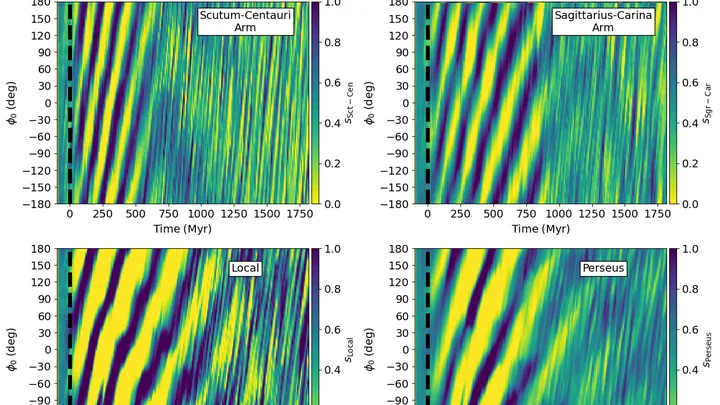
The Sagittarius galaxy plunged into the disk of the Milky Way and passed through again and again, like a stone thrown into a still pond. Each strike left ripples: waves and warps in the star field.
A giant planet circles too close to its star. With each orbit, it tugs on the star with its gravity, and waves are born deep inside the star, like ripples from a stone dropped into water. These waves damp the planet's orbit, and it spirals into the star. The star swallows the planet and starts spinning faster.
Stellar rotation is the key clue.
The Gaia space telescope has measured how fast more than a hundred thousand stars spin. It turns out that a star's rotation speed depends on its temperature. For stars cooler than 6500 degrees, the surface moves at 10–20 kilometers per second.
Space works like a billiard table. Massive outer planets, like heavy balls, transfer their energy to light inner worlds. Such a gravitational kick can fling a small planet out of the stellar system. It turns into a free-floating wanderer — a rogue exoplanet without a star.
Detecting these invisible bodies is hard: they neither emit nor reflect light.
Three distant galaxies spin like giant carousels. Their stars and gas move along spiral arms, and from the speed of this motion you can calculate how much total matter the galaxy contains — visible and invisible.
Astronomers combined two views: radio telescopes revealed cold gas, while the James Webb Space Telescope showed the stars.
Vortons are invisible cosmic hoops, closed loops of curved spacetime. Thinner than an atom but heavier than stars, these Big Bang relics spin like giant carousels, churning everything around them. Einstein's equations describe how particles dance near such a hoop: paths twist into spirals or dart chaotically.
The Milky Way's stellar disk is like a glowing pinwheel, and тёмное вещество is an invisible cloud around it. For the first time, its shape has been precisely measured. Astronomers tracked the motions of millions of stars and built a 3D map of the тёмное гало out to 160,000 light-years.
Using the most powerful space telescope, James Webb, astronomers peeked into the cosmic dressing room and saw how the rings of asteroid Chariklo are changing.
In the dark cloud NGC 6334I-North, 5500 light-years from Earth, the ALMA radio interferometer spotted something unexpected: around a young massive star, a disk of gas and dust is swirling, and inside it are seven dense clumps. Each one could become a star. This is what the birth of a stellar family looks like, and an unusually large one at that.