Cosmic Weather Vane: How a Star's Wind Reveals Its Secrets express
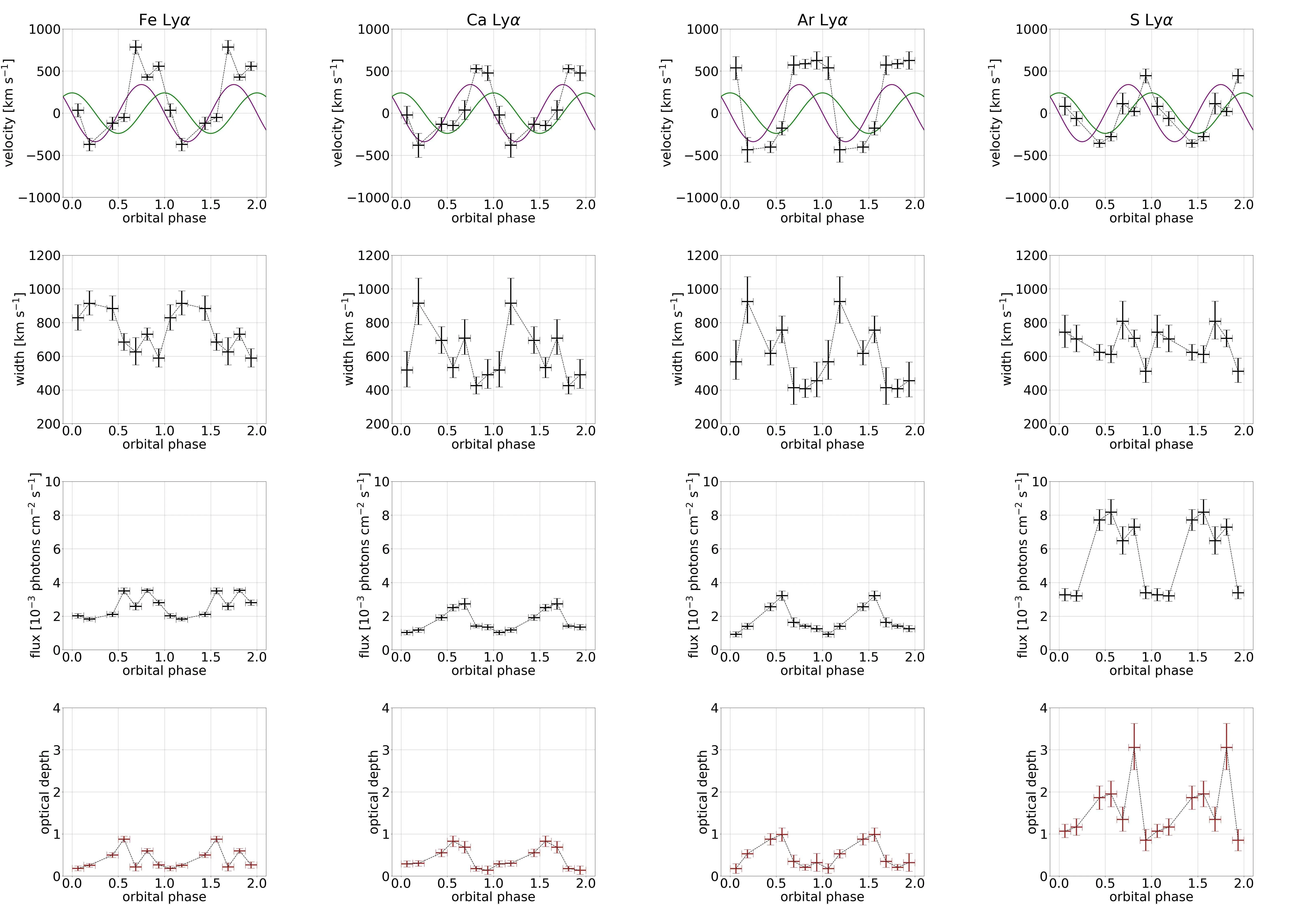
Deep in the constellation Cygnus, two stars circle each other. One is a giant, the other a black hole. The giant continuously ejects a stream of gas into space — a stellar wind. When this wind falls under the black hole's X-rays, it lights up like a neon sign. Astronomers captured this light and split it into colors to learn what the wind is made of and how it moves.
It turned out that different chemical elements in the wind move differently. Iron stays closer to the black hole and follows its orbital motion. Sulfur, on the other hand, is smeared across the entire system and barely responds to the black hole's gravity. Calcium and argon fall in between. This is like a crowd chasing a bus: those closest run faster and follow its route more precisely, while those far away just head in the same direction.
The scientists built a model of the wind to understand why the elements are distributed this way. They found that the black hole's X-rays heat and ionize the gas most strongly near it. Iron, which is heavier and loses electrons more readily, ends up 'tethered' to the black hole. Sulfur, being lighter, remains neutral and spreads throughout the system. This picture helped estimate how much gas the star ejects into space: roughly five to ten Earth masses per year.
Thus, the X-ray telescope XRISM turned the binary system into a natural laboratory. Instead of building a facility to study stellar winds, astronomers found one ready-made in space. And now we know that even in such an extreme environment as the vicinity of a black hole, chemical elements behave differently — depending on how strongly they are 'tethered' to the source of gravity.
Original abstract
as written by the authors arXiv:2604.23185
Cygnus X-3, hosting a Wolf-Rayet (WR) star whose dense wind produces various spectral lines due to photoionization by X-rays from a compact object, provides an ideal laboratory for studying wind dynamics and density structure. We measured the orbital modulations of the Fe, Ca, Ar, and S Ly$$\alpha$$ lines observed with the X-ray microcalorimeter (Resolve) onboard the $$XRISM$$, taking account of both emission and absorption lines of the Ly$$\alpha$$ complexes. The modulations of Doppler shifts of the Fe, Ca, Ar, and S Ly$$\alpha$$ lines showed amplitudes of 500 km s$$^{-1}$$ and phase offsets of 0.04, 0.09, 0.11, and 0.17, respectively, in units of an orbital period (4.8 hours) relative to the orbital motion of the compact object. This result indicated that H-like Fe most closely follows the compact object's motion. The line widths ranged from 400 to 1000 km s$$^{-1}$$. The intensities of both emission and absorption lines reached their minima around orbital phase 0.0 and their maxima around phase 0.5. The absorption peaks, however, did not align exactly with phase 0.5, suggesting the inhomogeneous structures such as an accretion wake and/or a bow shock. We compared the observed modulations with calculations based on a stellar wind model, accelerated by ultraviolet radiation from the WR star. One of the calculations qualitatively reproduced the observed trend that H-like Fe ions were concentrated near the compact object, whereas H-like S was distributed across the binary system, with H-like Ca and Ar showing intermediate spatial distributions. From this comparison, we estimated that a mass-loss rate of the stellar wind was approximately $$5 \times 10^{-6}$$-$$1 \times 10^{-5}\ M_{\odot}\ {\rm yr}^{-1}$$.
The wind speed in the Cygnus X-3 system reaches 500 kilometers per second: that's 1,500 times faster than the speed of sound in air.
In Arthur C. Clarke's novel 'Rendezvous with Rama,' a cylindrical ship uses rotation to create artificial gravity — similar to how a star's wind is held by a black hole's gravity.