Cosmic Weather Vane: How a Star's Wind Reveals Its Secrets express
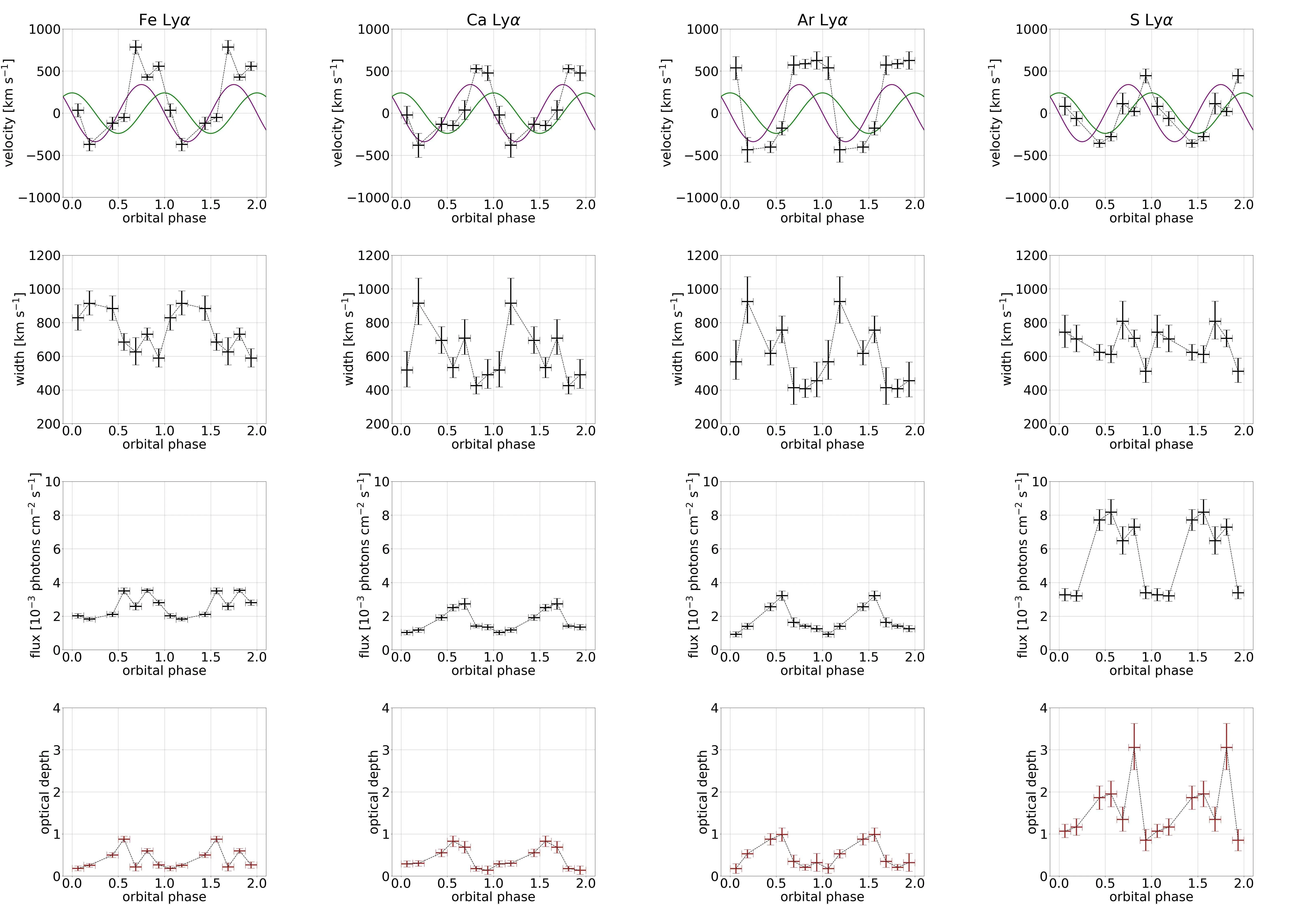
Deep in the constellation Cygnus, two stars circle each other. One is a giant, the other a black hole. The giant continuously ejects a stream of gas into space — a stellar wind. When this wind falls under the black hole's X-rays, it lights up like a neon sign. Astronomers captured this light and split it into colors to learn what the wind is made of and how it moves.
It turned out that different chemical elements in the wind move differently. Iron stays closer to the black hole and follows its orbital motion. Sulfur, on the other hand, is smeared across the entire system and barely responds to the black hole's gravity. Calcium and argon fall in between. This is like a crowd chasing a bus: those closest run faster and follow its route more precisely, while those far away just head in the same direction.
The scientists built a model of the wind to understand why the elements are distributed this way. They found that the black hole's X-rays heat and ionize the gas most strongly near it. Iron, which is heavier and loses electrons more readily, ends up 'tethered' to the black hole. Sulfur, being lighter, remains neutral and spreads throughout the system. This picture helped estimate how much gas the star ejects into space: roughly five to ten Earth masses per year.
Thus, the X-ray telescope XRISM turned the binary system into a natural laboratory. Instead of building a facility to study stellar winds, astronomers found one ready-made in space. And now we know that even in such an extreme environment as the vicinity of a black hole, chemical elements behave differently — depending on how strongly they are 'tethered' to the source of gravity.
The wind speed in the Cygnus X-3 system reaches 500 kilometers per second: that's 1,500 times faster than the speed of sound in air.
In Arthur C. Clarke's novel 'Rendezvous with Rama,' a cylindrical ship uses rotation to create artificial gravity — similar to how a star's wind is held by a black hole's gravity.