Ionization is the process of removing one or more electrons from an atom or molecule, leaving it with a net positive charge. In the context of dark matter, ionization refers to the stripping of dark matter particles from a larger structure, such as a cloud or halo, throughinteractions with other particles or fields. This concept is central to understanding how dark matter behaves in gravitational systems, especially when it is bound to ordinary matter.
History
The term 'ionization' was coined in the 19th century, with early work by Michael Faraday on electrolysis and later by J.J. Thomson on electron discovery. Its application to dark matter is a modern development, emerging from astrophysical simulations in the late 20th century.
How it works
When a particle gains enough energy—from a collision, photonabsorption, or electric field—it can overcome the electrostatic attraction holding it to its atom or molecule. In dark matter, ionization occurs when a dark matter particle is knocked out of a gravitational bound state, often by a close encounter with a star or another massive object. The stripped particle then becomes free, altering the density and dynamics of the original cloud.
In the early universe, the first light from stars ionized neutral hydrogen, a process that is directly observed in the cosmic microwave background as a 'reionization' signature.
Imagine a carousel carrying not children but tiny magnetic needles inside diamond dust. Usually these needles point randomly, and their signal is lost in noise. But if you tilt the carousel at a special angle and shine a green laser on it, the needles start aligning in one direction. That is exactly what physicists did with diamond particles, spinning them at 54.74° to the magnetic field.
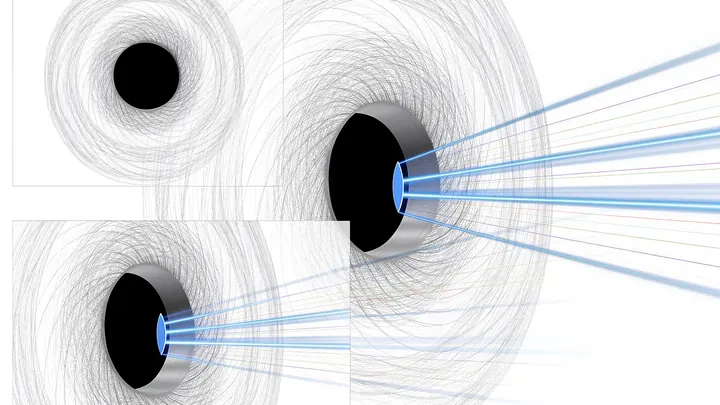
In the center of almost every large galaxy lurks a supermassive black hole, whose gravitational abyss was first mathematically described by Karl Schwarzschild. When it swallows gas, a dazzling active nucleus is born — a quasar.
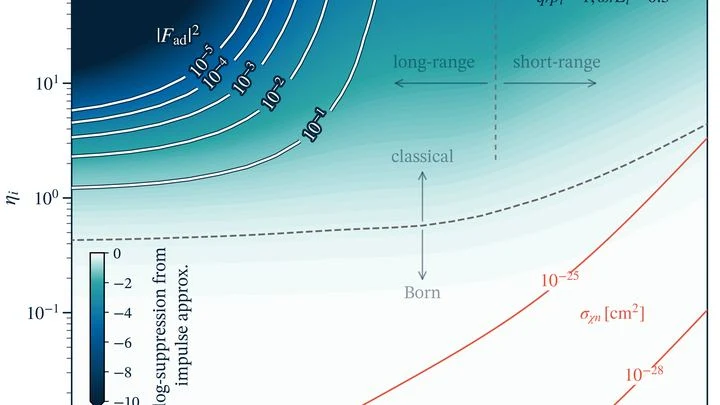
A billiard ball slams into another. Impact, and the balls scatter. But if the push is not sharp but very gentle, the balls just roll together without bouncing. An atom behaves much the same way when hit by a dark matter particle.
A dust grain hangs in the air, held by an invisible beam of light. Around it is ordinary air, but sometimes a tiny spark jumps across the grain. For the first time, scientists have observed such discharges up close and found that they are triggered not by the grain itself, but by invisible visitors from space and from the ground.
A deuterium molecule, two atoms of heavy hydrogen, falls apart under a laser pulse. One electron is ripped away, leaving an ion behind. At that moment, they are still linked: the direction of one immediately tells you which way the other went. This link is called quantum entanglement.
After the Big Bang, the Universe was filled with cold gas — mostly neutral hydrogen and helium. It enveloped the cosmos like a morning fog, impenetrable to light. The Dark Ages began.
When the first galaxies ignited, their radiation, like a searchlight beam, started knocking electrons out of atoms.
In a dark room, an invisible lamp flashes. Its light is unlike anything familiar: it has no steady brightness, only rare but powerful bursts. This is bright squeezed vacuum — a state of light with no ordinary wave but strong quantum fluctuations. It is with such light that physicists bombarded xenon atoms.
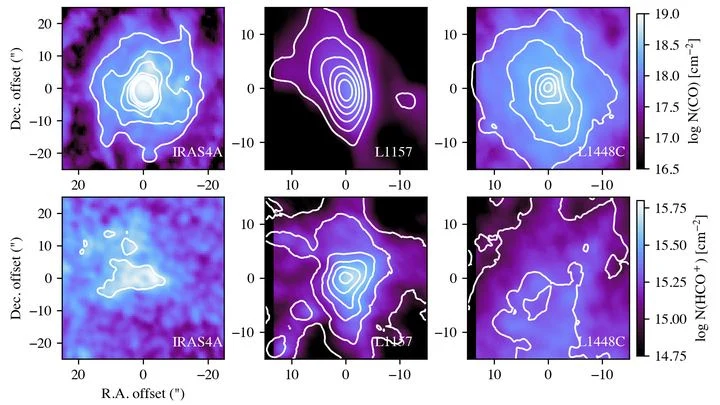
In the cold gas cloud where a star is born, chemistry sleeps. Molecules barely collide, reactions stall. But when a charged particle zips through the cloud, it knocks electrons off atoms — ionizing them. That's how active ions appear in a dormant cloud, ready to build new molecules.
A crystal of calcium ions in a trap, illuminated by a laser, is a tiny model of the matter inside a white dwarf. There, in the depths of a dying star, atomic nuclei arrange into a rigid lattice as the temperature drops.
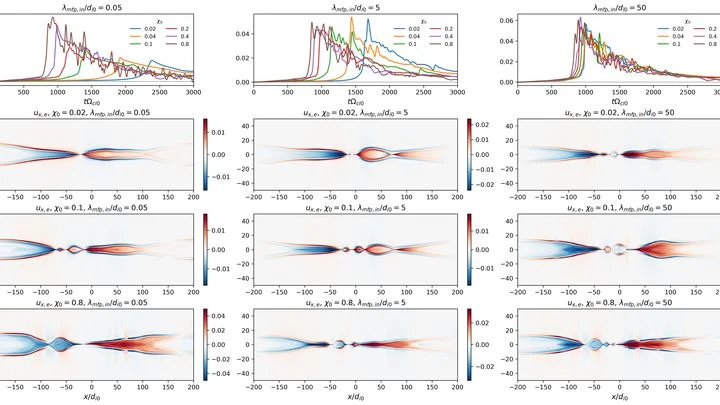
In plasma where some atoms remain neutral, magnetic field lines can rearrange at different speeds. This is like two rubber bands that are initially stuck together, then suddenly snap apart and contract, releasing energy.
Tiny black holes, the size of an atom but heavier than an asteroid, were born right after the Big Bang. Now, they are probably the dark matter — the invisible mass that keeps galaxies from flying apart. You can't catch them directly: they emit almost nothing.
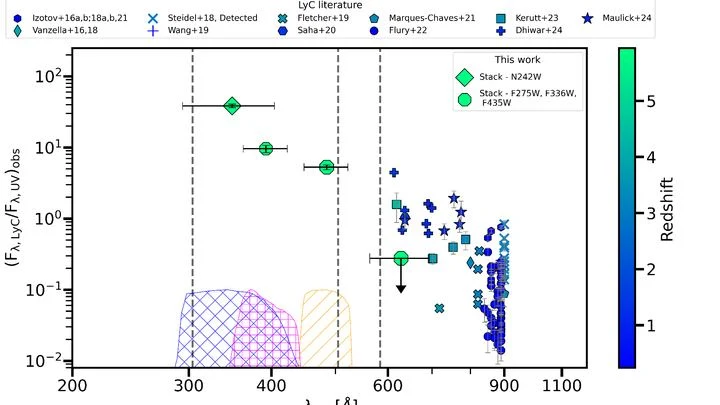
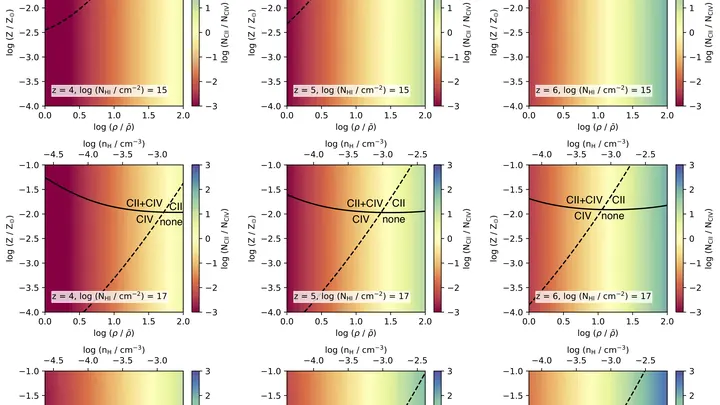
When the universe was less than a billion years old, it resembled a thick fog: ultraviolet light could not travel far because interstellar gas absorbed it. But gradually, as the first stars and galaxies were born, the fog lifted — a process known as the epoch of reionization. Astronomers want to understand exactly how this happened.
In a narrow slit between two plates, ions don't behave like free particles but like a crowd in a packed bus: pressed tightly together, they form dense clusters. This very property, the ability of ions to bunch up in extremely confined spaces, underpins a new mechanism for controlling ion transport.
Researchers studied ion behavior in two-dimensional nanochannels just a few atoms wide.
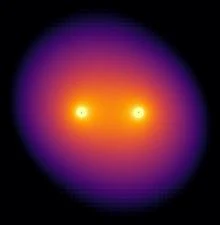
Two black holes circle in a tight dance, and around them something remarkable is born: a gravitational molecule. A cloud of ultralight bosons, particles with masses below an electronvolt, envelops the pair like the electron cloud in an H2+ ion.