Quieter Mirrors — Louder Universe express
Mirrors in gravitational wave detectors listen to the Universe, but they're drowned out by their own trembling — like a microphone in a noisy train station. Heat inside makes atoms vibrate, interfering with the capture of the faintest ripples of spacetime from distant black holes and neutron stars. Rainer Weiss and Kip Thorne spent decades seeking a way to quiet this noise.
The solution is a hybrid coating: an ultra-thin pattern that itself reflects light almost perfectly is applied to the mirror, and a few extra transparent layers compensate for the slightest inaccuracies. The design is much thinner than a conventional multi-layer stack, and there's simply no room for atoms to shake — thermal noise drops roughly tenfold. To such a mirror, a human footstep a couple of kilometers away is a deafening roar.
With this noise suppression, future detectors will be able to hear not only mergers of massive black holes, but also quieter events: supernova explosions or pulsars in binary systems. Quieter mirrors — louder Universe.
Original abstract
as written by the authors arXiv:2605.00714
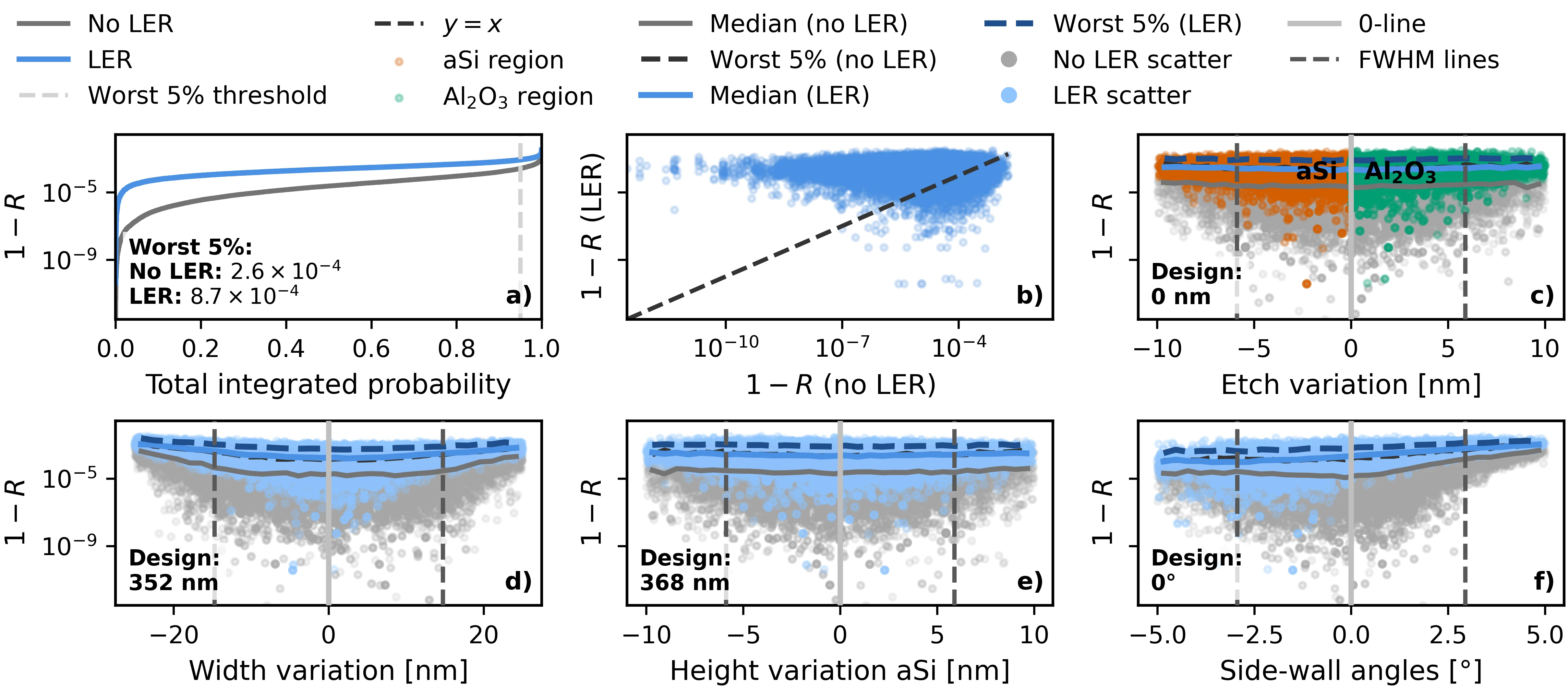
Coating thermal noise in high-reflectivity test-mass mirrors is a major limitation for future gravitational-wave detectors, especially in the 10--300 Hz band. ET-Pathfinder therefore requires mirror coatings that combine very high reflectance at 1.55 micrometer with low thermal noise under cryogenic conditions. Conventional dielectric Bragg mirrors provide high reflectance but require thick coatings, whereas metasurface mirrors can reduce coating-related noise but are limited by fabrication tolerances and line-edge roughness. We present a hybrid metasurface--Bragg mirror concept tailored to ET-Pathfinder. The design combines a fabrication-tolerant one-layer metasurface, an anti-resonant Fabry--Perot spacer, and a reduced dielectric Bragg stack. Optical performance is evaluated using full-wave electromagnetic simulations, while fabrication robustness is assessed with a truncated-Gaussian Monte Carlo analysis. Line-edge roughness is included as a systematic edge-smoothing effect. The resulting reflectance distributions are used to determine the minimum Bragg-stack support required to meet system-level specifications. The ideal metasurface exceeds 99.999% reflectance. When fabrication uncertainties and line-edge roughness are included, the metasurface reflectance is limited to about 99.9% at the 95% yield level. The remaining transmission can be compensated by a supporting Bragg stack with as few as seven layer pairs. For this configuration, the hybrid mirror achieves a total thermal displacement noise about one order of magnitude below the projected ET-Pathfinder coating-noise budget. These results show that fabrication-limited metasurface reflectance can be compensated within a hybrid architecture, enabling reduced coating thickness and thermal noise for next-generation gravitational-wave detectors.
The thermal trembling of a mirror is comparable to the vibration from a human footstep several kilometers away — to the detector it's a deafening roar.
In Carl Sagan's novel 'Contact,' to hear the message from the stars, the protagonists first meticulously clean out all earthly interference — the same principle of signal purification.