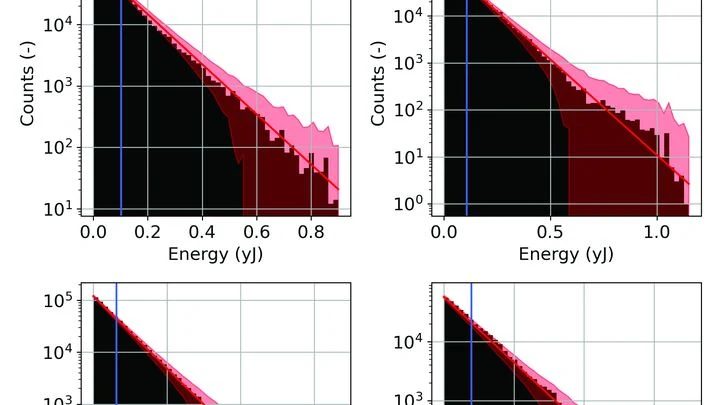
Thermal noise, also known as Johnson–Nyquist noise, is the random electrical voltage or current that arises in any conductor or electronic component due to the thermal agitation of its charge carriers (usually electrons). At any temperature above absolute zero, particles are in constant, jittery motion; in a conductor, this motion translates into tiny, fluctuating electric fields that appear as a background hiss in any measurement. It is a fundamental, unavoidable limit: you cannot reduce it by improving the quality of a device, only by cooling it or narrowing the measurement bandwidth.
History
The effect was first measured by John B. Johnson at Bell Labs in 1926, and explained theoretically the same year by Harry Nyquist, who derived the formula for the noise power using thermodynamics and statistical mechanics.
How it works
In a resistor, electrons are constantly colliding with the lattice of atoms, and their random thermal velocities create a fluctuating voltage across the terminals. The average power of this noise is proportional to the absolute temperature and the frequency bandwidth being observed, independent of the material or resistance value. This is why sensitive detectors, from radio telescopes to neural recording rigs, must be cooled to cryogenic temperatures — to lower the thermal energy and thus the noise floor that masks the tiny signals of interest.
In practice
Thermal noise sets the fundamental sensitivity limit in every electronic measurement, from gravitational-wave detectors to the amplifiers in your smartphone's receiver; it is also exploited as a natural source of random numbers in cryptographic hardware.
Fun fact
The same thermal noise that limits the sensitivity of neural recordings is also what allows certain biological neurons to fire spontaneously even in the absence of a stimulus, a phenomenon that helps keep the brain's circuits primed.
Picture a guitar string stretched between two frets. When you pluck it, a standing wave forms: some points on the string oscillate strongly, while others, the nodes, remain almost still. The chromosphere, a layer of the solar atmosphere sandwiched between the photosphere and the corona, behaves in much the same way.
A laser beam passes through a glass cell filled with cesium vapor. The atoms in the vapor dart around chaotically, like a crowd at a train station: each one enters the beam, spends a moment there, and flies back out. Their internal state, something like the orientation of a tiny magnet, changes under the influence of light. If all atoms were identical and stationary, the signal would be steady.
A light field, like a neat waffle iron, presses a regular pattern of bright and dark regions into space. Atoms get stuck in the brightest spots as if in tiny dimples: that's an optical lattice. It's a favorite tool for physicists who want to study quantum behavior of matter in its pure form.
Inside a supercomputer, fifteen stable wave clumps — solitons — collide to form a halo of dark matter. These waves obey an equation that Erwin Schrödinger derived for electrons at the beginning of the 20th century, but now they paint a portrait of a giant galactic cocoon.
Two clouds of ultracold atoms, almost frozen at temperatures of a few nanokelvins, mix in a trap. One cloud consists of light atoms, the other of heavy ones. They push each other differently. Physicists have long been able to describe such mixtures with simple equations, but those work only if the atoms are perfectly identical.
A lithium-ion battery is like a multi-story building where lithium ions live on every floor. When you charge the battery, the ions move from floor to floor, and the whole building warms up a bit. Usually, this heat dissipates evenly, like from underfloor heating. But sometimes one spot gets too hot, and then the whole building can go up in flames.
A laser strikes the crystal, and it responds with flashes of light, like a bell ringing after a blow. But if the bell is warm, its sound wavers and fades. Same here: the crystal's atoms constantly jitter from heat, and this jitter disrupts the electrons' smooth flight, making the light dim and blurry.
A thin semiconductor layer at low temperatures behaves like a pot of honey: electrons flow not as individual particles but as a thick liquid. If you run an alternating current through such a layer, the resistance responds with a smooth curve.
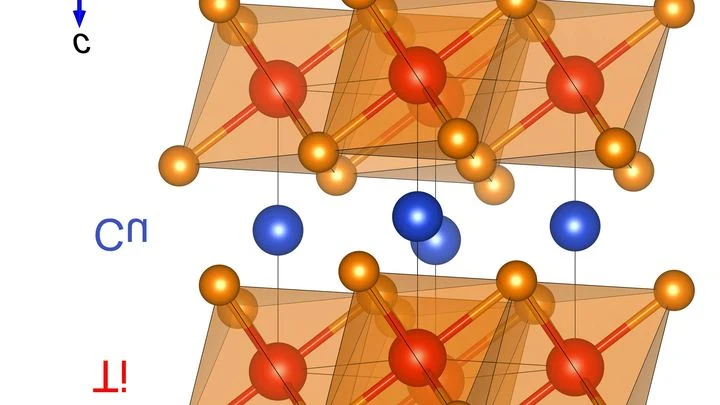
In the TiSe2 crystal, electrons behave like compass needles that suddenly start pointing in the same direction. This is called a nematic state — by analogy with liquid crystals, where molecules align along a common direction even though the material itself remains liquid.
A tiny seesaw weighing 1.5 nanograms oscillates not from the wind, but from the heat of its surroundings. Physicists nearly stopped it by cooling it to 0.006 degrees above absolute zero.
According to Einstein's theory, Earth's rotation drags space-time itself along — like a spoon dragging thick honey. This effect is incredibly weak: about one revolution in billions of years. But it can be caught.