Gravitational wave detectors like LIGO and Virgo are essentially enormous rulers that measure distortions of spacetime smaller than a thousandth of the width of a proton. To achieve such extreme sensitivity, they must contend with multiple sources of noise that can mask the faint signals from colliding black holes and neutron stars. Noise reduction techniques are the collection of strategies used to suppress these disturbances, allowing detectors to 'hear' the quiet whispers of the universe.
History
The systematic study of noise in gravitational wave detectors began in the 1970s with the pioneering work of Rainer Weiss, who analyzed the fundamental noise limits of laser interferometers. The first generation of detectors in the 1990s and 2000s gradually improved sensitivity by implementing these noise reduction strategies.
How it works
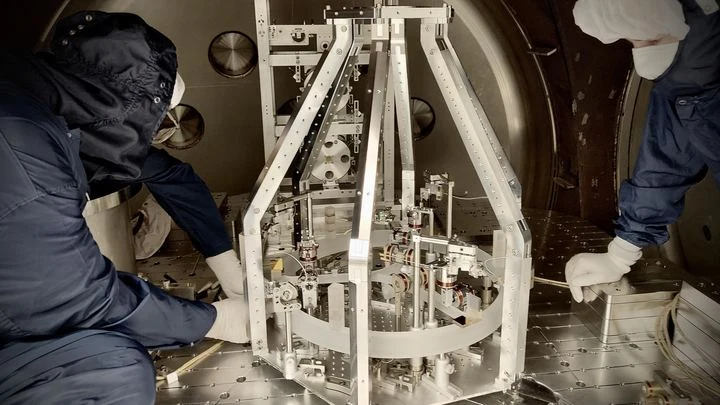
The main noise sources are thermal noise (from the vibration of atoms in the mirrors and suspensions), quantum noise (from the inherent uncertainty in the position of photons and the radiation pressure they exert), and seismic noise (from ground vibrations). Thermal noise is reduced by cooling components to cryogenic temperatures and using materials with low mechanical loss, such as fused silica or sapphire. Quantum noise is tackled with techniques like squeezed light, where the uncertainty in photon phase and amplitude is redistributed to reduce the measurement noise. Seismic noise is mitigated by sophisticated isolation systems with multiple pendulum stages and active feedback control.
In practice
These techniques are used in all current gravitational wave observatories (LIGO, Virgo, KAGRA) and are essential for detecting events like binary black hole mergers. They also inform the design of future detectors such as the Einstein Telescope and Cosmic Explorer.
Fun fact
The mirrors in LIGO are so well isolated from seismic noise that they move less than a billionth of a meter even during an earthquake.
A quantum detector is like a sensitive pendulum suspended in empty space. If a sharp gravitational wave passes by, you might expect the pendulum to swing. But the calculation shows otherwise: the wave doesn't swing it: it damps any existing oscillations.
Imagine a string stretched between two tuning pegs. The slightest touch makes it vibrate, and from the pitch you can guess exactly how it was plucked. Physicists at the University of Arizona have stretched a similar string — not on a musical instrument, but on a silicon membrane just a hundred nanometers thick.
Gravitational-wave detectors are like extremely sensitive ears: they pick up the trembling of space when black holes or neutron stars collide somewhere in the universe. But even the most sophisticated "ears" cannot hear everything. The new LIGO A# project is like replacing the eardrum with a thinner, more sensitive membrane.
A tiny defect in a diamond crystal is like a sensitive microphone picking up the faintest magnetic fields. That's how sensors based on nitrogen-vacancy centers work (where a nitrogen atom and a neighboring vacancy form a quantum system). To hear the whispers of individual molecules, the sensor is placed right at the surface.
A huge bowl of water. Drop a stone into it — ripples spread across the surface. The fabric of spacetime works much the same way: when two massive stars merge, they create ripples — gravitational waves. These waves travel to Earth and are picked up by giant detectors like LIGO and Virgo.
Predicted by Albert Einstein, gravitational waves are like beacons in the dark ocean of space. They flare up when black holes collide, sending ripples through the fabric of the Universe.
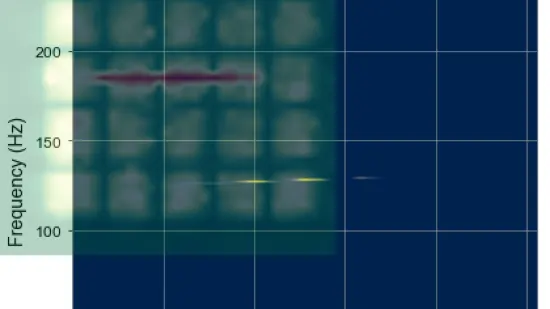
In 2019, the LIGO facility recorded a gravitational waves, a ripple in the fabric of spacetime, whose time-frequency map resembled a strange comb. Each such signal from a black hole merger leaves a unique pattern, like a fingerprint.
Isolating the signal from a single pair of supermassive black holes is like hearing a dancer's footsteps amid the roar of a hurricane. Somewhere in space, these monsters spin in a slow gravitational tango, distorting spacetime itself.
A laser beam in a multi-kilometer tunnel trembles as a gravitational wave passes, but the tremor is barely perceptible, on the scale of fractions of a proton's diameter. To hear this cosmic whisper, physicists squeeze every last bit of performance out of light.
In pursuit of gravitational waves, ripples in spacetime left by black holes and neutron stars, detectors like LIGO pump their arms with light of dazzling intensity.
The LIGO and Virgo detectors catch gravitational waves from mergers of black holes and neutron stars. But among the cosmic signals, their sensitive arms are constantly crossed by shadows — short-lived noise artifacts, glitches, that stage a true shadow theater.
A quantum computer is like an orchestra where every musician must play their part without missing a beat. The musicians are qubits — carriers of quantum information. For the orchestra to sound harmonious, you need qubits that are reliable, controllable, and not too sensitive to noise.
The universe is permeated by invisible mass, dark matter, whose existence was first proposed by Fritz Zwicky in the 1930s, based on his observations of galaxies moving in clusters.
An ultra-sensitive microphone listens not to sound, but to the trembling of space itself. That's how gravitational wave detectors work — LIGO, Virgo, KAGRA.
Gravitational telescopes listen to the cosmic 'music' — gravitational waves from distant cataclysms. But their recordings are full of 'scratches' — short terrestrial glitches. Previously, assessment was done over the entire track at once, and faint clicks were lost.
Imagine an orchestra where each musician plays their own part, and the conductor tries to catch a faint rhythm common to all. That's roughly how astronomers search for gravitational waves from pairs of supermassive black holes (weighing billions of suns) circling each other in distant galaxies.
A levitating dust grain in an optical trap is an ideal pendulum for measuring gravity. It hangs in vacuum, never touching the walls, and its motion depends only on external forces. The new work proposes an improved sensor: a mechanical 'squeezed' qubit based on a nonlinear oscillator.
A magnet the size of a grain of rice floats in a vacuum without touching the walls. It is held by the magnetic field of a superconducting trap — a ring cooled to a state where current flows without resistance.
A tuning fork sounds incredibly pure, but touch it and the pitch changes almost instantly. Engineers faced a similar challenge: creating a laser that simultaneously possesses two seemingly incompatible properties — exceptional spectral purity (a very narrow emission line, like a tuning fork producing a single note without wobble) and the ability to rapidly tune that frequency.
When two black holes merge, the resulting black hole 'rings' for a while, emitting gravitational waves — like a dying bell. This ringing is captured by giant detectors created by Rainer Weiss and Kip Thorne.
Mirrors in gravitational wave detectors listen to the Universe, but they're drowned out by their own trembling — like a microphone in a noisy train station.
Magnetic sensors smaller than a match head can already detect weak fields — from a beating heart or a distant planet. But making them even more sensitive involves a trade-off: improve one part, and you lose performance in another.
On the table sits a sensitive instrument — a torsion balance. Two heavy masses rotate near a suspended rod, and their attraction tends to twist the rod. But the masses are arranged so that their ordinary Newtonian attraction cancels out: one pulls one way, the other the opposite. Only a weak residual remains, which the instrument captures.
A detector that hunts for rare particles is like an ear trying to catch a whisper in a noisy room. The quieter the signal, the harder it is to tell apart from random noise. In the NUCLEUS experiment, such detectors, cryogenic calorimeters, are cooled to near absolute zero so they can pick up even a faint pulse of heat from a single particle.
When a massive star dies and collapses into a supernova, a neutron star is born — a city-sized sphere with the Sun's mass. Its matter is so compressed that a teaspoon weighs more than Mount Everest. Physicists are trying to learn the "recipe" of this matter — the equation of state that explains how matter behaves under extreme pressure.
A frictionless liquid that flows forever: that's superfluidity. Helium-3 only achieves it at thousandths of a degree above absolute zero. The theory of this state was developed by Lev Landau and Richard Feynman.
Black holes aren't silent abysses, but nature's tuning forks. Their rapid spin, predicted by Roger Penrose, makes spacetime itself sing, producing a stream of the lightest particles — axions. These accumulate around the hole, like sound in a concert hall, and begin to oscillate in unison.
Even Einstein predicted gravitational waves — a trembling of the very fabric of spacetime. Today they are captured by gigantic installations like LIGO, created thanks to Rainer Weiss and Kip Thorne.
In the dense Virgo galaxy cluster, astronomers have spotted six strange clouds of neutral hydrogen — gas that emits no light and is therefore invisible to ordinary telescopes. Radio telescopes can pick it up, but where it came from was unclear.
The Universe is expanding, and galaxies are flying apart like raisins in rising dough. But since the late 1990s, we've known that this expansion is accelerating. What force is pushing galaxies apart faster and faster is one of physics' greatest mysteries. It's called dark energy, and it makes up about 70% of everything in the cosmos.
The merger of two neutron stars is like a strike on a gong: a ripple in space, a gravitational wave, spreads through the universe. Detectors on Earth catch this ripple and, from its strength, calculate the distance to the source.
Dark matter is five times more massive than ordinary matter, yet it emits no light. Its nature remains unknown. One candidate is the ultra-light axion particle. Axions could pierce right through the planet, barely noticing atoms.
Measuring the universe’s expansion is like timing a race when the track stretches. Neutron star mergers act as standard sirens: their gravitational waves ring out with a known “volume,” so fainter signals mean greater distance.
Two black holes circle each other, and their dance isn't always a smooth waltz. If the holes spin on their own axes, their orbit can start to tumble, like a top that's been pushed and wobbles on its side while still spinning.
Dark matter makes up 85% of the matter in the Universe, yet remains invisible. It only reveals itself through gravity. We can catch it by its cosmic 'hum' — a faint vibration that permeates space. A single detector is powerless here: the signal is too quiet.
Physicists turn many sensors into a quantum ensemble.
Sound waves on a chip usually spread in all directions, like whispers echoing around a dome. In a gyroscope, this creates noise that obscures rotation. But a new design forces sound into a one-way flow. By tapping the sound path at several points with precise timing, backward-traveling waves cancel out, while forward waves reinforce.
According to Einstein's theory, Earth's rotation drags space-time itself along — like a spoon dragging thick honey. This effect is incredibly weak: about one revolution in billions of years. But it can be caught.
The Moon is not just a satellite; it is a potential gravitational bell. When massive bodies collide, spacetime shudders, and that shudder, gravitational waves, makes everything in their path vibrate.