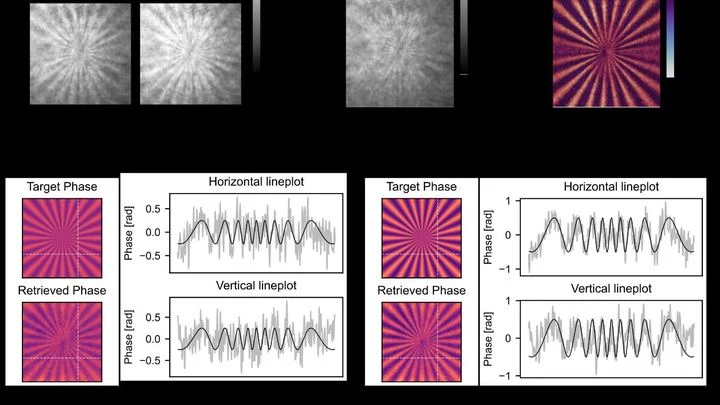
A metasurface is an artificially engineered thin layer, often just a fraction of a wavelength thick, covered with subwavelength patterns — tiny pillars, holes, or other structures. These patterns interact with light in a way that mimics a maze, guiding and bending waves according to the local geometry rather than the material's natural properties. This allows unprecedented control over light's phase, amplitude, and polarization.
History
The concept was popularized in 2011 by Nanfang Yu and Federico Capasso at Harvard, who demonstrated anomalous refraction and reflection using V-shaped nanoantennas, building on earlier theoretical work on frequency-selective surfaces.
How it works
Each subwavelength element acts as a miniature resonator that scatters light with a specific phase shift. By arranging these elements across the surface, you can create a spatial map of phase delays that shapes the wavefront exactly as desired — for example, to focus light like a lens or to bend it in a specific direction. The design is based on the generalized Snell's law, which accounts for the phase gradient along the interface.
Some metasurfaces can be made so thin that they are essentially two-dimensional, yet they can outperform conventional lenses that are thousands of times thicker.
Imagine a book with latches on its pages: you can only flip a page if you know how to click its edge. That is roughly how the mechanical metamaterial we are about to discuss works. Each cell is a small mass inside a larger one, connected by an elastic beam. The beam can sit in two stable positions, like a switch.
When light hits ordinary plastic, some of it reflects, like a glare on a window. To eliminate this glare, a special coating made of tiny structures is applied to the surface, which cancels out the reflection.
Two transparent sheets with circles drawn on them. If you stack them exactly, the circles align. But give one sheet a slight twist, and a new pattern emerges: in some places the circles bunch together, in others they spread apart. That's roughly how moiré works — an unexpected pattern born from rotating two periodic structures.
A typical laser is a cavity where light bounces between mirrors and gets amplified. But you can ditch the mirrors and make light circulate inside a tiny particle smaller than the light wave itself. That's how the new lasers work: nanoparticles of indium phosphide sitting on perfectly smooth gold.
Light flows like an invisible river. If you place an obstacle in the stream, the water whirls into eddies. Likewise, specially designed surfaces create light 'whirlpools' that catch nanoparticles like wood chips.
Imagine a philharmonic orchestra playing, but the microphone picks up only a blended roar — a tutti where double basses, flutes, and timpani all merge. Physicists have grappled with a similar task for decades, staring at fields of density, temperature, or magnetic induction.
Quantum bits (qubits) are like delicate music in a noisy factory. Ambient magnetic fields constantly 'drown out' their quantum state, turning a coherent signal into cacophony. Usually, this destructive process is slowed by retuning the qubits themselves to different frequencies, but that doesn't always work.
Tile a floor with identical triangles, and you get a boring repeating pattern. But what if you want the pattern to never repeat, yet use just one tile? For a long time, mathematicians were sure it couldn't be done: you'd need at least two different shapes. The famous Penrose mosaic is a case in point: rhombi with acute and obtuse angles arrange into an infinitely varied but strictly ordered pattern.
Light needs space. A camera lens sits several centimeters from the sensor so the rays have room to focus. Now, that gap has been squeezed to the thickness of a sheet of paper, and light still behaves as if it had traveled its rightful centimeters. That's what 'spaceplates' do: flat elements that mimic free-space propagation.
Mirrors in gravitational wave detectors listen to the Universe, but they're drowned out by their own trembling — like a microphone in a noisy train station.
An ordinary lens always refracts light the same way. Its properties are frozen in glass forever. But now there's a surface that changes the game on the fly.
Scientists made an ultrathin film with resonant elements and infused it with liquid crystals — the same stuff used in phone screens.
An ordinary sheet of paper looks white because it scatters all light rays chaotically. But a butterfly's wing shimmers blue and green without a drop of paint: its surface is covered with microscopic grooves that dampen some light waves and amplify others. Engineers have long dreamed of replicating this trick: creating a material that colors itself simply by trapping light in the right places.
A swimmer cutting through water at the speed of the waves running on it finds themselves in a strange position: the waves they themselves generate can neither overtake them nor fall behind. They pile up at the swimmer's bow and freeze. A similar phenomenon occurs when a light source moves inside a medium at a speed matching the speed of energy transfer of the waves.
A laser beam strikes a gold-and-silver film for just a few nanoseconds — in that time, light travels less than a meter. At the point of impact, the metal boils, splatters, and freezes into a random pattern of tiny particles. Each pattern is as unique as cracks in ice or tree branches.
A river flows in one direction, but a wave on its surface travels in the opposite direction. The same splitting happens in hyperbolic materials: the energy of a light wave and its fronts diverge, preventing a sharp lens from being created.
A glass marble in a glass of water is nearly invisible, but if you look through it at a checkered tablecloth, the lines behind it appear distorted. Transparent cells behave the same way: light passes through them but is slightly slowed and changes direction.
A fingernail-sized piece of ceramic is squeezed in a vise, and its internal structure rearranges like clay under your fingers. Inside, orderly rows of tiny domains line up where they were once randomly oriented. After this 'massage,' the crystal lets light through almost like glass and, at the same time, generates a strong electric charge when bent or pressed.
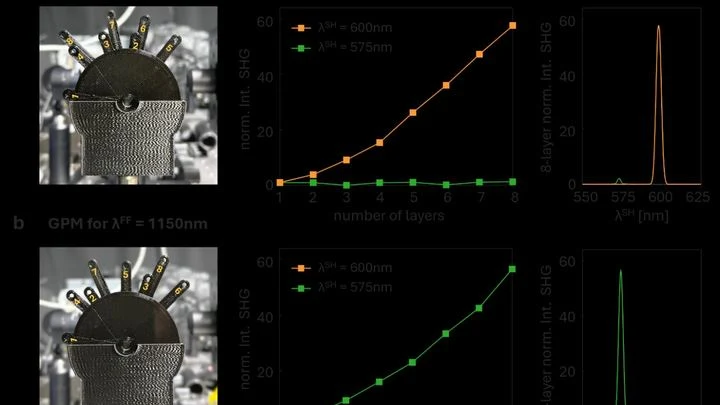
When two light beams meet in a crystal, they can generate a third beam with a different frequency. For this process to be efficient, the waves need to stay in step, like two people walking side by side without breaking stride. Previously, two old tricks were used: either picking a crystal with the right properties, or slicing it into thin layers.
A laser beam usually looks like a straight column of light. But if you pass it through a wafer with a pattern thinner than a hair, the beam scatters into thousands of tiny pockets of light. In each pocket, you can suspend a single atom, like a pea in a dimple.