The Quantum Whisper of Black Holes Becomes Audible ✛ ✦
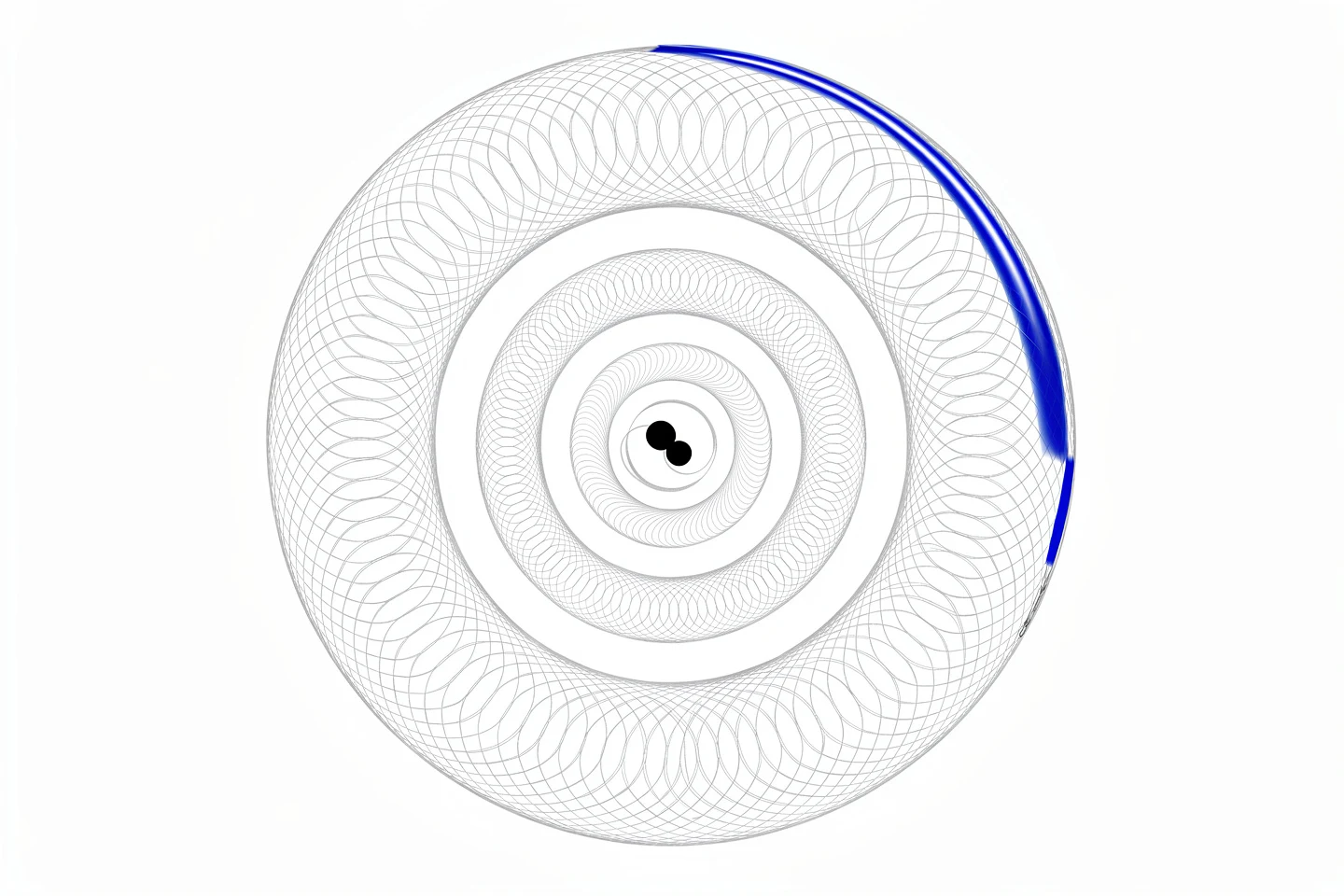
Gravitational waves — ripples in the curvature of space — radiate from colliding black holes. Predicted by Albert Einstein, they are caught by detectors like LIGO. At the quantum level, space itself trembles, but these tremors are vanishingly small. Near merging black holes, they enter a superposition — a state where an object seems to be in many places at once. Here the uncertainty principle kicks in: sacrificing precision in one aspect gains it in another. The wave amplifies itself, like a whisper repeated by echoes in a canyon until it becomes a roar. Building on the work of Stephen Hawking and the squeezed-state theory of Roy Glauber, physicists calculated the amplification: 100 billion times. The quantum whisper, quieter than a falling snowflake, swells to the crash of ocean surf. Now this signal is within reach of Earth's instruments. To capture it would mean the first direct quantum measurement in gravity, bridging gravitational waves and the microworld.
After amplification, the quantum noise of a gravitational wave rivals the crash of ocean surf, though it began quieter than a falling snowflake.