Quantum measurement is the process of obtaining classical information about a quantum system, radically changing its state. According to quantum mechanics, before measurement the system is in a superposition of possible values of a physical quantity; measurement irreversibly projects it onto one of these values. The probability of the outcome is determined by the squared modulus of the projection of the initial state onto the corresponding eigenstate. A key feature is that the result is probabilistic even with full knowledge of the wave function, and the act of measurement itself influences the system (observer effect).
History
The problem was recognized by the founders of quantum mechanics: Bohr and Heisenberg in 1927–28 introduced the concept of wave function reduction. The Einstein–Bohr debate (1927–1935) revealed the paradoxical nature. Von Neumann in 1932 formalized two types of processes: unitary evolution and collapse. In 1964, Bell proved that any hidden-variable theory reproducing quantum predictions must be nonlocal. Aspect's experiments in the 1980s confirmed quantum nonlocality and emphasized the role of measurement. Decoherence theory (Zeh, 1970s) provided an understanding of the loss of interference, but the measurement problem remains open.
How it works
Consider measuring the spin of an electron. Spin is described as a two-level system: |ψ⟩ = a|↑⟩ + b|↓⟩. When passing through a Stern–Gerlach apparatus (a magnet with an inhomogeneous field), the electron's trajectory is deflected, entangling the spin state with spatial position. As a result, entanglement with the environment occurs, effectively implementing the measurement. The spin operator Ŝ_z with eigenstates |↑⟩ and |↓⟩ yields values +ħ/2 and –ħ/2 with probabilities |a|² and |b|². After measurement, the state collapses into the corresponding one. The Heisenberg uncertainty principle limits the simultaneous knowledge of non-commuting observables, such as spin components.
In practice
Quantum sensors that detect gravitational waves and devices that see through walls by changes in quantum states are built on this.
Fun fact
In the delayed-choice quantum eraser experiment, it appears that the decision of what to measure now can change the particle's behavior in the past.
At night on a volcano summit, six telescopes stare at the same speck of light. Each catches its own copy of the wave, and if you combine their signals, you get an image that no single instrument could produce alone. But there's a catch: light captured by different stations cannot simply be added like photographs.
A quantum detector is like a sensitive pendulum suspended in empty space. If a sharp gravitational wave passes by, you might expect the pendulum to swing. But the calculation shows otherwise: the wave doesn't swing it: it damps any existing oscillations.
In a superconductor, where electrons move in pairs without resistance, special waves can run along the edges, like ripples along the edge of a carpet. The number of such waves is an important characteristic of the material, but measuring it directly is difficult.
If you push water in a narrow channel too fast, a steep wave forms and breaks into foam. In the world of ultracold atoms, cooled to near absolute zero, quantum laws prevent such a wave from breaking. Physicists took a cloud of rubidium atoms stretched into a thin thread and sharply compressed it from one end with a movable wall of light.
Imagine a ladder whose rungs are tiny magnets. If neighboring magnets point in opposite directions, the ladder is "calm." But if you make them all point the same way, the whole structure becomes magnetized and "stubborn."
Scientists built such a ladder from germanium atoms — a semiconductor used to make transistors.
A quantum state is like mountain weather: it changes with every glance. To estimate its uncertainty, physicists make copies and take measurements. Each copy is a thermometer that breaks after use.
Quantum systems made of many particles are the basis of future computers and secure networks. But the more particles there are, the harder it is to understand how they are arranged: the number of possible states grows like an avalanche. The usual approach, measuring everything, takes an incredibly long time.
In 1996, physicists asked: how much noise can a quantum channel withstand before it stops transmitting information? A phone call where every third word is replaced by random noise is still understandable. Up to what level of interference can the listener still grasp the meaning?
A handful of coins drops onto a table — heads and tails land wherever they please. The same goes for an instantaneous snapshot of a quantum chain: in some places a particle is present, in others it is not. But behind the disorder lurks a precise angle.
In this work, a chain of particles closed into a ring was considered. It was divided into four arcs: two were measured, two were left untouched.
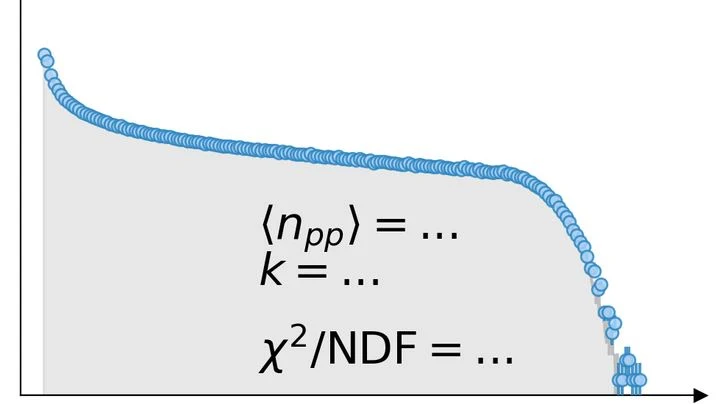
When two heavy nuclei smash into each other at enormous speeds, they don't collide as whole objects like billiard balls. Only part of their matter comes into contact. How many nucleons (protons and neutrons) actually took part in the collision, and how many flew past, is not known in advance. All subsequent measurements depend on this number, but it cannot be observed directly.
A handful of coins drops onto a table — heads and tails land wherever they please. The same goes for an instantaneous snapshot of a quantum chain: in some places a particle is present, in others it is not. But behind the disorder lurks a precise angle.
In this work, a chain of particles closed into a ring was considered. It was divided into four arcs: two were measured, two were left untouched.
In a hall with a thousand spectators, applause blends into a general noise, but if someone falls out of rhythm — a ripple runs through the crowd. The quantum world works similarly: atoms in a trap can behave as a single whole, or they can fall apart into independent individuals.
Imagine a huge puzzle where each piece is a quantum particle. To complete the picture, you don't just fit the pieces together: you need to entangle them in a special way. Usually, this is done by carefully applying operations one after another, like assembling the puzzle strictly by the instructions, row by row.
Two tiny diamonds float in a vacuum, separated by a distance that light cannot cross during the experiment. Inside each, like a frozen spark, resides an entangled spin — a quantum state linking them into a single whole. Now the diamonds begin to move, but not just any motion: each one seems to split, existing in two places at once.
A handful of pebbles drops into a pond: each one sends out ripples. If the pebbles are different, the ripples will be different too: some sharp, some smooth. But when you look at the water from a distance and see only a small part of the ripples, all those differences blur together.
Imagine a huge puzzle where each piece is a quantum particle. To complete the picture, you don't just fit the pieces together: you need to entangle them in a special way. Usually, this is done by carefully applying operations one after another, like assembling the puzzle strictly by the instructions, row by row.
Drop an ice cube into a glass of water — within a minute it melts, and the temperature evens out. That's thermal equilibrium in action: energy spreads evenly, and the system "forgets" its past.
The quantum world does not forgive forgetfulness. Throw a stone into a pond — the ripples spread and vanish, the information about the impact dissipates without a trace. In quantum mechanics, everything is different: the evolution of a system is reversible, and the past is never completely erased.
A camera looks at two distant sparks. They're so close together that they merge into a single fuzzy blob. It seems impossible to tell them apart — the classic limit of optical microscopy has been reached.
But quantum mechanics hints that the light field still holds a secret about where each spark sits.
The quantum world never stands still. Even in the most perfect resonator, a trap for particles of light, energy gradually leaks away, and information is erased. Physicists call this process decay, and it has its own rhythm: some 'notes' fade quickly, while others linger.
A quantum computer is usually like an assembly line: operations proceed one after another, and each error accumulates. In the new work, physicists tried a different path — an architecture where the computation grows out of the measurement process itself. They took 56 ions in a trap and wove them into a three-dimensional cloud of entangled particles.
In a noisy hall, an interpreter tries to catch every word, but rustles and echoes muddle the meaning. That's roughly how conventional computer methods handle complex quantum systems: the more particles and the stronger their correlations, the faster calculations drown in interference.
The quantum world is full of strange connections. Two particles can become “entangled”: the state of one instantly affects the other, even if they are kilometers apart. But how do you know if they are truly entangled? It's like a ball of yarn: at first glance, you can't tell whether it's a single tangled ball or just a mess of loose threads.
Quantum calculations often resemble assembling a complex mechanism: a physicist knows a part will fit, but can't always explain why. One favorite trick is to insert a 'unity' into the middle of a formula — not an ordinary one, but one built from an infinite set of all possible states of the system. This turns a cumbersome expression into a chain of simple integrals.
A quantum particle can be a wave, and pass through two paths at once. But if something 'peeks' at which path it took, the wave disappears. This effect is called loss of interference. Usually, photons or air molecules do the peeking.
A massive aluminum cylinder weighing a ton hangs in a vacuum. A gravitational wave, a ripple in spacetime, passes through it, and the bar begins to tremble almost imperceptibly. That trembling can be heard as sound: gravitational waves turn into a phonon — a quantum of sound vibrations.
Gravity in our world is curved spacetime. That's how Einstein's general theory of relativity describes it. But what happens to gravity at the level of atoms and particles, where quantum mechanics rules? This question has remained unanswered for nearly a century.
A delicate watermark on wet paper, and a fogged-up glass before your eyes. That's roughly what reading quantum states of light looks like: fragile photon patterns get distorted by losses, and detectors catch only a small fraction of the signal.
If you accelerate an observer to near-light speed, the emptiness around them stops being cold. A thermal glow emerges — an effect predicted in 1976 and named after William Unruh. For earthly accelerations, this glow is vanishingly faint, like a whisper at a rock concert.
A tiny magnetized sphere floats in a vacuum, held by invisible fields. It starts to spin around the axis of the magnetic field, just like a top that's been given a gentle nudge. That's precession. But when the sphere becomes really small, quantum laws come into play.
Any battery, from a AA to a quantum one, is simple in principle: there's a store of energy, and there's a way to get it out. In the quantum world, this 'way' looks like a careful switching between particle states, akin to moving a ball from a high shelf to a low one.
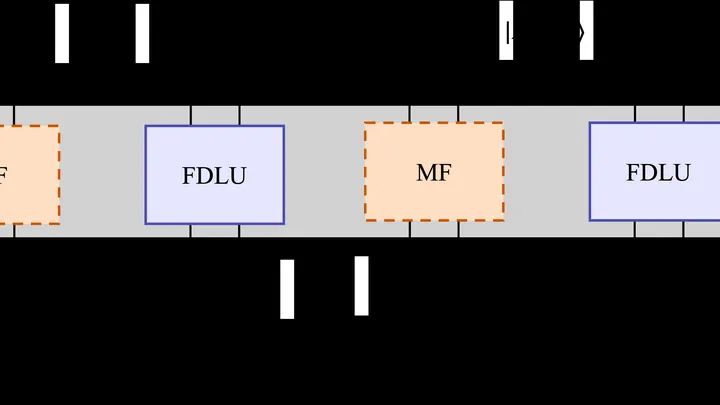
Quantum devices are no longer lab curiosities. They are assembled, tuned, and repaired like ordinary hardware — except inside them, it's not just current but intricate tangles of particles that can exist in multiple states at once. Engineers draw schematics, programmers write code, physicists calculate effects.
Photographing hummingbird wings with an ordinary camera gives a blurry smudge. For a sharp picture, you take many rapid shots from different angles and piece them together: that's how a quantum 'snapshot' is made. In the lab, scientists 'feel' the vibrations of a tiny mirror with a laser beam.
In the first moments after the big bang, the universe was filled with quantum jitters — tiny fluctuations that could later turn into gravitational waves, ripples in space itself. But when physicists try to calculate this process, infinitely large numbers pop up in the equations.
The classical neuron is a chamber musician, drawing only one note from each string: it takes a weighted sum of inputs, adds a bias, and passes it through a nonlinearity.
The classical Mpemba paradox — hot water freezes faster than cold — has teased scientists for centuries. Only recently has nonequilibrium statistical mechanics explained it: it’s all about boundary conditions; the system seems to seek an excuse to “hit the wall” and speed up cooling.
A living cell constantly emits faint magnetic signals, as if whispering. Scientists eavesdrop on this whisper with two microscopic 'microphones'—magnetic field sensors.
Quantum tunneling — the ability of particles to pass through barriers forbidden by classical physics — powers stars with thermonuclear fusion, ignites primordial nucleosynthesis, and gives us flash memory.
According to Einstein's general theory of relativity Albert Einstein, a massive rotating body drags the fabric of spacetime along with it, much like a spoon twirled in a jar sets thick honey flowing.