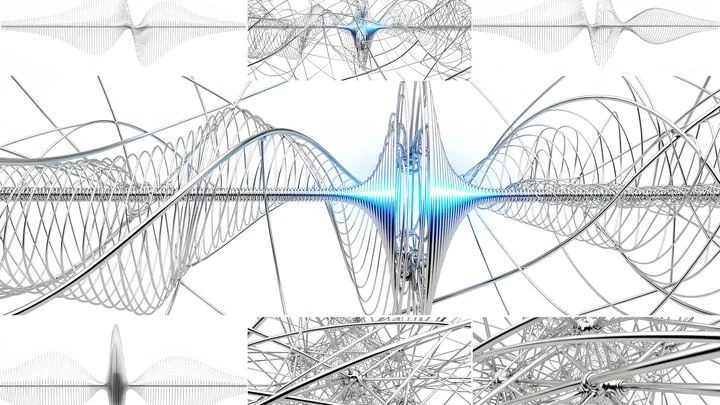
Gravitational wave strain is a dimensionless measure of how much a passing gravitational wave stretches and squeezes spacetime. It is defined as the fractional change in distance between two free-falling test masses: if the original separation is L and the wave changes it by ΔL, the strain is h = ΔL / L. Because spacetime itself is being distorted, the strain is not a force pushing objects apart; rather, it is a geometric effect that alters the very metric of space.
History
The concept of gravitational wave strain was formalized in the early 20th century through Einstein's general relativity, with the first explicit derivation of gravitational waves by Einstein in 1916. The first direct detection of strain was made by the LIGO collaboration in 2015.
How it works
A gravitational wave is a ripple in the curvature of spacetime, produced by accelerating massive objects (like merging black holes or neutron stars). As the wave passes, it alternately stretches space along one axis while compressing it along a perpendicular axis. The strain quantifies the amplitude of this distortion. For a wave traveling along the z-axis, the two polarizations (plus and cross) cause the separation between test masses to oscillate with a characteristic pattern. The strain is typically extremely small — for events detected by LIGO, h is on the order of 10^-21, meaning a change of one part in a billion trillion.
In practice
Gravitational wave detectors like LIGO and Virgo measure strain directly using laser interferometry, where the tiny changes in arm lengths (on the order of 10^-18 meters) are detected as phase shifts in the laser light.
Fun fact
The strain from the first detected gravitational wave (GW150914) was smaller than the diameter of a proton, yet it carried information about the merger of two black holes 1.3 billion light-years away.
In a binary star system, one star pulls matter from its companion. Over centuries, this material settles onto the surface of a neutron star — the ultra-dense remnant of a dead star. This process, called accretion, usually proceeds smoothly. Gravity behaves as general relativity predicts, without surprises.
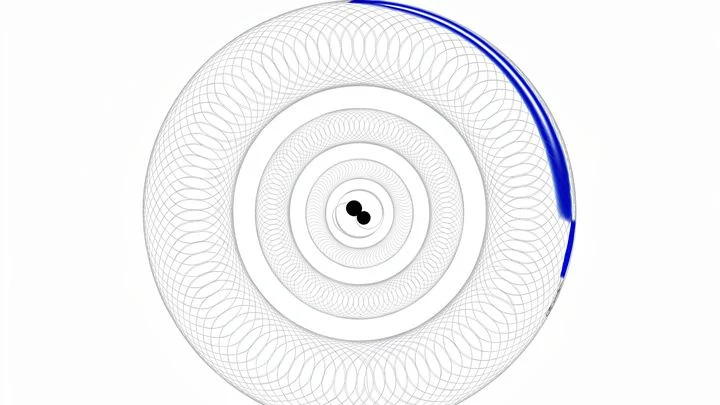
In 2017, detectors picked up a gravitational wave from the collision of two neutron stars. Just 1.7 seconds later, telescopes saw a flash of gamma-ray burst from the same spot. That tiny delay became a treasure for physicists.
In the first moments of its life, the universe resembled a boiling cauldron. Matter wasn't spread evenly — clumps and voids were brewing within it, and their violent motion gave rise to a trembling of space itself: gravitational waves.
A thousand years ago, Vikings took Iceland spar to sea. The translucent crystal split light into two rays. By their brightness, they could find the sun even in fog. Birefringence — the physical term for this phenomenon — now helps hunt for the most elusive force in the cosmos.
When a piano falls into an abyss, we think about the abyss. We don't think about the piano's cover. In much the same way, astrophysicists have for decades studied extreme close encounters between small bodies and massive black holes. They focused on the black hole itself and what orbits it. But what the 'bullet'—the small object heading toward doom — is wearing, almost no one asked.
A dead star with a magnetic field billions of times stronger than Earth's is a magnetar. Its crust cracks, sending a powerful X-ray burst into space. But some of that light doesn't reach us in its usual form. In an ultra-strong field, photons can turn into gravitational waves — the trembling of space itself.
The Universe doesn't just expand — it resonates. After the Big Bang, stretched strings remained in its fabric — thin as a proton, yet heavy as a mountain range. Their oscillations give birth to gravitational waves, and in this radiation, like in a musical score, the history of fundamental symmetries is encoded.
Imagine a giant orchestra where every musician is a particle born in the fire of the Big Bang. When time's baton gives the downbeat, these particles begin to decay into lighter ones. Each decay is accompanied by a quiet chord — the emission of gravitons, tiny quanta of gravity.
Stephen Hawking imagined that the universe was born not from an explosion, but by smoothly emerging from a quantum 'nothing.' In worlds with concave geometry (anti-de Sitter space), such a birth acquires a rim, like the hoop of a drum.
In the silence of the cosmos, the fabric of spacetime trembles almost imperceptibly: this is the quantum whisper at the scale of 10⁻³⁵ m, which until now was considered fundamentally undetectable. But collisions of black holes can turn it into a deafening scream.
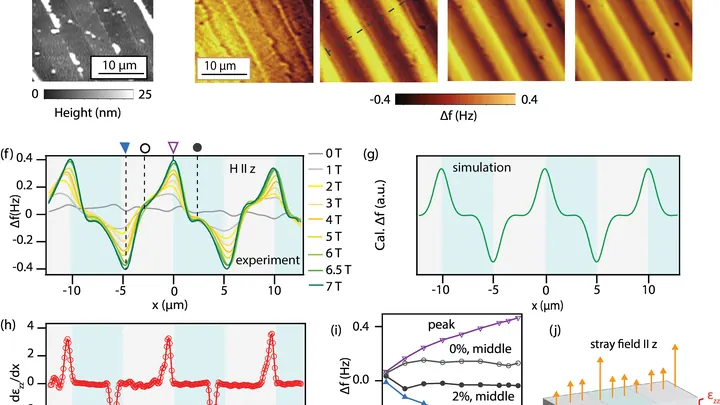
A piece of gold doesn't attract paperclips. But if you take a thin film of a gadolinium-gold-germanium alloy and start bending it, magnetic regions can appear. Scientists did this not with their hands, but with a beam of helium ions that penetrated the material through a patterned mask.
The universe is expanding, but at what rate is a question that has been troubling astronomers for decades. Two methods of measurement give different answers, and this discrepancy is called the Hubble tension. Some look at the early universe through the cosmic microwave background, others at nearby supernovae and Cepheid variables.
When water churns behind a boat, the energy of motion is converted into heat through a cascade of vortices. Measuring how quickly this happens directly is difficult: you'd need to track all the vortices at once. So scientists use a simplification: they look at only one velocity component at a single point.
The ocean is like a layered cake: warm, light water on top, cold, heavy water below. Between the layers, at the interface, invisible waves roam. They don't lift crests like a storm; instead, they slowly rock the entire water column, as if someone were shaking a giant aquarium from within.