A measure of distance in general relativity, often equal to half the Schwarzschild radius.Gravitational radius is a measure of distance in general relativity, often equal to half the Schwarzschild radius. It marks the scale at which gravitational effects become extreme, such as the event horizon of a black hole. This concept is central to understanding black holes, gravitational waves, and the bending of light in strong gravitational fields.
The concept was introduced by Karl Schwarzschild in 1916, shortly after Einstein published general relativity. Schwarzschild found the exact solution for a spherical mass, which led to the notion of a critical radius where gravity becomes inescapable.
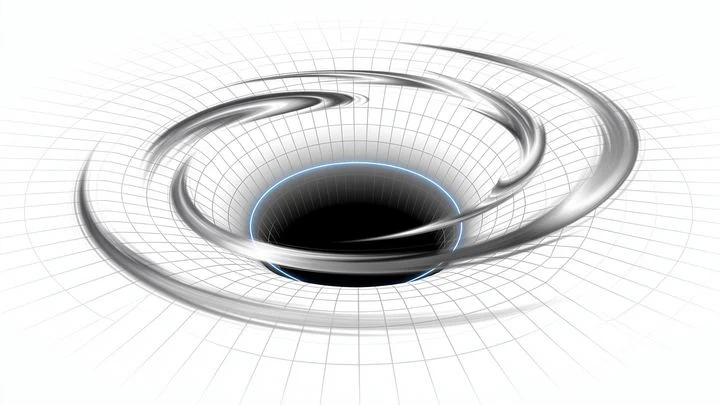
The gravitational radius is derived from the Schwarzschild solution to Einstein's field equations. For a non-rotating black hole, the Schwarzschild radius is the distance from the center to the event horizon, and the gravitational radius is half of that. It sets the scale for phenomena like gravitational time dilation and the orbits of particles near a black hole.
Gravitational radius is used in astrophysics to model black holes, interpret gravitational wave signals from mergers, and calculate the shadows of black holes imaged by telescopes like the Event Horizon Telescope.
The gravitational radius of the Sun is about 1.5 kilometers, meaning if the Sun were compressed to that size, it would become a black hole.
| R_g | variable | Gravitational radius — gravitational radius metre |
| M | variable | Mass of the gravitating object — mass kilogram |
| G | constant | Fundamental constant quantifying the strength of gravity — gravitational constant = 6.67430e-11 cubic metre per kilogram per second squared |
| c | constant | Universal speed limit for massless particles and information — speed of light = 299792458 metre per second |