Glass That Gets Stronger on the Fly express
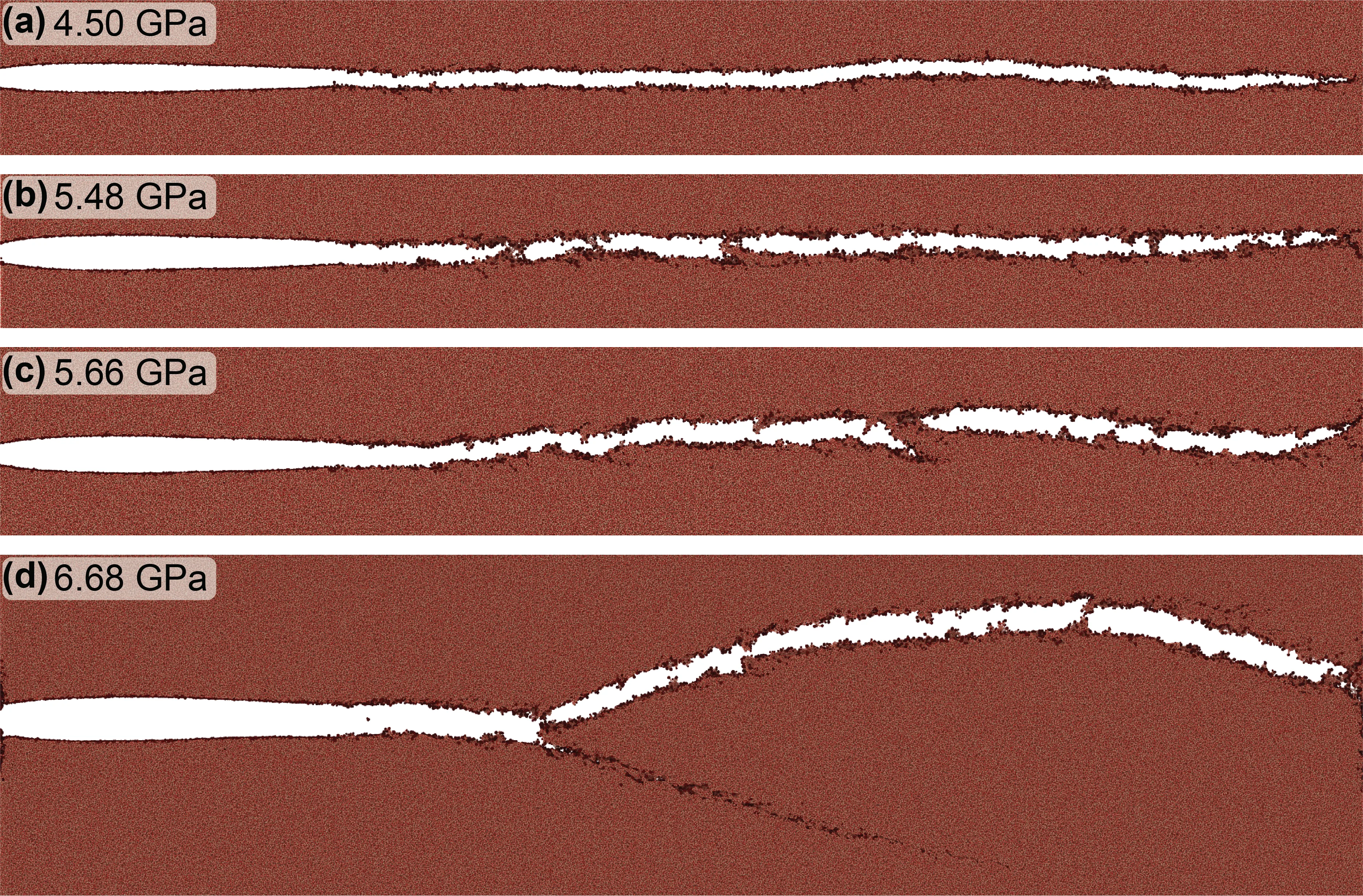
A thin crack runs through glass. At first glance, the fracture line simply reflects the material's brittleness. But if you zoom in to the atomic level, the picture gets more complex: glass starts to resist differently when the crack accelerates.
Using a computer model that simulates the behavior of every atom in quartz glass, researchers tracked how fracture energy changes — the work needed to break bonds and create new surface. They found that at speeds below the branching threshold, the point where the crack splits into many arms, this energy can jump by 33%. Previously, it was thought that the energy increase was only due to the fracture becoming rougher and its actual area increasing. But the model showed that about half of the increase comes from the surface itself becoming different at the nanoscale — atoms rearrange so that breaking their bonds is harder.
This result means that fracture energy is not a tabulated constant like melting point. It depends on how exactly the material breaks. For engineers, this is a hint: to more accurately predict when and how a glass part will fail, you need to consider not only microcracks but also their growth speed. And for solid-state physics, it's another step toward understanding how atomic-level disorder governs macroscopic strength.
A crack that initially seemed just a line of weakness actually reveals the complex life of atoms. As it accelerates, it forces the glass to rearrange, and become stronger right in the path of the fracture.
The quartz glass modeled in this work is made of the same silicon dioxide molecules as ordinary sand, but the atoms are not arranged in a strict crystal lattice — hence both its transparency and its brittleness.
In Peter Watts's novel Blindsight, an alien ship is made of a material that changes its structure under stress — much like the glass in this study.