Critical mass is the minimum amount of a fissile material—such as uranium-235 or plutonium-239—needed to sustain a nuclear chain reaction. Below this threshold, neutrons produced by fission escape the material before they can trigger further fissions, so the reaction fizzles out. At or above it, the reaction becomes self-sustaining, releasing energy at a steady or rapidly increasing rate.
History
The concept emerged during the Manhattan Project in the early 1940s, with key contributions from physicists like Robert Serber and J. Robert Oppenheimer, who used it to design the first atomic bombs.
How it works
In a fissile nucleus, absorbing a neutron causes it to split, releasing energy and two or three new neutrons. For a chain reaction, at least one of these neutrons must go on to split another nucleus. If the material is small or spread out, neutrons leak from its surface before finding a target. Critical mass is the size and shape at which neutron production just balances neutron loss—through leakage and absorption by impurities. A larger mass, a denser form, or a neutron reflector can lower the required amount.
In practice
It is central to nuclear reactor design (where criticality is carefully controlled) and to nuclear weapons, where exceeding critical mass triggers an explosive chain reaction.
Fun fact
A sphere has the smallest critical mass for a given material because it minimizes surface area and thus neutron leakage.
Units by system: SI: kg · CGS: g · Planck: m p · natural: gev
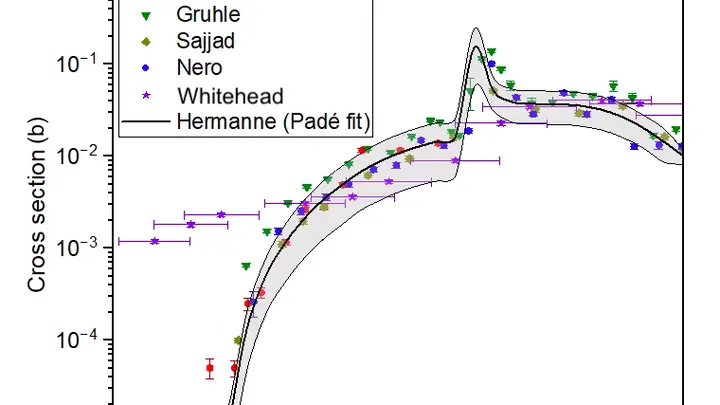
When a massive star explodes as a supernova, heavy nuclei are forged in its interior within seconds. Among them is titanium-44, a radioactive isotope that later glows in gamma rays for years. How much of it remains depends on a single nuclear reaction: a proton is captured by a vanadium-45 nucleus, turning it into chromium-46.
In nuclear physics, a puzzle has long been nagging: why among elements lighter than bismuth, only technetium (No. 43) and promethium (No. 61) have no stable isotope at all? All their neighbors in the periodic table can boast at least one long-lived variant, but these two seem to fall out of the general pattern.
Two pieces of sandpaper are pressed tightly together. As you start to slide them, they first catch on the rough spots, then suddenly slip. A fault in the Earth behaves much the same way during an earthquake. But there's a crucial detail: how far do you need to push the edges before the grip gives way? This distance is called the critical slip distance.
An old factory where instead of machines there are atomic nuclei, and neutrino radiation seethes all around. When a massive star exhausts its fuel, its core compresses a hundredfold, and the temperature skyrockets to billions of degrees.
Atomic nuclei are rarely perfect spheres. More often, they resemble a slightly squashed ball — the electric charge inside is unevenly distributed, and protons may shift a bit, creating a tiny 'pear-shaped' bulge.
Atomic nuclei are wrapped in fluffy electron coats — in such attire, they can't get close enough to embrace. But swap the light coat for a heavy one: a muon, a particle from the standard model, shrinks the cloud by nearly 200 times.
Hot tea in a freezer doesn't freeze all at once. First, tiny ice needles dart around — forming and melting until the temperature drops enough for the ice to set solid. The early universe behaved similarly as it cooled and changed its internal structure.
A thin crack runs through glass. At first glance, the fracture line simply reflects the material's brittleness. But if you zoom in to the atomic level, the picture gets more complex: glass starts to resist differently when the crack accelerates.
The outer crust of a neutron star is like a layered cake, where each layer is a strictly defined filling. It's a crystalline lattice of atomic nuclei immersed in a sea of electrons. The deeper you go, the stronger the pressure, and the heavier the nuclei that can exist there without falling apart.
An aluminum pot on the stove melts at 660 degrees Celsius — everyone knows that. But what happens if you heat aluminum a hundred times hotter? The liquid starts to boil, and here's the puzzle: at what exact temperature does that happen?
An ordinary nuclear reactor is like a boiler where fuel burns evenly throughout the volume. Here the picture is different: a fission wave, a narrow zone where atoms split and release heat, slowly creeps along a cylindrical rod of uranium carbide. Ahead of the wave, the fuel is untouched; behind, it is already spent. So fire runs along a candle wick, leaving wax behind.
Deep inside a dying star, just before it goes supernova, nuclear reactions determine which chemical elements will be scattered across the cosmos. One such reaction is the collision of an oxygen nucleus with a proton, producing a nitrogen nucleus and an alpha particle (a helium nucleus).
In the mid-20th century, astronomer Vera Rubin discovered that stars on the outskirts of galaxies were moving too fast — held by an invisible mass. Thus the mystery of dark matter was born. It doesn’t emit light but reveals itself through gravity. The big question: why is there exactly as much as we see?
An atomic nucleus usually follows its own rules: its decay doesn't care about temperature, pressure, or molecular neighbors. But the uranium-235m isotope is a striking exception. This nucleus sits in an excited state, like a tightly coiled spring, and sooner or later it releases the extra energy.
Hidden in the nucleus of a gold atom lies a potential future cancer treatment. When a gold target is struck by a gamma ray with an energy of about 30 megaelectronvolts, one of the nuclei loses a proton and a neutron, transforming into a rare platinum isotope — platinum-195m.
Igniting a miniature sun is a long-held dream of humanity. Typically, scientists try to confine scorching plasma (a gas of charged particles) at temperatures of hundreds of millions of degrees. But plasma tends to escape magnetic traps, and confinement comes at enormous cost.
Aluminum-26 is an isotope that doesn't live long by cosmic standards: only about a million years. When a massive star explodes as a supernova, it flings this aluminum into space. Later, it decays, emitting gamma rays that telescopes can catch.
The authors recalculated how much aluminum-26 a star with 20 solar masses should eject.
For two atomic nuclei to fuse, they must overcome their fierce electric repulsion — like trying to bring two angry bulls together. Normally, only monstrous energy does the trick, as in stellar cores, where Hans Bethe explained fusion back in the 1930s.
A snowflake falling from a cloud chooses between a left-handed and a right-handed form. The difference between them is almost imperceptible, like a breath of wind, yet it is that very breath that decides which pattern will grow.