The nanoscale is the size range roughly between 1 and 100 nanometers — about one-thousandth the width of a human hair. At this scale, materials behave differently than in bulk: quantum effects become significant, surface atoms dominate, and properties like color, melting point, and electrical conductivity can change dramatically. This is the realm where the classical physics of everyday objects meets the quantum world of atoms and electrons.
History
The concept of the nanoscale was popularized by Richard Feynman in his 1959 lecture 'There's Plenty of Room at the Bottom,' though the term 'nanotechnology' was coined later by Norio Taniguchi in 1974.
How it works
At the nanoscale, the wavelength of electrons becomes comparable to the size of the structures, so quantum confinement effects emerge. The surface-to-volume ratio becomes enormous, meaning surface energy and interactions with the environment play a dominant role. Thermal fluctuations and quantum tunneling also become more pronounced, leading to phenomena like size-dependent melting points and discrete electronic energy levels.
In practice
Nanoscale engineering is used in electronics (transistors in modern chips are a few nanometers), medicine (targeted drug delivery nanoparticles), and materials science (stronger, lighter composites).
Fun fact
Gold nanoparticles at the nanoscale appear red or purple in solution, not yellow, because their plasmon resonance shifts with size.
A tiny diamond, invisible to the naked eye, sits on a chip and senses heat like no ordinary thermometer can. Hidden inside it are two defects: places where a carbon atom is replaced by a nitrogen atom, with a vacancy nearby.
A thin silver thread nearly as long as a hair's width, and inside it, pristine quantum laws hold sway. Physicists built a conductor where electrons can only move forward or backward, like on a perfectly straight single-lane road with no shoulders. On such a road, any pothole or pebble would normally destroy the fragile quantum state.
A solid under a microscope is not a monolith at all. In glass, polymer, or solidified resin, atoms are arranged randomly, and as a result, the material's properties vary from point to point. On large scales, we are used to describing them with smooth fields, like temperature or pressure in a room. But when you zoom down to a few atomic layers, that smoothness disappears.
A speed of 7,5 kilometers per second is the threshold beyond which a cosmic collision turns dust grains into a chemical reactor. In the interstellar medium drift tiny cosmic dust grains — the legacy of dying stars.
The quantum many-body world is a jazz ensemble, where each electron improvises, continuously listening to all the others, and the overall wave function is born from this tense dialogue.
A stone falls into water, and ripples spread in all directions. Throw a handful of stones at once, and the ripples overlap: you can no longer tell which ripple came from which stone. A neutron beam hitting a detector looks much the same: a bright spot blurred by many causes.
Conventional photolithography, used to make chips, hits a fundamental limit: light cannot draw features smaller than its wavelength. Here, they took a different route. First, they made sparse vertical ridges of oxide, then deposited layers of aluminum oxide, each one atom thick, onto them.
In a narrow gap between two plates, water from humid air collects on its own: this is capillary condensation. If the gap is only a few nanometers wide, water no longer behaves like a continuous liquid: every molecule counts.
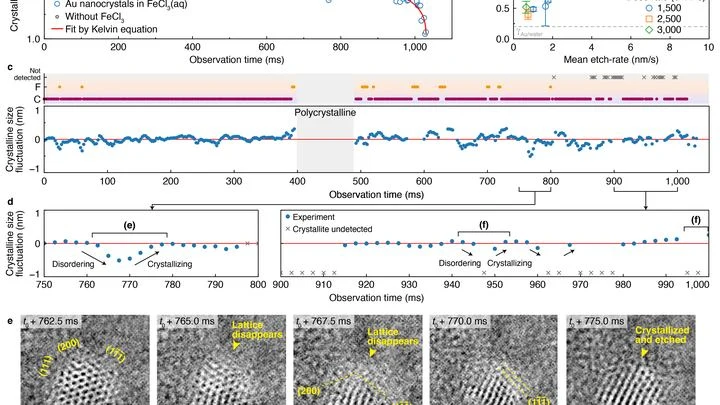
Gold nanoparticles in liquid are like tiny living creatures: they constantly change their internal structure, as if breathing. Scientists managed to peek into this process using an electron microscope that takes snapshots every millisecond, and a neural network that cleans the images from noise.