Hearing the Dance of Black Holes Without Interference express
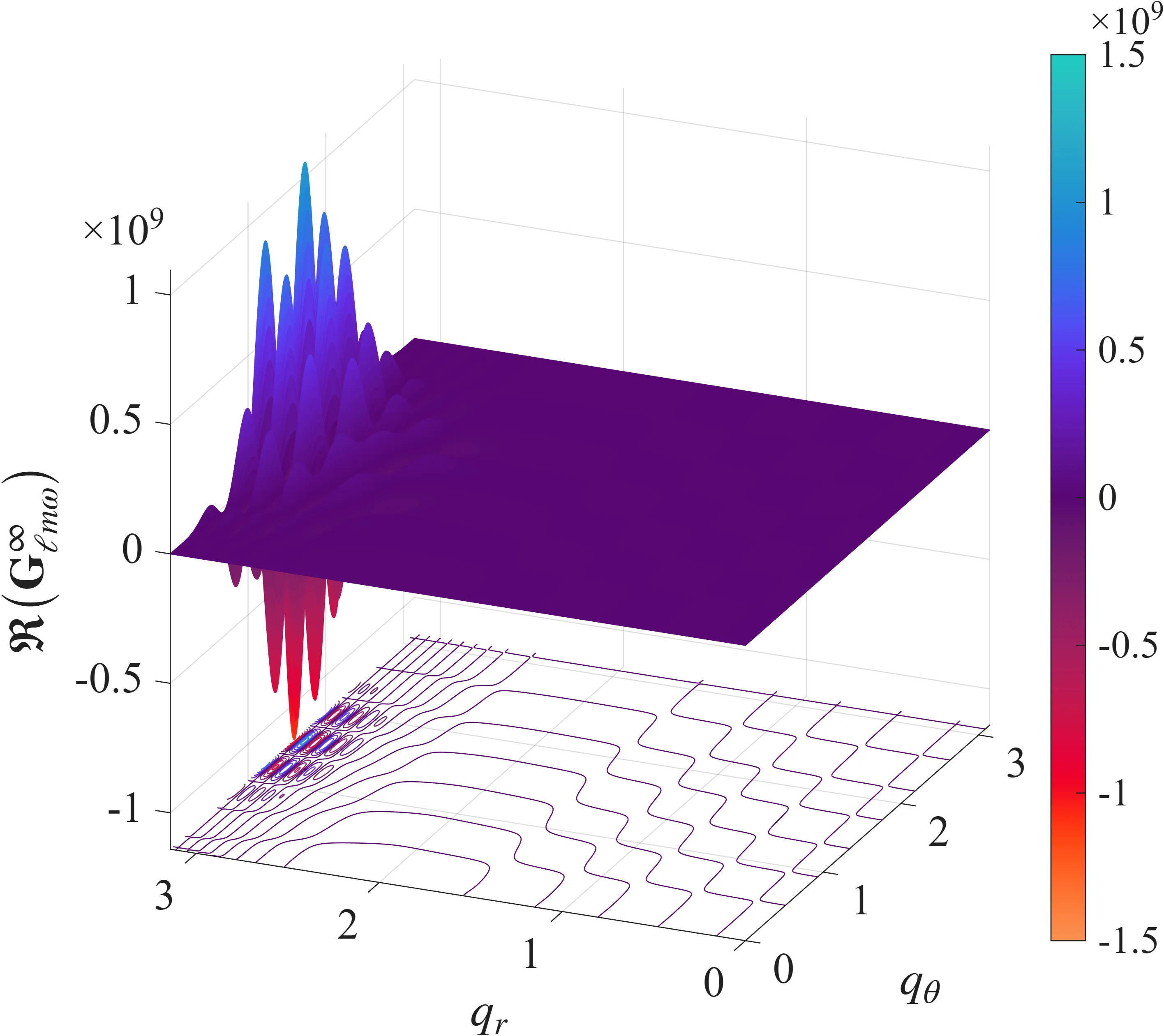
The orchestra is playing, but the musicians can't hear each other: each follows their own tempo, while the conductor tries to weave the disparate sounds into a single melody. That's roughly what it's like to compute gravitational waves from a system where a small compact object (say, a neutron star) spirals around a supermassive black hole. The star traces an intricate orbit, warping the space around it, and these distortions, like sound waves, ripple across the universe. To "hear" them with ground-based or space-borne detectors, we need to know the score in advance: that is, precisely predict the signal we expect. Classical methods often stumble here: they either require fitting extra parameters or fail near the black hole or at high frequencies.
The authors of the new study rewrote the score in a different language. Instead of ordinary notes, they used so-called Heun functions — mathematical constructs that behave like perfect tuning forks: they inherently "know" the right frequency and need no manual adjustment. With their help, they eliminated the auxiliary parameters that previously had to be tuned by hand, obtaining solutions that converge across the entire domain. But another challenge remained: for complex orbits, the integrands began to oscillate wildly, as if a hundred violins in the orchestra all played at once, each slightly off-key. To preserve accuracy, the scientists applied adaptive partitioning with a weight function — something like a smart microphone that adjusts to the volume and isolates the pure tone.
The result exceeded expectations. Compared to the best current programs, such as GeneralizedSasakiNakamura.jl, the new method proved 3–13 times faster for the majority of modes, and up to 60 times faster for the most finicky high-frequency harmonics. Moreover, accuracy didn't suffer; it reached a level previously unattainable with standard double-precision computations. In effect, the scientists didn't just speed up the calculation: they made it possible to compute what was once deemed too expensive or unstable.
Now astrophysicists have a tool to quickly and reliably generate signal templates for future observations. This is critical for missions like LISA, where the faint whisper of gravitational waves must be extracted from the cosmic noise. And that means we can better hear the dance of black holes and perhaps learn something new about how spacetime curves in the most extreme corners of the universe. Then, at last, the conductor will hear the entire orchestra — the pure melody played by the very fabric of the cosmos.
An error of 10⁻¹¹ means that if you were calculating the distance to the nearest star, you'd be off by less than a millimeter.
In Carl Sagan's novel "Contact," the alien signal contains blueprints for a machine that uses gravitational waves — calculations like these could help decipher such a message.