Zhoujian Cao

5 articles · 9 co-authors · latest: 2026-08-16
73 citations · h-index 4 · 10 papersData: Semantic Scholar

We have retold 5 papers by this author. most often about: black hole merger, gravitational waves, gravitational singularity. 9 co-authors across our retellings.

Links in the knowledge graph
General Relativity2026-01-071 minarXiv:2601.03571express
Gravitational waves test the symmetry of the Universe
Two giant black holes spiral together and collide — a ripple of spacetime spreads across the Universe. Detectors of gravitational waves catch this ripple. But the signal may hide more than just mass and distance: if the laws of physics differ ever so slightly in different directions, the wave will be distorted.
General Relativity2026-04-282 minarXiv:2604.25536express
How to Hear the Dance of Stars on a Stretched Orbit
A figure skater glides on the ice, arms outstretched. If their path is nearly a perfect circle, describing the motion is straightforward. But when they race along a highly flattened oval, they almost freeze at the far edge and then zoom past the near edge at tremendous speed. That's roughly how two stars behave on a very elongated orbit.
General Relativity2026-05-102 minarXiv:2605.09250express
Hearing the Dance of Black Holes Without Interference
The orchestra is playing, but the musicians can't hear each other: each follows their own tempo, while the conductor tries to weave the disparate sounds into a single melody.
General Relativity2026-07-231 minarXiv:2607.20945express
A White Hole in the Lens: What the Telescope Will See
A black hole is a place from which nothing can escape. But some theories allow that deep inside, at the quantum level, it might bounce and turn into its opposite — a white hole, which only spews out matter and light. A group of physicists built a computer model of such a transformation.
General Relativity2026-08-162 minarXiv:2608.15723express
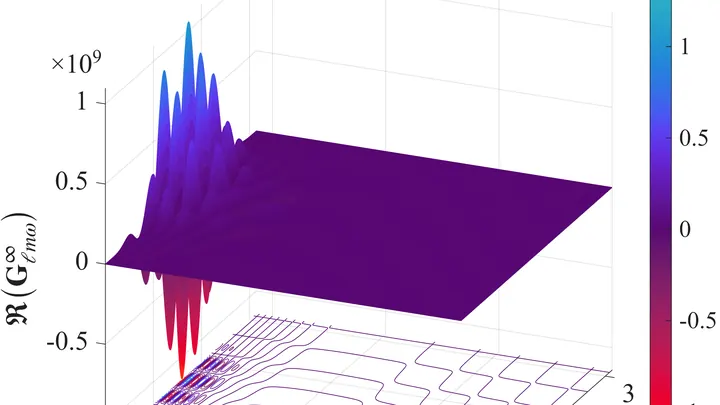
A Date of Two Black Holes: How to Calculate Their Dance More Precisely
Two black holes, caught in a dance, spiral closer and closer until they merge into one. This dance is not silent: it shakes spacetime itself, sending gravitational waves rippling across the Universe. To understand what we hear in these waves, we need a precise mathematical model of the dance.