Compact objects are the end states of stellar evolution, where matter is crushed to extreme densities by gravity. The three main classes are white dwarfs, neutron stars, and black holes. White dwarfs are supported by electron degeneracy pressure, neutron stars by neutron degeneracy pressure and nuclear forces, and black holes by nothing—they are regions where gravity is so strong that not even light can escape. These objects are the 'corpses' of stars, but they are far from inert: they can spin rapidly, emit intense magnetic fields, and accrete matter from companions, making them some of the most energetic phenomena in the universe.
History
The concept of a black hole dates back to John Michell (1783) and Pierre-Simon Laplace (1796), who speculated about 'dark stars.' White dwarfs were first recognized in the early 20th century, with the discovery of Sirius B. Neutron stars were proposed by Lev Landau in 1932 and by Walter Baade and Fritz Zwicky in 1934, and were confirmed with the discovery of pulsars in 1967.
How it works
When a star exhausts its nuclear fuel, it can no longer support itself against gravitational collapse. For stars up to about 8 solar masses, the core becomes a white dwarf, where electrons resist further compression. For more massive stars, the core collapses further, and protons and electrons merge into neutrons, forming a neutron star—a city-sized object with the mass of the Sun. If the core is too massive (above about 2-3 solar masses), no known force can halt the collapse, and a black hole forms. The extreme conditions in and around these objects produce phenomena like pulsars (rotating neutron stars emitting beams of radiation) and accretion disks that glow in X-rays.
In practice
Compact objects serve as natural laboratories for testing general relativity, nuclear physics, and quantum electrodynamics under extreme conditions. They are also used as precise cosmic clocks (pulsars) for detecting gravitational waves and for navigation in deep space.
Fun fact
A teaspoon of neutron star material would weigh about a billion tons on Earth.
A light ray passing near a massive body bends around it, like a runner rounding the corner of a stadium. For a neutron star, this deflection angle is usually assumed to be the same as for a point mass. But if the star is wrapped in an invisible halo of dark matter, the picture changes: light passing through the halo is deflected less than the total mass would predict.
At the center of a galaxy, where a supermassive black hole spins a disk of scorching gas around itself, giant stars sometimes form. They are unlike ordinary stars: the disk continuously feeds them with matter, and a star can grow to hundreds of solar masses, staying bright as long as the gas flow lasts.
A white dwarf is the former core of a star like the Sun, squeezed down to the size of Earth. A teaspoon of its material would weigh several tons. A neutron star is an even denser remnant: a city the size of Manhattan, but with more mass than the Sun.
Drop two stones of different shapes into a pond — the ripples will tell you which one was smooth and which was jagged. Gravitational waves work the same way: when two ultra-dense objects merge, the trembling of spacetime carries details about their inner workings.
Two neutron stars whirl in a close dance, each feeling the tidal field of its partner. It's like the Moon raising oceans on Earth, but here it's spacetime itself and the star's matter that deform. Astrophysicists call this tidal deformation — a measure of how much an object 'bends' under the gravitational pull of its companion.
Two hundred and eighty-nine days: that's how long one rotation of the white dwarf white dwarf WD 1532+129 takes. This is not just a record: on its surface, near the magnetic poles, scars of iron and other metals appear — silent testimony to planets it has devoured.
In August 2019, the LIGO and Virgo detectors picked up gravitational waves from the merger of two compact objects in a binary star. One weighed 23 solar masses — a standard black hole. The other came in at 2.5–2.67 M⊙.
At the centers of many galaxies, not only supermassive black holes lurk, but also vast clouds of invisible matter. If this matter consists of ultralight particles, it can gather into dense clumps — a kind of 'star' made of dark matter.
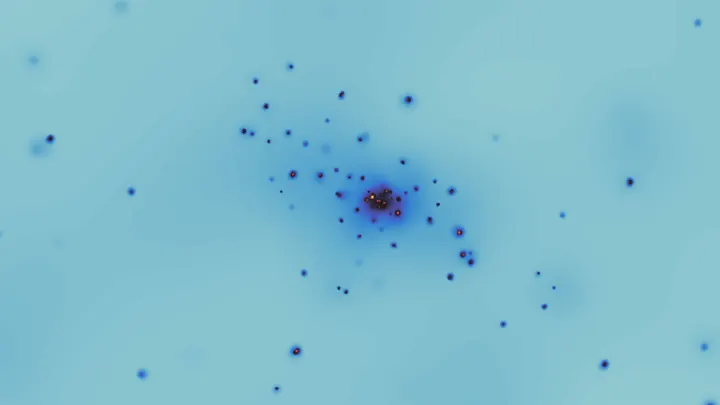
At the center of attention are tiny stellar cities: ultra-faint dwarf galaxies. They resemble sparse swarms of fireflies circling within a vast invisible cloud. This cloud is a halo of ultralight dark matter. Its particles are so light that they behave not like billiard balls but like waves.
At the center of a galaxy, gravity condenses dark matter into a dense 'spike.' Such a dark spike resembles a funnel of invisible particles around a massive body. But if both the center and the particles are primordial black holes, the picture breaks down.
At the heart of a warp drive lies Einstein's idea that massive bodies curve spacetime — the very stage on which all cosmic events unfold. Picture a bubble of such curved spacetime. Inside it, the ship floats without any G-forces, like a passenger in an airplane cabin who doesn't feel the headwind.
Neutron stars are cosmic 'ice cubes' of unimaginable density: a tablespoon of their material would outweigh Mount Everest. It was a mystery what lay in their cores: ordinary neutron matter (a giant atomic nucleus) or exotic quark matter, where particles are not bound into neutrons.
In the silent theater of the cosmos, a star’s life plays out over billions of years. But sometimes an invisible director sneaks onto the stage — a primordial black hole.
Drop a stone into a pond, and ripples spread outward. Something similar happens inside compact clumps of dark matter when they encounter a special medium — a scalar field. This field, which pervades everything around us, can spontaneously intensify in the depths of such objects, much like ripples on water growing ever taller and more pronounced.
For a long time, a void yawned in the family of ultra-dense remnants of dead stars. Neutron stars, swift city-sized tops, rarely weigh more than two Suns. Black holes start at about five solar masses. Between them lies a 'gap' where for decades no object could be found.
If you squeeze a handful of sand down to the size of a pinhead, it turns into a rock. But squeeze it even harder, to the density of an atomic nucleus, and the grains lose their identity. Protons and neutrons dissolve, and the stuff becomes a soup of free quarks.
In the standard picture, black holes are the undisputed density champions: all their matter is squeezed into a single point. Imagine the entire mass of Mount Everest packed into a grain of salt. But physicists have found a theoretical trick.
Just after the Big Bang, clumps weighing as much as a trillion Suns and with an electric charge of colossal strength, like trillions of electrified balloons, could have drifted through space.
A handful of sand weighing as much as a small mountain: that's roughly what strangelets are like: tiny clumps of 'strange' quark matter where particles are squeezed to unimaginable densities. In a new study, astrophysicists tested whether such objects could exist in nature and what they would look like.
In the searing plasma of the newborn Universe, when space itself still rang with the echo of the Big Bang, objects may have emerged that challenge gravity itself. Not ordinary black holes — but electrically charged giants, astrons.
A galaxy is like a cosmic highway where stars, like cars, race along circular orbits. Their speed is set by the invisible "cargo" of mass enclosed within the orbit: the more massive the central region, the faster the stars at the periphery.
A sugar cube sits on a saucer next to a cup of hot tea. Drop it in, and it dissolves within minutes. But if you lower it slowly, the sugar melts gradually, releasing its sweetness into the drink. Something similar is happening in two newly discovered stellar pairs, except the sugar is a brown dwarf and the tea is a star.
A white dwarf is what remains of a star like the Sun after it sheds its outer layers. What's left is a hot core the size of Earth but with a mass close to that of the Sun. A teaspoon of this material would weigh as much as a truck. Some of these stars have extremely strong magnetic fields — a billion times stronger than Earth's.
Two non-spinning black holes at the moment of merger give birth to gravitational waves — ripples in the very fabric of spacetime, captured by instruments developed with the help of Kip Thorne.
A star made of dark matter is an invisible ocean of ultra-light particles, whose existence was first suspected by Fritz Zwicky back in the 1930s. Into this ocean plunges a neutron star — a tiny, yet unimaginably dense sphere.
The first stars ignited from clouds that contained nothing but hydrogen and helium. Heavy elements (carbon, oxygen, iron) came later, forged inside stars. But among those pioneers, there could have been lightweight stars, with masses just below that of the Sun.
In the dense core of the globular cluster NGC 6397, where stars jostle like commuters at rush hour, astronomers have spotted a peculiar pair. One star is a white dwarf with a surface temperature of 16,000 K, the scorched remnant of a star that has been cooling for billions of years, and circling it is an unseen companion.
The night sky is full of beacons, but some shine in a way that makes them nearly invisible. Astronomers have discovered a new class of objects: ultrasoft X-ray sources. They are so "cool" by X-ray standards that their emission falls at the boundary between ultraviolet and soft X-rays, where ordinary telescopes are almost blind.
The neutron is the particle that makes up most of a neutron star. On its own, it is unstable: a free neutron lives for about fifteen minutes, then decays into a proton, an electron, and an antineutrino.
In the Large Magellanic Cloud, a galaxy that orbits our Milky Way, astronomers have caught five stars that look like fossils from the very distant past. They contain almost no metals, only one-hundredth to one-thousandth of what the Sun has, but they have tens of times more carbon.
A star 300 light-years away dances with an invisible partner. One side of the star heats up more than the other, as if the unseen dancer is breathing a hot wind onto it. This partner is a neutron star — a city-sized cinder so dense a teaspoon of its matter outweighs Mount Everest.
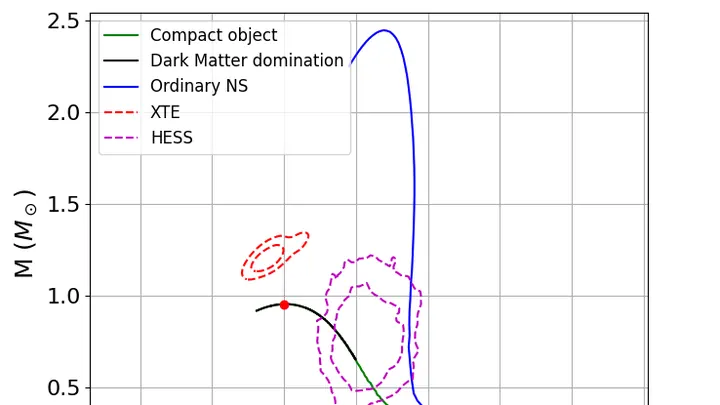
Neutron stars are the compressed remnants of massive stars: their matter is squeezed so tightly that a thimble-sized amount would weigh a colossal amount. If dark matter, the mysterious invisible substance thought to hold galaxies together with its gravity, accumulates inside such an object, under certain conditions this accumulation becomes fatal.
At the center of the supernova remnant SN 1987A, 168,000 light-years from Earth, hides an object that astronomers have been seeking for 37 years. This is the closest supernova to have exploded in front of modern telescopes, and the only one where the compact remnant has yet to be seen directly.