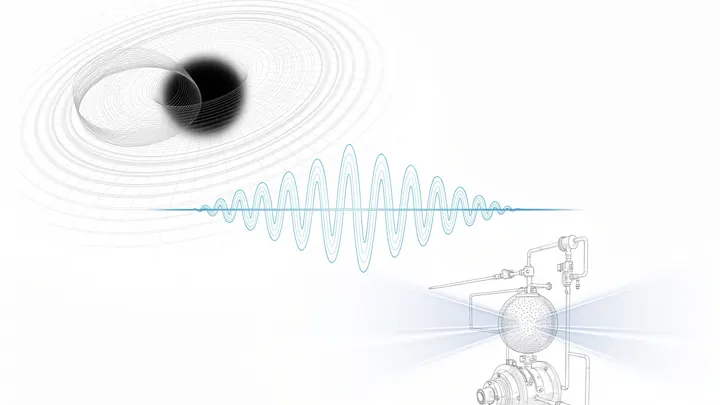
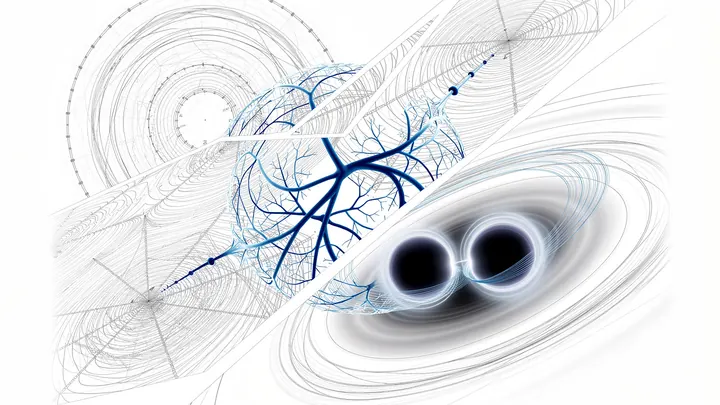
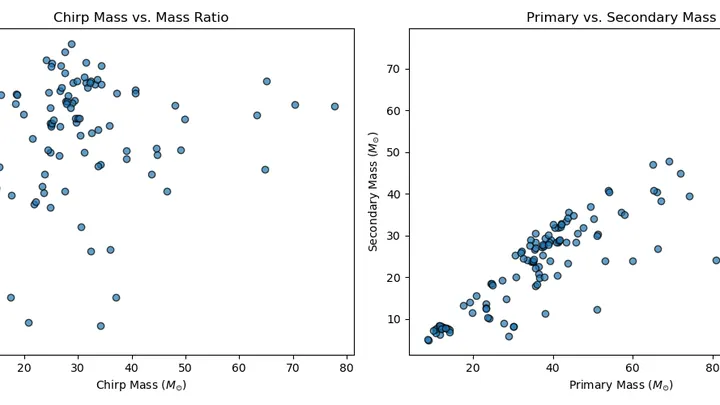
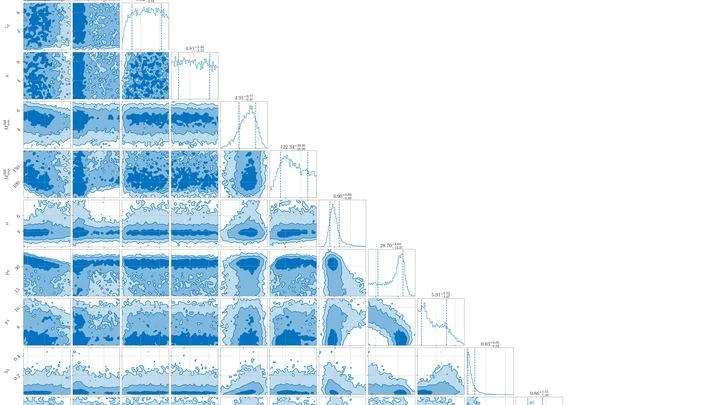
Gravitational wave parameter estimation is the process of extracting physical properties of astrophysical sources from the detected gravitational wave signals. This includes measuring parameters like the masses, spins, and eccentricity of merging black holes or neutron stars, as well as testing the predictions of general relativity. Accurate parameter estimation is crucial for understanding the population of compact objects and for probing the nature of gravity in strong-field regimes.
History
The field developed in the 1990s with the planning of gravitational wave detectors, and became a practical reality after the first detection in 2015. Since then, continuous improvements in waveform models and computational methods have refined the accuracy of parameter estimation.
How it works
The process involves comparing the observed gravitational wave signal with a bank of theoretical waveforms generated from general relativity or alternative theories. Using Bayesian inference, the likelihood of each set of parameters is computed, and posterior distributions are obtained. Techniques like matched filtering and Markov Chain Monte Carlo methods are employed to efficiently explore the parameter space and find the best-fit values with uncertainties.
In practice
This is used in all gravitational wave observatories (LIGO, Virgo, KAGRA) to identify the source properties of each event, and in future space-based detectors like LISA to study extreme mass ratio inspirals and cosmological sources.
Fun fact
The eccentricity of a binary system can be measured from gravitational waves, providing clues about the dynamical environment where the system formed, such as dense star clusters.
Imagine a simultaneous interpreter in a room where two people are speaking: they must keep up with both meaning and intonation, but if the speech is too fast, only a paraphrase remains. That's roughly how scientists feel as the stream of gravitational waves from black hole and neutron star mergers grows, while precise signal calculations lag behind.
A sculptor shapes mountains from magnetic fields and heat, but the stone resists. A neutron star, the ultra-dense remnant of a supernova explosion, in a binary system pulls matter from its companion star. This infalling matter heats the star's crust unevenly, while the magnetic field tugs from within.
Somewhere in the depths of space, two supermassive black holes are circling each other. Their dance is not smooth — the orbit is stretched, like a rubber band that alternately tightens and relaxes. Each revolution sends ripples through the fabric of spacetime — gravitational waves.
At the end of a massive star's life, its core collapses in a fraction of a second, giving birth to a supernova flash. This cataclysm shakes spacetime itself, emitting gravitational waves — ripples that race across the Universe.
Light escaping a massive body loses energy: its waves stretch, and its color shifts toward the red. This is gravitational redshift, known since the work of Einstein.
Gravity isn't just the force that keeps us on the floor. On cosmic scales, it conducts galaxies, bends light rays, and decides the fate of everything. A century ago, Einstein described it as the curvature of space and time.
In the ocean of space, every storm of birth or merger of supermassive black holes generates ripples — gravitational waves traveling at the speed of light. Over billions of years, these waves superimpose, merging into a low-frequency hum, like a distant surf.
Isolating the signal from a single pair of supermassive black holes is like hearing a dancer's footsteps amid the roar of a hurricane. Somewhere in space, these monsters spin in a slow gravitational tango, distorting spacetime itself.
The universe as painted in Einstein’s textbooks is a smooth four-dimensional canvas. But string theory adds a frame of extra dimensions — invisible, yet tangible to gravity. Imagine our universe as a membrane that trembles under the pressure of hidden layers.
At the heart of nearly every large galaxy lives a supermassive black hole — a silent giant around which stars, gas, and other, smaller black holes orbit. From time to time, one of these objects breaks free from its orbit and begins to fall toward the central monster in a tightening spiral.
Gravitational waves from a tiny body falling into a black hole work like an X-ray image. Only instead of a bone, they illuminate the curved spacetime itself.
Imagine an orchestra where each musician plays their own part, and the conductor tries to catch a faint rhythm common to all. That's roughly how astronomers search for gravitational waves from pairs of supermassive black holes (weighing billions of suns) circling each other in distant galaxies.
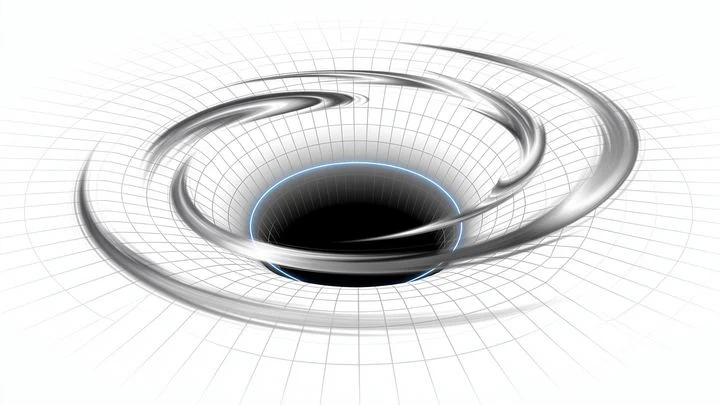
Light passing by a black hole swirls like water down a bathtub drain. The most intriguing part is the thin ring where rays can orbit forever, neither falling in nor escaping. This is the photon sphere — an invisible boundary that paints the hole's shadow on the sky.
Two dots on the surface of a balloon: that's all the reference points you have when trying to figure out how it inflates. That's roughly how cosmologists reconstruct the history of the universe's expansion.
Back in the 1960s, physicist Joseph Weber tried to catch gravitational waves using aluminum cylinders: they were supposed to tremble like tuning forks from the ripples of spacetime.
The orchestra is playing, but the musicians can't hear each other: each follows their own tempo, while the conductor tries to weave the disparate sounds into a single melody.
The symphony plays, but a barely perceptible wrong note has crept into the score. This is roughly how physicists search for deviations from general relativity in the 'sounds' of the universe — gravitational waves from merging black holes.
The trembling of space sounds like an orchestra. Gravitational waves caught by the LIGO and Virgo detectors tell of black hole collisions. Sometimes the music carries off-key notes — tiny deviations from Einstein's score. They might whisper of new physics or simply of dust on the bows.
A figure skater glides on the ice, arms outstretched. If their path is nearly a perfect circle, describing the motion is straightforward. But when they race along a highly flattened oval, they almost freeze at the far edge and then zoom past the near edge at tremendous speed. That's roughly how two stars behave on a very elongated orbit.
A distant orchestra plays a symphony, but the recording is full of noise. The melody is written for two instruments, yet a third voice seems to break through the static — quiet and unfamiliar. This is how astrophysicists listen to gravitational waves, trying to catch the slightest deviations from Einstein's predictions.
A flat crystal of charged atoms suspended in an electromagnetic trap behaves like a perfectly calm pond. The slightest breeze, and ripples spread across its surface. This 'pond' catches the splashes from dark matter particles and the ripples of spacetime — high-frequency gravitational waves.
Neutrinos are the most abundant massive particles in the universe. Trillions of them pass through us every second, yet they leave barely a trace. Their collective gravity, though tiny, can influence the motion of entire galaxies. Think of two people approaching each other on a busy street; invisible passersby alter their speed.
An album with hundreds of family photos holds countless stories. If you look at each picture on its own, you might easily decide that Uncle is a real giant: that day he happened to stand a step higher than everyone else. But flip through the whole album, and it becomes clear — his height is perfectly ordinary; it's just that a step showed up in a couple of frames.
The merger of two black holes is like a dance that ends in a powerful burst — a gravitational wave. This wave carries the imprint of how spacetime is curved around the objects. If the geometry differed from what we're used to, as if a ball rolled not on a flat floor but on wavy linoleum, the signal would be different.
Two black holes spiral faster and faster until they merge into one. This dance shakes space itself: waves ripple outward from the collision site, like ripples from a stone thrown into a pond. Sometimes the merger also produces a flash of light.
Gravitational waves are ripples in space, born, for example, when pairs of supermassive black holes spiral around each other. To catch them, scientists monitor pulsars — dead stars that emit radio pulses with clockwork precision.
Each merger of black holes produces gravitational waves — ripples in the fabric of the universe — predicted by Einstein and first detected with key contributions from Kip Thorne.