Simple

How Superconductors Help Us Hear a Black Hole's Ring

Original: "Stability and quasi-normal ringing in analogue black-white holes in SNAIL-based traveling-wave parametric amplifiers"
arXiv:2605.11565v1 · 2026-05-12 · CC BY 4.0 · ⏱ 1 min · General Relativity Quantum Physics
Physicists demonstrated the stability of an electrical black hole model and characterized its distinctive damped ringing.
Abstract

Imagine an electric circuit where a strong wave pulse creates something like an 'event horizon' for a weak signal—a boundary that the signal cannot cross. Scientists found that in such a system, dangerous instabilities do not arise, and they calculated how it vibrates after a disturbance, like a bell ringing after being struck. What else might these artificial 'black holes' reveal about real ones?

Links in the knowledge graph 1

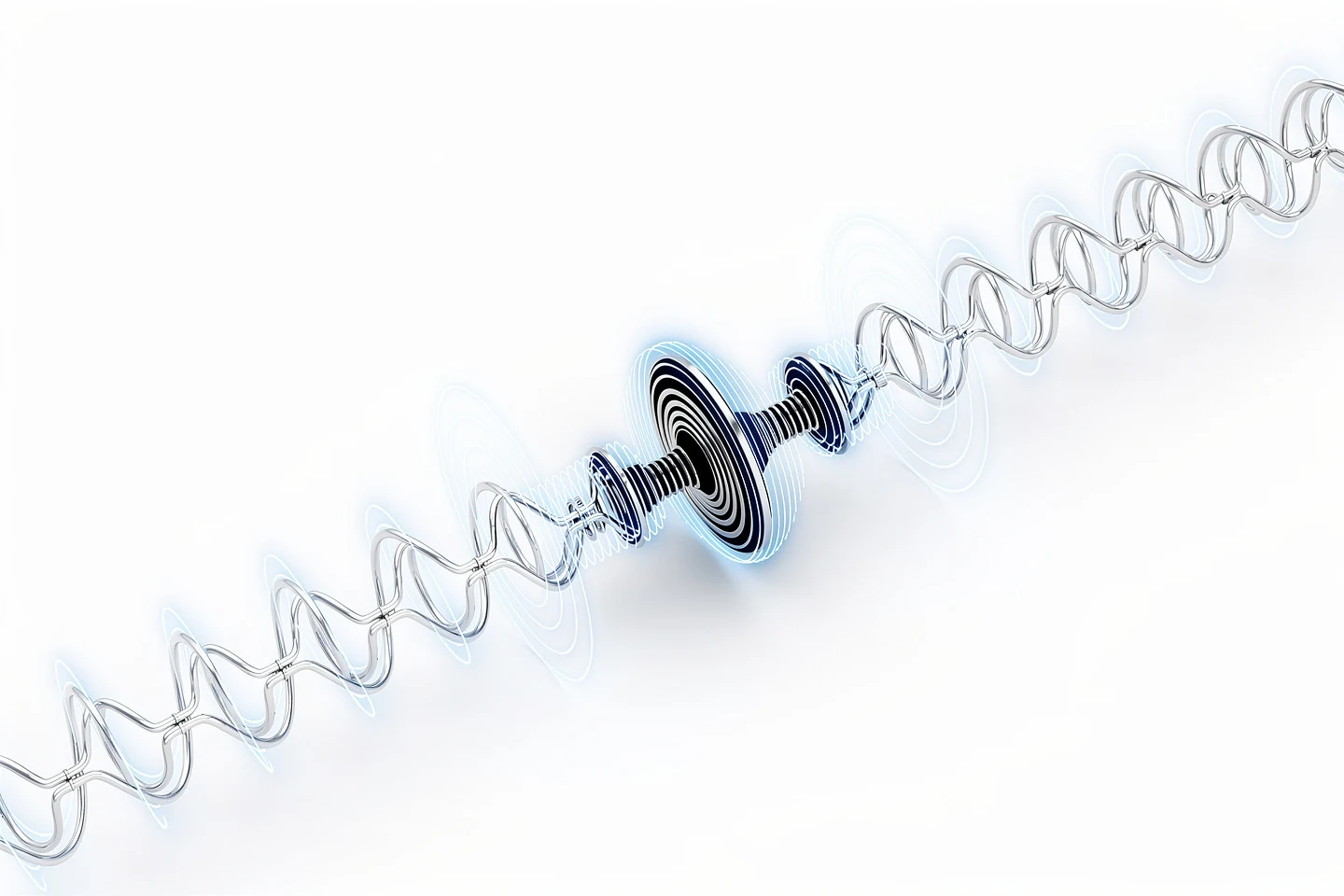
A black hole is a whirlpool that not even light can escape. Its event horizon has been recreated in a superconducting circuit, where components form a wave trap. Nearing the boundary, signals get stretched, and the flow of time slows down. Schwarzschild and Hawking explained the nature of such objects.

New research, using methods from Penrose and numerical simulations, showed that any disturbances in this trap do not grow but give rise to a ring – not a musical tone, but a muffled thud, like a stone plopping into water and instantly falling silent. Measuring this ring will let us “hear” curved spacetime and build quantum amplifiers, turning the lab bench into a proving ground for gravity theories.

And if you connect two such circuits, you get an analog of a wormhole—a tunnel through space, bringing physicists closer to unraveling quantum gravity.

🎯 The term “tortoise coordinates” was coined by Karl Schwarzschild to vividly describe how a falling object takes infinite time to reach the horizon.

🎬 Wormholes, familiar from the movie Interstellar, connect different regions of the Universe.

-\frac{d^2 H}{d\eta_*^2} + V(\eta_*) H = \epsilon^2 \Omega^2 H
H is the amplitude, V is the volcano-shaped potential sandwiched between horizons, η_* is the tortoise coordinate that stretches spacetime.
V = \frac{1}{\sqrt{v}} \frac{d^2 \sqrt{v}}{d\eta_*^2}
v(η_*) is the probe field’s speed; at the horizon it vanishes, and the potential disappears, leaving purely dissipative modes.
Scientists
Wolfgang PauliErwin SchrödingerPaul DiracStephen HawkingJacob BekensteinAlbert Einstein
Tags
black hole Wormhole superconductivity numerical simulation spacetime curvature Time dilation gravitational waves redshift
Laws
Pauli exclusion principleHawking radiationgravitational lensingBekenstein-Hawking entropyEinstein field equationsLorentz transformations
Original: arXiv:2605.11565v1 · CC BY 4.0 · bridge42worlds