A Drop Under an Invisible Finger express
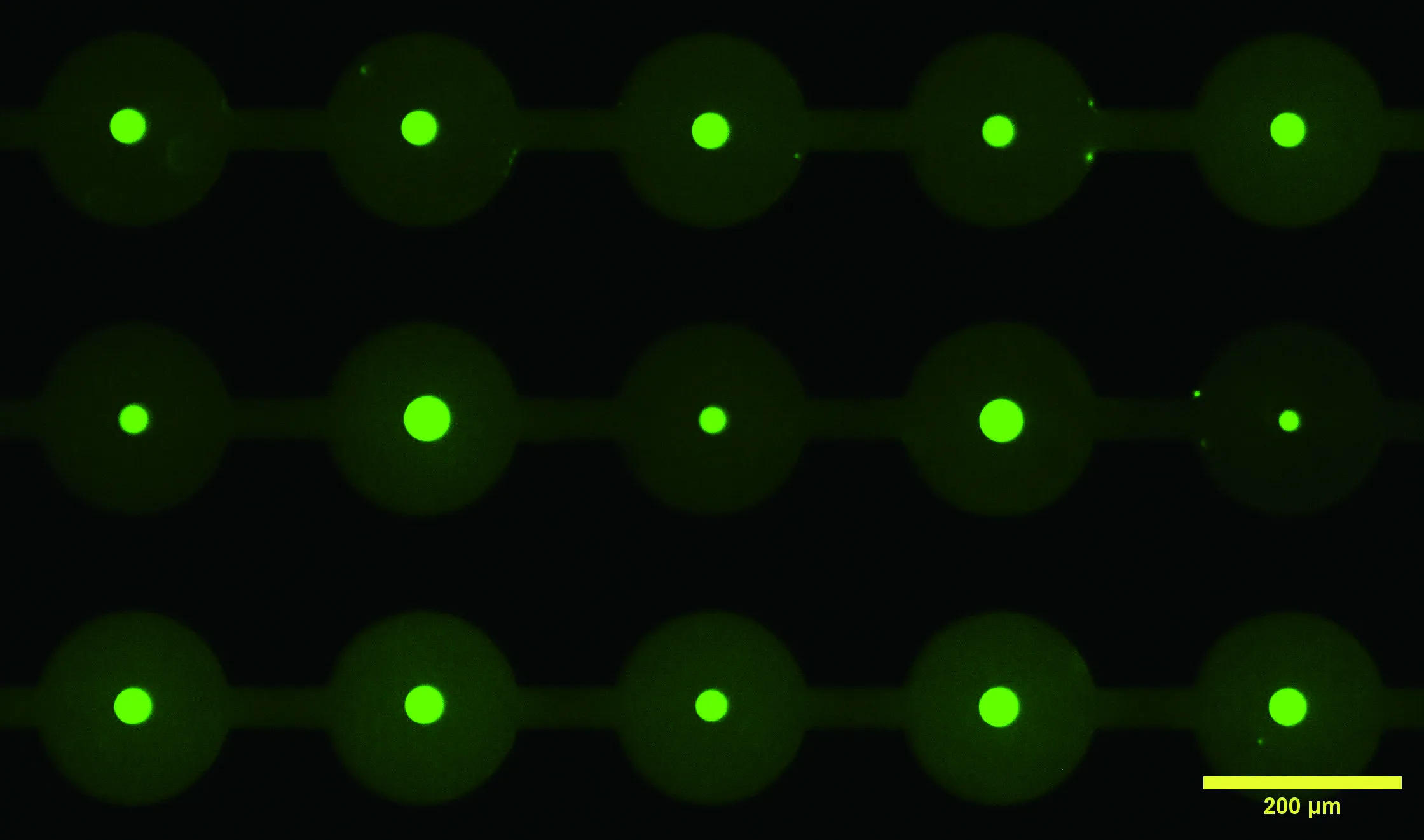
A drop of oil in a glass of water forms a sphere. Inside a living cell, a similar separation occurs, but instead of oil, proteins and nucleic acids form dense droplets — condensates. These droplets act as temporary workshops: they gather needed molecules, speed up reactions, and break apart when the task is done. If a workshop becomes too stiff or, conversely, too runny, the cell starts having problems. Such malfunctions are linked to Parkinson's and Alzheimer's diseases.
Measuring the elasticity of a single droplet a few hundredths of a millimeter across is nearly impossible. Standard instruments either poke it with a probe, damaging it, or mix in foreign marker beads that distort the picture. The new work offers a touch-free approach. The droplet is placed in a tiny acoustic chamber and irradiated with ultrasound. The sound wave presses on the droplet's surface like an invisible finger — squeezing and releasing it at rates from one push every hundred seconds to ten pushes per second.
By measuring how quickly the droplet recovers its shape after a push and how strongly it resists vibration, the device calculates its viscoelastic properties. Roughly speaking, it tells whether the droplet is more like thick honey or a soft gel. First, the method was tested on droplets of dextran (a sugar) in a polyethylene glycol solution — here, results matched what was already known. Then they moved to nucleic acid droplets and found that adding salt noticeably changes their internal stiffness. Previously, such subtle changes in a single droplet could not be detected.
The acoustic tweezer does not harm the droplet and requires no markers, so it can be applied to living cells and sensitive materials. This paves the way for high-throughput drug screening: one could quickly test how different substances affect the mechanics of cellular droplets and pick out those that restore healthy elasticity.
Original abstract
as written by the authors arXiv:2605.11660
The rheology of phase-separated condensates plays a central role in applications spanning advanced materials design and cellular processes, yet quantitative characterization of their viscoelasticity remains challenging due to the limitations of existing microrheological methods that require tracer particles or mechanical contact. Here, we establish tracer-free and contactless acoustic microrheometry as a versatile platform for quantifying the frequency-dependent complex shear modulus of single microscale condensates over 0.01-10 Hz. Using spatiotemporally controlled acoustic radiation force generated within a micro-acoustic resonator, this method deforms condensates for creep-recovery and oscillatory viscoelastic measurements. Quantitative validation using dextran condensates in a polyethylene-glycol continuous phase successfully captures their size- and frequency-dependent mechanical responses, while application to nucleic-acid condensates reveals salt-dependent internal viscoelastic changes at single-condensate resolution. By enabling quantitative dissection of condensate mechanics without invasive probes, acoustic microrheometry provides a broadly applicable framework for investigating phase-separated condensates across materials science, soft matter physics, biology, and beyond.
The largest cellular droplets, the nucleoli inside the nucleus, reach several micrometers and behave like elastic balls, but under stress they can 'melt' and spread out.
In Peter Watts's novel Blindsight, alien life does without cells, but its biochemistry still depends on phase separation — perhaps acoustic analysis could help humans understand its workings.