A Spiral of Magnet and Superconductor express
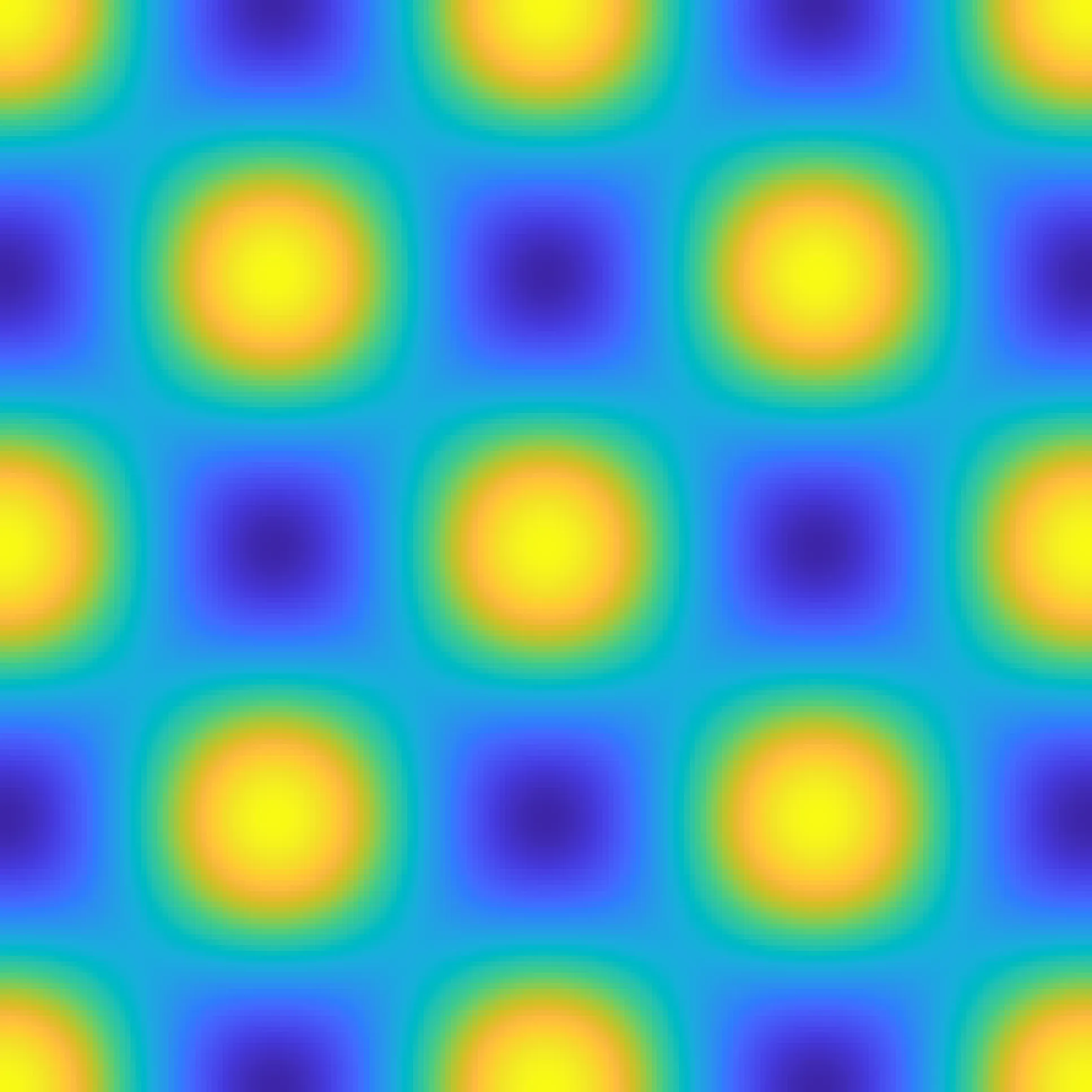
Inside the EuRbFe4As4 crystal, layers of iron and arsenic alternate with spacers of europium and rubidium. When cooled below 15 Kelvin (–258°C), europium atoms align their magnetic moments into a spiral: each successive layer is rotated by 90 degrees, like steps of a spiral staircase. It is in this state that the strange superconducting ripple is born: electron pairs, which usually carry current without resistance equally in all directions, here bunch into stripes along one direction.
The key lies in the iron layers. They are asymmetric: the iron atom lacks an inversion center, and electrons experience Rashba spin-orbit interaction. This is like a runner feeling a crosswind: their trajectory is slightly curved depending on the spin direction. The europium magnetic spiral acts as a rotating field, and together with the Rashba effect, it creates an effective gauge field for Cooper pairs (bound electrons). This field acts selectively: it affects only electrons with a certain orbital symmetry: those that resemble dumbbells oriented along the x and y axes.
This momentum shift gives rise to spatial modulation — the superconducting order parameter oscillates in space with a period of about 8 nanometers, matching experiment. Moreover, the theory predicts that spontaneous loop currents should flow between layers — tiny vortices that could be detected by muon relaxation or scanning SQUID microscopy. If found, this would be direct confirmation of the mechanism.
The magnetic ordering temperature of europium in this compound is only 15 Kelvin. That's colder than the average temperature on Pluto, which is about 44 K.