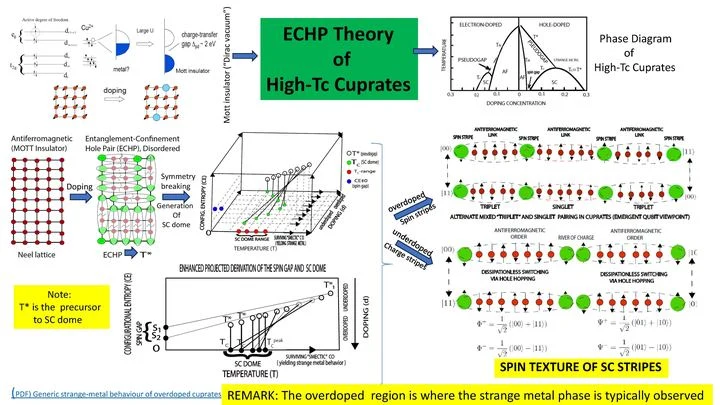
A Cooper pair is a bound state of two electrons with opposite spins (intrinsic angular momenta) and momenta, arising from phonon-mediated attraction in the lattice. The pairs behave as bosons (particles with integer spin) and condense into a single quantum state, giving rise to superconductivity.
History
In 1956, Leon Cooper showed that in a degenerate Fermi gas, arbitrarily weak electron-electron attraction leads to the formation of a bound state of two electrons — a Cooper pair. In 1957, John Bardeen, Leon Cooper, and John Schrieffer generalized this to a many-body system, creating the microscopic theory of superconductivity (BCS). The existence of pairs was experimentally confirmed through tunneling effects (Ivar Giaever, 1960) and direct observation of the superconducting gap in the spectrum.
How it works
A conduction electron moves in the crystal lattice and polarizes it, displacing positive ions from equilibrium. This creates a local excess of positive charge, which attracts a second electron. Due to the inertia of ions, the interaction is retarded, avoiding instantaneous Coulomb repulsion. In momentum space, the attraction is maximal for electrons with opposite wave vectors (k and –k) and antiparallel spins. According to the Pauli principle, two fermions cannot occupy the same state, but a pair with integer spin acts as a boson, obeying Bose-Einstein statistics. The spin-statistics theorem guarantees that Cooper pairs can accumulate in the ground state, forming a macroscopic quantum condensate. The binding energy of the pair determines the magnitude of the superconducting gap Δ, which protects the current from dissipation.
In practice
Without Cooper pairs, MRI and maglev trains would not work; they are the foundation of all superconducting electronics.
Fun fact
The size of a Cooper pair in classical superconductors is about 1000 interatomic distances; the electrons in a pair can be separated by hundreds of nanometers, interacting at a distance.
In a large hall, two tuning forks stand on rotating stands. Each is tuned to its own note, but if the stands are turned to the right angle, the forks begin to sound in unison, exchanging vibrations through the air.
A metal made of five different atoms is like a soup with bits of carrot, peas, potato, onion, and meat floating in it. Each bit is its own element: chromium, vanadium, titanium, niobium, and tantalum. Such an alloy is called high-entropy: there is no single order, and the atoms are mixed almost randomly.
Two dancers on one stage: the triangle and the stripe. In a quantum gas of dysprosium atoms cooled to 62 nanokelvin, these two spatial structures have met for the first time in a single experiment. The gas is held in a trap shaped like a surfboard, and its atoms are among the most magnetic in the periodic table.
In a narrow corridor, people walk in rows rather than as a crowd. The number of rows depends on the width of the passage. In graphene, this corridor is a quantum point contact — a constriction where electrons move ballistically without scattering.
At the Jefferson Lab accelerator, a beam of light strikes protons, and the collisions give birth to short-lived particles — omega mesons. They live for less than a billionth of a second, but they still manage to tell us about the forces inside the atomic nucleus.
A quantum spin liquid is a state of matter in which the magnetic moments of atoms behave like a fluid: they constantly fluctuate and never settle into a rigid order, even at extremely low temperatures. One of the most famous theoretical models of such a liquid was proposed by Alexei Kitaev.
A quantum spin liquid is a state of matter in which the magnetic moments of atoms behave like a fluid: they constantly fluctuate and never settle into a rigid order, even at extremely low temperatures. One of the most famous theoretical models of such a liquid was proposed by Alexei Kitaev.
Take two thin sheets of a semiconductor. One is saturated with free electrons, like a packed café where every table is taken. The other, by contrast, is full of empty spots—'holes' eager to be filled. When these sheets are brought close together, a spark of attraction jumps between them: electrons and holes begin to feel each other across the thin gap.
The wind carries pollen, and each grain moves as if on its own. But once the air swirls into a vortex, the pollen trajectories can no longer be separated: they are tangled. This is roughly how electrons behave in a strange metal: their motion is so strongly coupled to soft fluctuations of the medium that the usual particle carriers disappear.
At low temperatures, many materials become superconductors — current flows without resistance. But how exactly does this happen if electrons were initially trapped in an insulator? Half a century ago, Philip Anderson suggested that the answer lies in a special quantum dance of particles.
A superconductor is like a perfect wire — current flows through it with zero loss. The catch is that you have to cool it way down. Physicists have long hunted for materials that superconduct at more practical temperatures. One approach: don't wait for nature to oblige — build your own material, layer by layer, like a Lego set.
At low temperatures, many materials become superconductors — current flows without resistance. But how exactly does this happen if electrons were initially trapped in an insulator? Half a century ago, Philip Anderson suggested that the answer lies in a special quantum dance of particles.
Lossless current is the dream of energy technology. Some materials become superconductors, but usually only at extreme cold. Recently, in the family of nickelates, compounds based on nickel, candidates were found that work at higher temperatures.
Drop by drop from a faucet, or a steady stream without a single splash. That's roughly what the two regimes of current in a superconducting contact look like. Only here, the role of water is played by Cooper pairs — bound electrons that move without resistance.
Drop by drop from a faucet, or a steady stream without a single splash. That's roughly what the two regimes of current in a superconducting contact look like. Only here, the role of water is played by Cooper pairs — bound electrons that move without resistance.
In superconductors, electrons pair up and flow without resistance. Usually, these pairs are distributed uniformly, like water in a calm lake. But sometimes ripples appear in the material — pairs bunch up and thin out with a certain period. This state is called superconductivity with pair-density waves.
Electrons in a solid usually either run freely (metal) or are locked in place (insulator). But sometimes strong mutual repulsion locks them into a halfway state: charges stand still, while spins, tiny magnetic arrows, continue to live their own life. This is called a Mott insulator.
Honeycombs filled with electronic 'honey.' In the normal state, electrons move chaotically, but upon strong cooling they can pair up: this is how superconductivity emerges. The shape of these pairs, or pairing symmetry, determines the material's properties: some dance a waltz, others a foxtrot.
Imagine trying to overhear a whisper between two people in a noisy hall. That's roughly the challenge physicists face when they want to understand how electrons pair up inside a superconductor. And if the "hall" is also squeezed by a giant press to pressures of hundreds of thousands of atmospheres, the task seems impossible.
The authors of the new study found an ingenious solution.
A magnetic field of 42 tesla — about a million times stronger than Earth's field. In such a field, the crystal SrCu₂(BO₃)₂ behaves unusually: its magnetization doesn't increase smoothly but in jumps, pausing at specific values.
A thin film of a special crystal (for instance, molybdenum disulfide) sits on a microscope stage. The temperature is just above the point where the material becomes a superconductor.
Superconductivity is often pictured as a frozen dance of electrons: they pair up and move without resistance, like figure skaters on perfect ice. But in high-temperature superconductors, that ice turns out to be not so smooth.
Light hits an organic molecule, and inside, a pair of twin excitations is born. They're called triplet pairs. In single pentacene molecules, such pairs have long been known to share their energy with neighbors: this is the basis of singlet fission, which boosts the efficiency of solar cells.
The heart sometimes loses its rhythm, like an orchestra where the violins suddenly start playing each on their own. Cardiologists in such cases look for the "out-of-tune" areas by reading the heart's electrical signals and precisely ablating them with a thin probe — a catheter.
In boiling water you can see a prototype of a quantum trick: if part of the liquid turns into long-lived vapor bubbles, the main mass cools down. This is exactly what happens when you sharply jolt a system of interacting electrons: doublons flare up — pairs of particles that absorb excess energy and don’t decay for an astonishingly long time.
A tiny crystal of charged atoms, trapped in a trap, trembles with heat. Each ion oscillates like a ball on a spring, and these vibrations hinder using the crystal for precise quantum operations. Usually, excess energy is removed with a laser — the beam hits the ions and slows their motion, like a stream of air damping a pendulum.
In a long corridor, a crowd of people tries to keep as far apart as possible. In a spacious hall, they would simply spread out, but here the walls squeeze them so tightly that they have to move single file, coordinating every step. Electrons in graphene layers twisted by a tiny angle behave in a similar way.
A quantum computer is like an orchestra where each musician, a qubit, must play their part accurately and on time. Usually, musicians are seated in fixed positions and connected by conductors' consoles. But what if we let them move freely across the stage and turn the movement itself into part of the music?
A superconductor is like an ideal highway with no traffic lights: electrons race along without hindrance. But apply a voltage, and the picture changes. In a new experiment, physicists found that an electric field penetrates the superconductor and creates a mixed regime inside.
Usually, superconductivity is a story about cold. The lower the temperature, the easier it is for electrons to pair up and flow without resistance. But in a new study, physicists grew thin films of nickelates doped with europium and saw the opposite picture.
A thin film of yttrium barium copper oxide warms under a stream of infrared light, and suddenly stops dissipating energy. That's superconductivity: electrons pair up and move as a single quantum swarm. But in underdoped samples, the harmony breaks long before the pairs fall apart. The pairs are there, but the collective rhythm isn't.
The quantum world is full of surprises. In a Kerr parametric oscillator, a device where light is trapped in a ring and driven by an external field, researchers recently noticed something strange: pairs of energy levels merge in an embrace. Physicists have dubbed this a "spectral kiss" spectroscopy.
At accelerators, by smashing heavy nuclei, physicists briefly create a quark-gluon plasma — a state of matter where quarks and gluons are not confined inside particles but are free. For a long time, it was imagined as a gas, but experiments showed it's an almost perfect liquid.
In some materials, electric current can flow without any loss: this is superconductivity. But before becoming a superconductor, a substance often passes through a strange state: electrons already sense each other and form pairs, yet they cannot move in unison.
Three dancers move as one: each feels all the others, and the overall harmony cannot be reduced to individual interactions. This is roughly how three particles behave, born from an electron and positron collision at the speed of light. They are a top quark, its antiparticle, and a Z boson.
Using laser spectroscopy — a method akin to listening to the echo from a crystal — physicists examined the layered material. They found regions where electrons move freely (Fermi pockets) and noticed that each such region behaves in its own way.
Superconductors conduct current without loss, but usually require extreme cold. Hg1223 — a mixture of mercury, barium, calcium, copper and oxygen — breaks the rule: it stops resisting current already at –139°C. The secret is that the strong electrical repulsion between electrons forces them to pair up.
Electrons in a conductor are like a chaotic crowd: colliding, they lose energy, and resistance arises. In a superconductor, however, they move in unison, like partners in a well-coordinated dance, without touching each other. This state has reduced энтропией — meaning disorder.
Such behavior is rare for gold and copper.