Electron pairing is the quantum phenomenon where two electrons, which normally repel each other due to their negative charges, form a bound state that behaves as a single particle. This pairing is the foundation of conventional superconductivity, where a material conducts electricity with zero resistance below a critical temperature. The pairs, known as Cooper pairs, have integer spin and thus behave as bosons, allowing them to condense into a single quantum state that can carry current without scattering. Electron pairing also plays a role in other phenomena, such as superfluidity in certain fermionic systems and the formation of polarons in solids.
History
The concept was introduced by Leon Cooper in 1956, and it was immediately incorporated into the BCS theory of superconductivity by Bardeen, Cooper, and Schrieffer in 1957, which earned them the Nobel Prize in Physics in 1972.
How it works
In a conventional superconductor, an electron moving through a crystal lattice attracts the positively charged ions, creating a slight distortion. A second electron is then drawn to this region of positive charge, effectively forming a pair mediated by lattice vibrations (phonons). The pairing is strongest when the electrons have opposite momenta and spins, as this minimizes the energy cost. Once paired, the electrons are no longer subject to the same scattering processes that cause resistance, because the collective condensate is rigid against perturbations. The energy gap between the paired state and unpaired electrons protects the superconducting state.
In some exotic materials, electrons can form not just pairs but quartets, as observed in certain iron-based superconductors, challenging the standard BCS picture.
At low temperatures, many materials become superconductors — current flows without resistance. But how exactly does this happen if electrons were initially trapped in an insulator? Half a century ago, Philip Anderson suggested that the answer lies in a special quantum dance of particles.
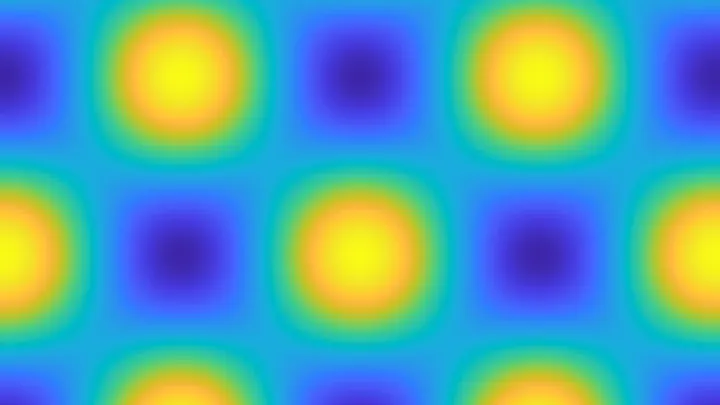
In superconductors, electrons pair up and flow without resistance. Usually, these pairs are distributed uniformly, like water in a calm lake. But sometimes ripples appear in the material — pairs bunch up and thin out with a certain period. This state is called superconductivity with pair-density waves.
An electron and its antiparticle — the positron, predicted by Дираком, — upon meeting, momentarily form позитроний: a tiny pair circling each other, like in an atom but without a nucleus. Almost instantly it decays, emitting two photons that turn out to be mysteriously linked.
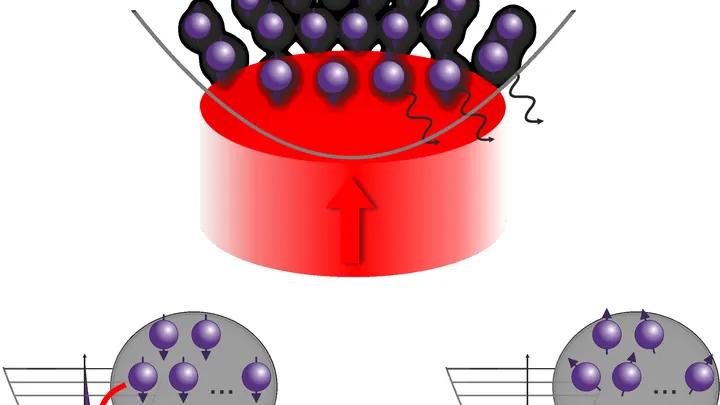
A tiny crystal of charged atoms, trapped in a trap, trembles with heat. Each ion oscillates like a ball on a spring, and these vibrations hinder using the crystal for precise quantum operations. Usually, excess energy is removed with a laser — the beam hits the ions and slows their motion, like a stream of air damping a pendulum.
A lone potassium atom enters a dense cloud of sodium atoms cooled to near absolute zero. Such a medium is called a Bose–Einstein condensate — all particles merge into a single quantum wave. One might expect the impurity to simply pick up a single neighbor and form a pair. But the experiment showed something else.
The quantum world is full of surprises. In a Kerr parametric oscillator, a device where light is trapped in a ring and driven by an external field, researchers recently noticed something strange: pairs of energy levels merge in an embrace. Physicists have dubbed this a "spectral kiss" spectroscopy.
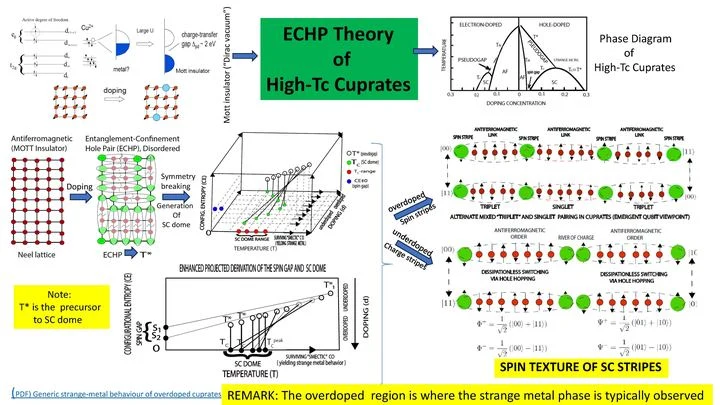
In some materials, electric current can flow without any loss: this is superconductivity. But before becoming a superconductor, a substance often passes through a strange state: electrons already sense each other and form pairs, yet they cannot move in unison.
Using laser spectroscopy — a method akin to listening to the echo from a crystal — physicists examined the layered material. They found regions where electrons move freely (Fermi pockets) and noticed that each such region behaves in its own way.
Inside the EuRbFe4As4 crystal, layers of iron and arsenic alternate with spacers of europium and rubidium. When cooled below 15 Kelvin (–258°C), europium atoms align their magnetic moments into a spiral: each successive layer is rotated by 90 degrees, like steps of a spiral staircase.
The dance floor is full of couples waltzing. Usually, partners move in opposite directions: one steps forward, the other backward, to keep the overall rhythm.
Imagine a line of people holding hands but facing in opposite directions: some look north, others south. That's how a p-wave magnet is arranged. Electrons in it align their magnetic moments (spins) not randomly but in a strict wave-like pattern.
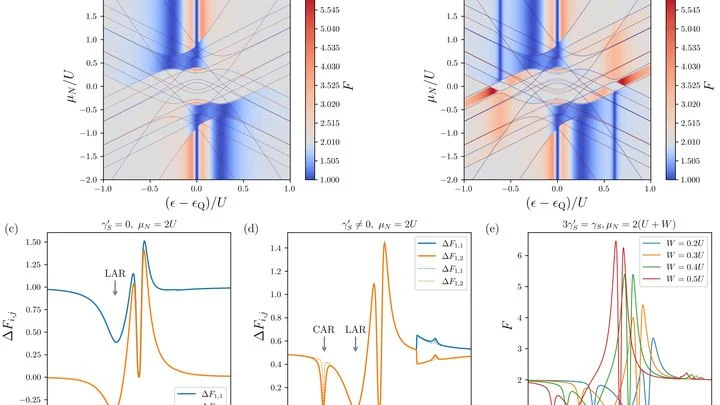
In the world of superconductors, electrons don't like to be alone. They typically pair up into Cooper pairs and move without resistance, like figure skaters holding hands. But you can make them dance in fours. The authors of this work propose a scheme where Cooper quartets, groups of four electrons exchanging partners in a rapid rhythm, are born.
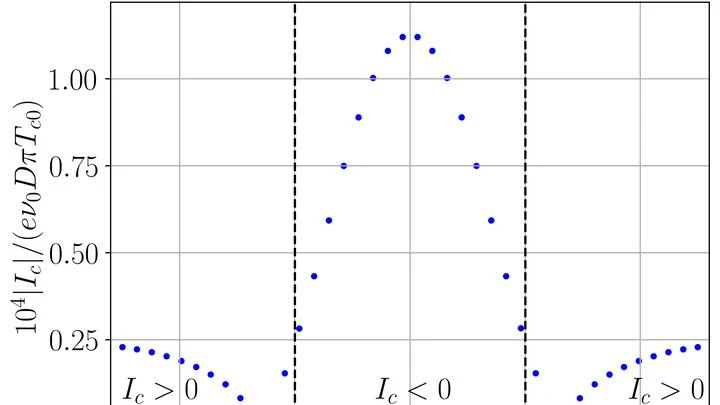
Two superconducting banks are connected by a bridge of magnetic material. Inside the bridge lies a domain wall: a narrow boundary where the magnetization rotates, like a column of soldiers changing their marching direction.
In a dark room, an infrared laser flashes, and a speck of black K3C60 powder conducts electricity without resistance for a split second. The light strikes at 10 terahertz — a thousand times faster than a microwave oven. The effect is a hundred times stronger than at other frequencies. Why this particular frequency?
An ordinary superconducting qubit is like a swing that any gust of wind can set rocking. The slightest change in electric charge nearby, and the quantum state is already spoiled.
A uranium crystal the size of a grain of rice was cooled to one-fiftieth of a degree above absolute zero. At such temperatures, heat is not transported chaotically but strictly according to the rules of the quantum world.
In two-dimensional crystals, electrons and holes, quasiparticles corresponding to the absence of an electron and carrying positive charge, attract each other, forming bound pairs called excitons. When cooled strongly, as thermal fluctuations die down, the motions of many excitons can synchronize, like a coordinated dance.
Two tiny emitters, each about the size of an atom, can together do what neither can do alone. We're talking about light scattering — when light hits particles and bounces off in all directions. Usually, a pair of particles scatters light only slightly more than a single one.
Certain materials, near absolute zero, superconduct: electricity flows without loss. The critical temperature starts this. John Bardeen and colleagues explained that atomic vibrations glue electrons into Cooper pairs.
A thin film of indium arsenide on an insulating substrate behaves like a double-walled thermos: the electrons inside barely give off heat to the surrounding crystal. In an ordinary metal, electrons quickly exchange energy with atomic vibrations, so their temperature is always close to that of the sample.
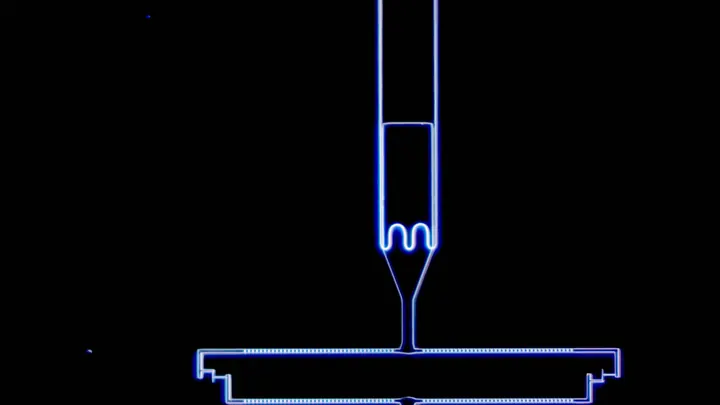
A superconducting qubit is a tiny electrical circuit that behaves like an artificial atom. In its normal state, current flows through it without resistance, and the energy levels are evenly spaced, like steps on a staircase. But if a single electron gets stuck in the circuit, everything changes.
A magnesium oxide crystal is like a row of soldiers: atoms stand in neat lines, and an electron runs along them. But if the electron lingers, the nearest atoms shift slightly from their positions, like neighbors in a rank turning their heads. The electron finds itself in a dip made of displaced atoms and can no longer move freely.
Dark matter is the invisible scaffold of the cosmos, its existence betrayed by whirls of galaxies to Fritz Zwicky and Vera Rubin. What it is made of remained a mystery for half a century.
A new hypothesis paints an unusual picture.
Ordinary wires: electrons jostle, lose energy, and heat up: that's resistance. In superconductors, some electrons pair up in sync, like dancers swirling without collisions. But these pairs hide: you can't see them directly, only infer their presence from flawless coordination.
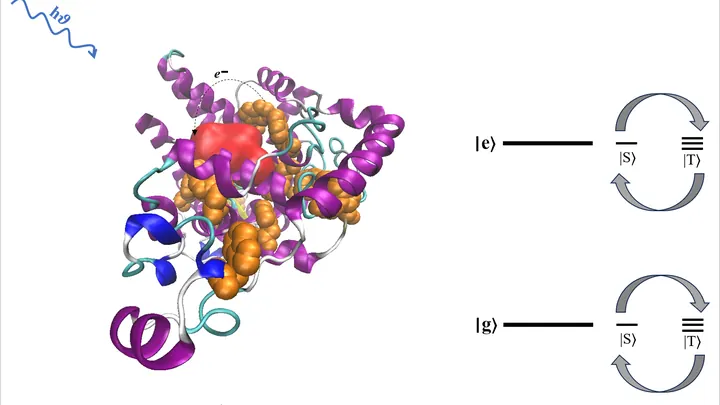
Birds migrate using the magnetic field. In their eyes, there's a protein called cryptochrome. It captures sunlight, especially blue light, and triggers a reaction. Absorption of light leads to the formation of a particle pair that is acutely sensitive to magnetic fields.
In 1976, Gerard 't Hooft noticed that the vacuum of a gauge theory is not as simple as it seems: it possesses a topological structure that manifests itself in a nonzero topological susceptibility.
A drop of ink in a glass of water quickly spreads, tinting the whole liquid. Similarly, electrons in a metal move freely, like molecules in a gas. But when a magnetic impurity, an atom with its own magnetic moment, enters this medium, something strange happens.