Scientist

Augustin-Louis Cauchy

1789–1857 · mathematics, mathematical analysis, complex analysis, mechanics
Augustin-Louis Cauchy was a French mathematician who transformed analysis from an intuitive art into a rigorous science. He gave precise definitions of limit, continuity, and derivative, built the foundations of complex analysis, and left a mark on mechanics and elasticity theory. In terms of the number of theorems named after him, he has no equal.

Biography

Born in Paris at the height of the Revolution, studied at the École Polytechnique and the School of Bridges and Roads. He was a professor at the École Polytechnique, the Sorbonne, and the Collège de France. After the July Revolution, he voluntarily went into exile, worked in Turin and Prague, but later returned. Knight of the Legion of Honour.

Key discoveries

💡 Cauchy's incredible prolificness is legendary: he wrote about 800 articles, and the Paris Academy had to limit the volume of publications because the budget could not withstand the printing of his endless works. It is said that his last words were: "Man passes away, but the formulas remain."
"He held that a man should not be proud of what he knows, but proud of what he does."
Concepts
limiteigenvalue
Laws
law of conservation of momentum

Related articles

The String Theory Swampland: Why de Sitter Vacua Don't Live Here
The universe is expanding faster and faster, and the standard explanation is a positive cosmological constant, that is, a de Sitter vacuum. String theory, which aspires to be the theory of quantum gravity, should be able to describe such a vacuum, but after decades of effort, no reliable construction has emerged.

Five Questions Physics Asks Philosophy
At night, an astronomer points a telescope at the edge of the visible universe and sees not stars but ripples — the imprint of the first moments. He knows these ripples should obey statistics, like the heights of people in a crowd. But he has only one crowd, and nothing to compare it with. This is cosmic variance.
Cosmic Tango: How Spins Dance with Dark Matter
Among the fundamental symmetries of nature, mirror parity holds a special place. The Standard Model already knows one violation of it, in the weak interaction, but hypothetical long-range forces that don't conserve left and right could reveal a lot about dark matter.
Quantum Physics2025-06-031 minarXiv:2506.02637express
Pilot droplets: a new look at quantum reality
In the quantum world, particles do not have precise properties until they are measured. The official model refuses to explain what lies behind this uncertainty. But the idea that invisible 'pilots' control particles has been around since the 1920s.
Galaxies2025-07-283 minarXiv:2507.20684
Levitating Nanospheres Catch Dark Matter Recoils
A silicon sphere 166 nanometers in diameter floats in a beam of infrared laser light. The pressure is below 10⁻⁸ mbar, and the motional temperature is about 10 millikelvin. That is colder than the cosmic microwave background.
Dust Veil Over the Beacon at the Heart of SN 1987A
At the center of the supernova remnant SN 1987A, 168,000 light-years from Earth, hides an object that astronomers have been seeking for 37 years. This is the closest supernova to have exploded in front of modern telescopes, and the only one where the compact remnant has yet to be seen directly.
Quantum Clamp: Film Thickness Rewrites the Pauli Limit
A magnetic field of 8 tesla is 200 times stronger than Earth's field. Under such a field, superconductivity in a thin film of palladium ditelluride not only survives but persists down to 20 millikelvin, which is a hundred times colder than outer space. For comparison, a thick film of the same material has a critical field 80 times smaller.
Stellar2025-08-253 minarXiv:2508.18348
The Coil That Wraps Itself
At 78 K, a crystal of Mn₃Si₂Te₆ turns into an inductor that needs neither copper wire nor a superconductor. The electrons inside it spontaneously organize into closed vortices with a definite sense of rotation: chiral orbital currents.
Strings That Don't Snap Right Away
A stretched string between two quarks doesn't pop instantly like a rubber band. It first vibrates, develops knots, and only then breaks, if it breaks at all. This isn't just a metaphor; it's an accurate description of what physicists call confinement: quarks are permanently locked inside hadrons, and the only way to separate them is to snap the flux tube that binds them.
Galaxies2025-09-122 minarXiv:2509.10615
The Invisible Janitor at the Heart of the Milky Way
At the center of the Milky Way, 27,000 light-years from Earth, lives the supermassive black hole Sagittarius A*. It weighs in at four million Suns. It does not flare brightly like quasars; instead, it smolders almost imperceptibly. For a long time, astronomers debated whether it blows a wind. Now we have the answer: it does.
Galaxies2025-09-182 minarXiv:2509.14983
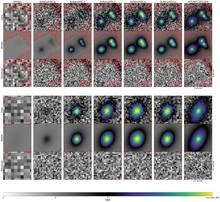
A Cosmic Magnifying Glass with an Invisible Handle
The light from a distant galaxy split into two, then three, then four, and in the center a fifth ghost appeared. That is HerS-3: a young galaxy full of dust and newborn stars, whose light passed through a gravitational lens, a massive object that bends rays like a magnifying glass bends light.
Noise as an X-ray: How Hidden Triplet Superconductivity Emerged at a Superconductor-Iron Interface
Run a current through a contact between a superconductor and a ferromagnet, and you will hear the whisper of the quantum world. In the lab at 0.3 K, that whisper turned into a roar: the shot noise—electrical noise due to the discreteness of charge—was a hundred times louder than theory allows for ordinary contacts.
Red Dots as Gravastars: A Birth Mechanism
The James Webb Space Telescope has spotted a scattering of compact objects in the early universe, nicknamed 'little red dots.' They are too red and too dim to be ordinary quasars, and astrophysicists are scratching their heads over what powers them.
Cosmology2025-10-081 minarXiv:2510.07382express
Invisible Object Weighing a Million Suns: Gravity Acts as a Magnifying Glass
Astronomers have found an invisible object in the Universe weighing just a million Suns — for cosmic scales, that’s a mere trifle, a hundred times lighter than anything they’ve been able to “weigh” at such distances. The object itself doesn’t shine, but it gave itself away by bending the light from an even more distant galaxy.
Galaxies2025-10-091 minarXiv:2510.08684express
The Milky Way's Dark Halo is Flattened and Twisted
The Milky Way's stellar disk is like a glowing pinwheel, and тёмное вещество is an invisible cloud around it. For the first time, its shape has been precisely measured. Astronomers tracked the motions of millions of stars and built a 3D map of the тёмное гало out to 160,000 light-years.
Galaxies2025-10-131 minarXiv:2510.11006express
Dark Matter: An Invisible Web Explains Three Mysteries
As early as Vera Rubin found that stars on the outskirts of galaxies move too fast — as if held by an invisible web. And Fritz Zwicky was the first to suspect that clusters of galaxies hide enormous invisible mass. Today we call it dark matter and try to understand what it's made of.
Quantum Physics2025-10-131 minarXiv:2510.12017express
Glowing Atoms Create a Nearly Perfect Engine
Atoms, like a swarm of fireflies, shine in unison. When they flash together, the light multiplies — a hundred atoms shine ten thousand times brighter than one. Physicists have turned this trick into a heat engine. A typical motor needs both a hot and a cold source, but here the atoms operate with just a cold one.
Quantum Physics2025-10-301 minarXiv:2510.26605express
Cosmology2025-10-312 minarXiv:2510.27416express
Earth's Gravitational Lens: Hunting Axions in the Focus of Spacetime
Dark matter is the invisible scaffold of the Universe, revealing itself only through gravity. Vera Rubin, studying the rotation of galaxies, found that stars at the periphery move too fast, as if held by an unseen mass. This became compelling evidence for the existence of dark matter, yet its particles still elude direct detection.
Quantum Physics2025-11-031 minarXiv:2511.02125express
Quantum Computer Reveals Hidden Electron Pairs in Materials
Ordinary wires: electrons jostle, lose energy, and heat up: that's resistance. In superconductors, some electrons pair up in sync, like dancers swirling without collisions. But these pairs hide: you can't see them directly, only infer their presence from flawless coordination.
Quantum Gases2025-11-041 minarXiv:2511.02218express
Quantum Patterns from Chaos: How Disorder Gives Birth to Solid Flow
The Penrose tiling, assembled from two types of tiles, covers a plane without a repeating pattern — a mathematical marvel discovered by Roger Penrose that has found physical embodiment in the quantum world. Researchers modeled a chain of particles interacting according to a rule reminiscent of Fibonacci numbers and the golden ratio.
Materials2025-11-131 minarXiv:2511.10160express
Cosmology2025-11-171 minarXiv:2511.13220express
How Dark Matter Influences the Rhythm of Cosmic Collisions
Particles of dark matter can behave like molasses: in one model they don't interfere with each other; in another, they gently jostle, creating viscosity. This determines how quickly giant black holes at the centers of galaxies fall into each other and merge.
Galaxies2025-11-171 minarXiv:2511.13708express
Why 'impossible' galaxies don't break cosmology
When Edwin Hubble discovered the expansion of the universe, and Vera Rubin discovered dark matter, the framework of cosmology seemed solid.
General Relativity2025-11-241 minarXiv:2511.19606express
Ghost Stars as Precise Cosmic Clocks
Scientists have described a new type of invisible star that behaves like a breathing lens. Such a star is made of ultralight boson particles (not yet discovered). Its gravity causes spacetime curvature — this is the lens, which rhythmically expands and contracts, as if breathing.
General Relativity2025-11-241 minarXiv:2511.19736express
The Mystery of Massive Early Galaxies: A Solution in Motion
On a high-speed highway, a steady flow of cars sometimes clumps into a traffic jam because of random slowdowns. In the young Universe, the overall expansion of galaxies after the Big Bang resembled this orderly movement. But each galaxy also performed its own maneuvers — braking or accelerating under the pull of neighboring galaxies.
General Relativity2025-11-271 minarXiv:2511.22276express
How a Black Hole Splits Light by Polarization
A black hole doesn't just suck in matter — like a giant cosmic whirlpool, it warps the very fabric of reality and bends light rays around itself, focusing them. The effect is even stronger for black holes that spin at nearly the speed of light: their rotation twists space into a tight spiral.
Cosmology2025-12-031 minarXiv:2512.03357express
Invisible Vortices of Dark Matter
Dark matter is an invisible ocean that, as shown by observations by Vera Rubin, keeps stars in galaxies from flying apart. Physicists suspect that if dark matter consists of ultralight particles, in the cosmic cold it turns into a frictionless fluid — a so-called condensate.
Cosmology2025-12-031 minarXiv:2512.04061express
Dark Stars: First Light from Invisible Matter
After the Big Bang, the universe was hot and dense. In clumps of dark matter, invisible stuff felt only through gravity, its particles, colliding, annihilated, giving birth to powerful radiation. This hidden heat, like an invisible furnace, warmed gas clouds from within.
Quantum Physics2025-12-281 minarXiv:2512.23119express
Superconducting Resonators: Small Current, Big Effect
A superconducting circuit is like a frictionless swing, only possible at temperatures of liquid helium (–273 °C). In such cold, electric current runs in a loop without fading, keeping its rhythm.
Galaxies2025-12-311 minarXiv:2601.00044express
Mysterious Red Dots: How Dark Matter Hides Growing Galaxies?
The James Webb telescope spotted “red dots” in the early Universe — dense objects tens of light-years across. Spectroscopic analysis of their light revealed the hue of hydrogen. Yet in X-rays they are nearly invisible, like a powerful spotlight wrapped in layers of gas curtains.
Exoplanets2025-12-311 minarXiv:2601.00057express
A Cosmic Wanderer Steps on the Scales for the First Time
In the darkness of interstellar space drift millions of rogue planets — worlds not bound to any star. They are almost impossible to see, but when such a wanderer passes in front of a distant star, its gravity bends the light and momentarily creates a cosmic magnifying glass.
Cosmology2026-01-011 minarXiv:2601.00443express
Dark Matter Gave Rise to Galactic Magnetic Fields
Without the invisible framework of dark matter, galaxies would fly apart. Astronomer Vera Rubin proved back in the 1970s that stars rotate as if held by an unseen mass. But new research shows it's not just passive ballast.
How to Make Light Late
Mass curves spacetime like a heavy stone pressing into an asphalt road. Light passing by skirts around this dent, its path lengthens, and it arrives late. Astronomers have observed this Shapiro effect many times near the Sun and planets. A new plan proposes to recreate this delay on a lab bench.
Quantum Physics2026-01-012 minarXiv:2601.00483express
Levitation on Quantum Glue: The Casimir Effect in Action
The space between two closely spaced surfaces is far from empty: it's a seething "quantum glue." Within it, quantum fluctuations continuously pop in and out of existence: microscopic bursts of energy in electromagnetic fields that, according to quantum theory, give the vacuum a dynamic structure.
Nuclear Theory2026-01-021 minarXiv:2601.00534express
Proton smashes into deuteron: how speed changes the rules
A proton slams into a deuteron — a tiny bundle of a proton and a neutron. In the past, such collisions were described by equations where time flows the same for everyone, as in everyday life. But when particles are accelerated to near-light speeds, time slows down for them and lengths contract. It's like two runners on a track measuring the distance with different rulers.
Superconductivity2026-01-021 minarXiv:2601.00723express
Superconductivity and 'liquid-crystal' electrons
In the TiSe2 crystal, electrons behave like compass needles that suddenly start pointing in the same direction. This is called a nematic state — by analogy with liquid crystals, where molecules align along a common direction even though the material itself remains liquid.
Superconductivity2026-01-021 minarXiv:2601.00931express
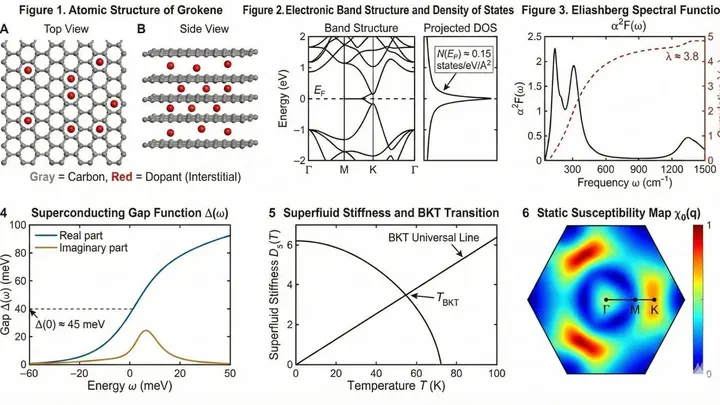
Grokken: The Graphene That Promises Room-Temperature Superconductivity
Graphene is a sheet of carbon just one atom thick. Fold it in a special pattern and you get a new material — grokken. It wasn't a human who found it, but an AI: a large language model sifted through possibilities and proposed exactly this lattice.