Rubidium-87 (⁸⁷Rb) is a stable isotope of the alkali metal rubidium, with 37 protons and 50 neutrons. It is one of the most widely used atomic species in cold atom physics and quantum optics. Its popularity stems from a combination of properties: it has two hyperfine ground states that are convenient for laser cooling, a relatively simple energy level structure, and a favorable wavelength for diode lasers (780 nm). These features make it an ideal workhorse for experiments that require trapping and manipulating atoms at microkelvin temperatures.
History
Rubidium-87 was first laser-cooled and trapped in the late 1980s, following the development of laser cooling techniques by Steven Chu, Claude Cohen-Tannoudji, and William Phillips. The first Bose-Einstein condensate in 1995 was created using rubidium-87 by Eric Cornell and Carl Wieman.
How it works
Rubidium-87 atoms are cooled using laser cooling techniques such as magneto-optical traps (MOTs). The atoms absorb and re-emit photons, losing momentum with each cycle, which reduces their kinetic energy. Because ⁸⁷Rb has a closed cycling transition (the D2 line at 780 nm), a single laser frequency can repeatedly scatter photons without the atom falling into a dark state. Its large hyperfine splitting (6.8 GHz) allows for efficient optical pumping and state manipulation, which is essential for creating Bose-Einstein condensates and for quantum information experiments.
In practice
Rubidium-87 is used in atomic clocks (including GPS satellites), quantum computing research, atom interferometers for precision measurements, and tests of fundamental physics.
Fun fact
The first Bose-Einstein condensate ever created in a laboratory (in 1995) was made from rubidium-87 atoms cooled to 170 nanokelvin, colder than the space between stars.
The neutron is a particle that usually sits in the atomic nucleus and doesn't disappear. But some theories suggest that occasionally it might transform into its invisible twin — a particle that ordinary detectors can't catch.
No one has ever seen dark matter, but it should pass through detectors like wind through leaves. Sometimes, very rarely, a dark matter particle bumps into an atomic nucleus, and then the detector must catch that jolt. The trouble is that light dark matter particles can hardly move heavy nuclei: it's like trying to knock down a bowling pin by throwing a feather at it.
Rydberg molecules are like a pair of dancers holding hands at arm's length. One partner is an ion, the other is an atom, and the bond between them is as weak as an invisible thread. Such a pair can exist for only an instant, but that instant stretches into microseconds — an eternity by the standards of the microworld.
The atomic nucleus is not a bag of marbles but an ordered structure where protons and neutrons fill shells, much like electrons in an atom. When a shell is filled, the nucleus becomes especially stable, and the number of particles is called magic. For calcium with 20 protons, the classic magic neutron numbers are 20 and 28.
An extra electron in a molecule is like a passenger barely hanging onto the step of a departing train. Such a 'passenger' turns the particle into an anion — a negative ion. Studying it is tough: the bond is weak, the electron cloud is diffuse, and any jolt can knock the electron off.
At the center of every atom lies a nucleus — a dense ball of protons and neutrons. These particles don't just crowd together randomly; they fill strict energy levels, much like floors in a skyscraper. When a floor is completely filled, the nucleus becomes especially stable — physicists call this a magic number.
Light in an optical fiber runs along the core, barely escaping outside. But if you get very close, you can feel a faint trembling of the field at the surface — the evanescent wave. It is in this 'light fog' above the surface of a tiny silicon ring that physicists have caught a single rubidium atom.
Tiny magnets inside atoms, nuclear spins, can 'freeze' for long minutes in a cold crystal. This hinders the quick tuning of quantum sensors: everything takes too long to reach the desired state. Physicists have found a way to nudge them with light.
A laser is tuned to a frequency at which a rubidium atom normally does not get excited. But if an excited atom is already nearby, it shifts the energy levels of its neighbor, and the neighbor starts absorbing light. So the pair of atoms acts like a duo: one helps the other light up.
An ordinary kitchen knife made of niobium would suddenly start conducting electricity with zero loss at −258 °C. That's how superconductivity works, and you can "switch it on" right at the metal's surface by blasting it with a laser in a nitrogen atmosphere.
Inside the Sun, invisible nuclear transformations occur every second. One of them is the birth of boron-8: a beryllium-7 nucleus captures a passing proton and momentarily becomes a new element. This step kicks off a chain that ends with the emission of a neutrino — a particle capable of passing straight through Earth.
A solid electrolyte is like a sponge for lithium ions. In a regular lithium battery, ions float in a liquid, like fish in an aquarium. In a solid-state battery, they have to squeeze through the crystal lattice, like through narrow corridors.
Light enters a tiny cavity with mirrored walls and hits an erbium atom hidden in a crystal. The atom absorbs the light and flips its nucleus into another state, like a toggle switch that clicks when pressed. But this switch is not ordinary: it obeys the laws of the quantum world and can be in two positions at once.
A laser beam usually quivers slightly, like a plucked string. In optical clocks, that quiver turns into timing errors. Engineers swapped the shaky light for steady light, and rubidium vapor clocks started ticking five times more evenly.
Inside a large particle accelerator, an invisible shower of gamma rays reigns, like leaving a glass thread under an X-ray machine switched on for years. Ordinary electronics there quickly fail, yet data from the detector still needs to get out. The solution is optical fiber: a thin glass core that carries light.
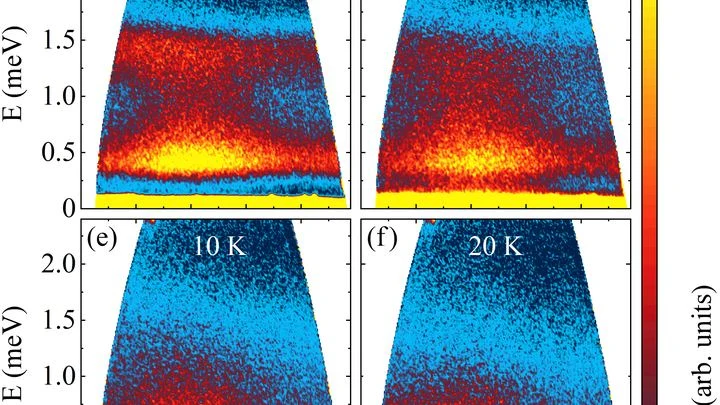
The tiny magnetic arrows inside a crystal of terbium-iridium oxide behave strangely: instead of lying along their preferred axis, they stand across it. This state fully forms when cooled to 1.5 Kelvin — colder than outer space.
Researchers probed the crystal with neutrons and observed how these flipped arrows oscillate and exchange energy.
Deep inside stars, light nuclei fuse, giving birth to helium and streams of neutrons. On Earth, we recreate this process by combining deuterium and tritium — special isotopes of hydrogen.