Dark mountains of neutron stars: gravitational waves probe dark matter ✦
Original: "First Constraints on the Ellipticities of Self-Interacting Fermionic Dark Matter Admixed Neutron Stars from Continuous Gravitational-Wave Searches"
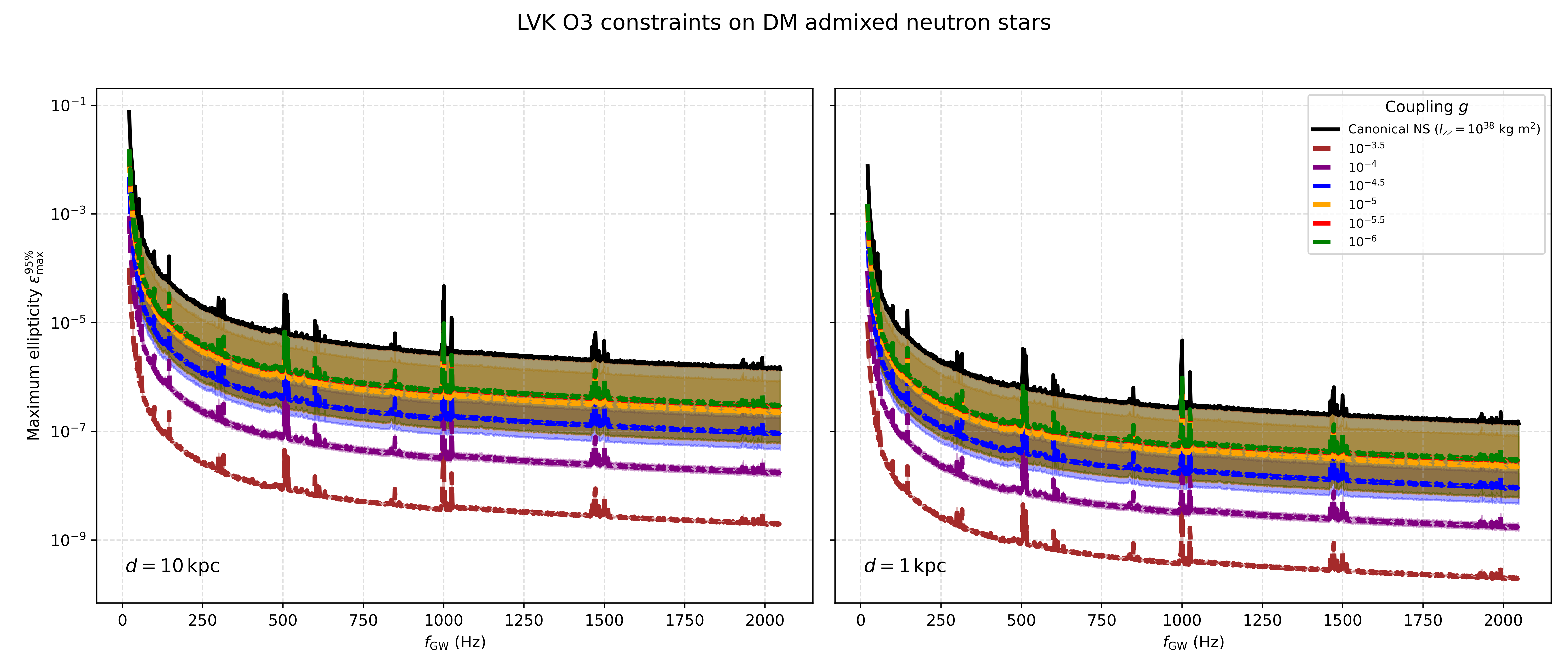
Continuous gravitational waves from neutron stars with a dash of self-interacting dark matter enable first-ever constraints on the unknown parameters of the dark sector.
Links in the knowledge graph 1
Inside a neutron star lurks an invisible mountain of dark matter — a tiny bump, but with a mass like the Himalayas. It turns the star into a cosmic tuning fork: gravitational waves carry its chime across the Universe. LIGO remains silent for now, but this silence has already outlined the boundaries of the unknown. Upcoming observatories will be able to catch this music and, perhaps, touch the dark sector for the first time.
🎯 If a 'dark mountain' on a neutron star were visible, it would be a bump less than a millimeter high, yet containing a mass comparable to the Himalayas.
h_0 = \frac{4\pi^2 G}{c^4} \frac{\varepsilon I_{zz} f_{\rm GW}^2}{d}
h0 — gravitational wave amplitude, ε — equatorial ellipticity, I_zz — moment of inertia, f_GW — gravitational wave frequency, d — distance to the source
\varepsilon = \frac{|I_{xx} - I_{yy}|}{I_{zz}}
Measure of deviation from axial symmetry