Invisible Mountains on Stars: Gravitational Waves Seek Dark Matter ✛ ✦
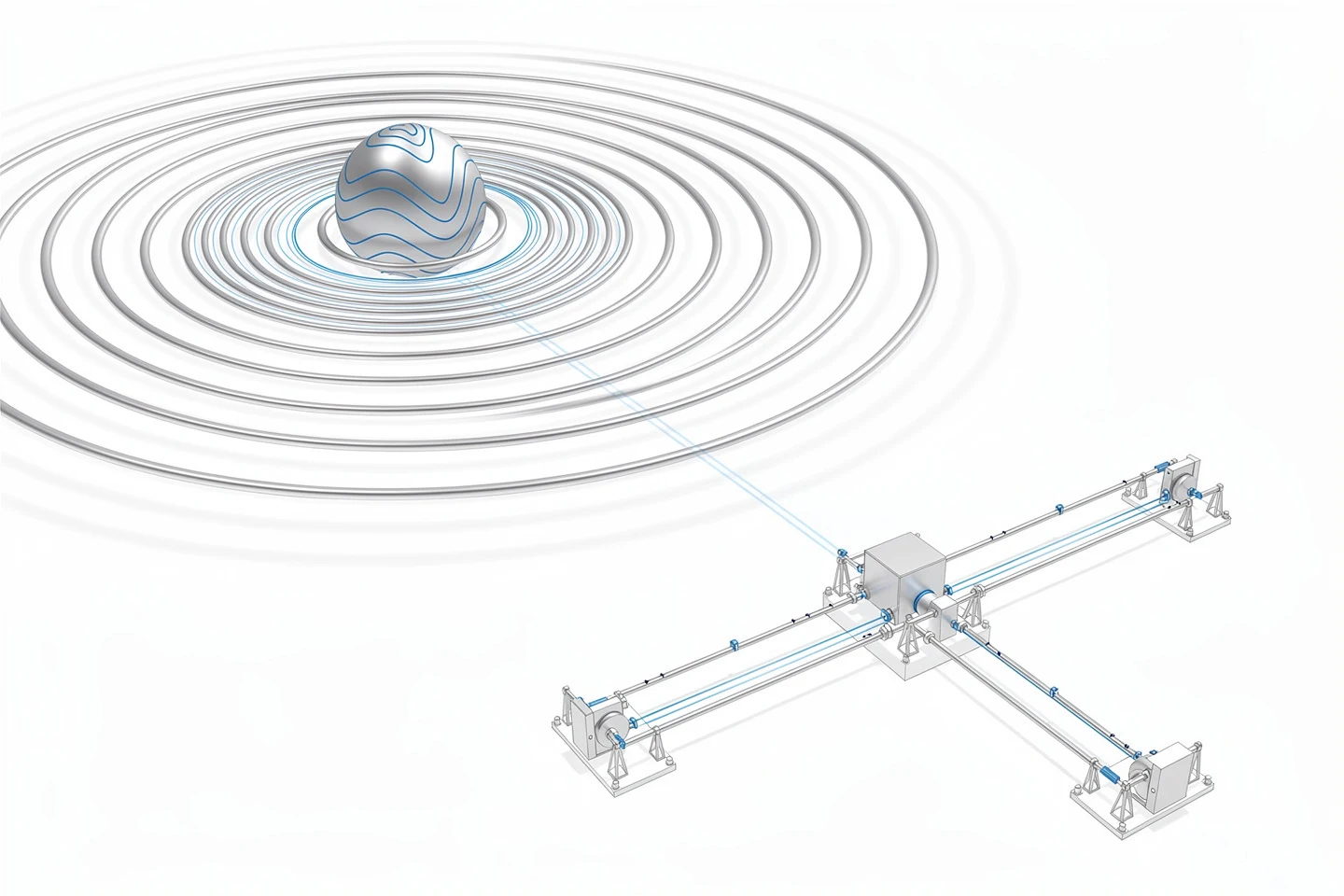
A neutron star is the dead core of an exploded star, crushed to the size of a city. It spins like a flawless top. But if a clump of dark matter, invisible stuff, accumulates inside, it turns into a bump thinner than a hair yet as massive as the Himalayas. This imperfection makes the star shudder, sending a gravitational wave, a ripple in spacetime itself, out into the cosmos.
Comparing the model with data from the LIGO detector, scientists heard no tremors. This means dark matter particles can’t clump together too strongly — otherwise the waves would have been noticed by now. The search focuses on neutron stars — remnants of supernovae, which sometimes appear as pulsars (discovered in 1967 by Jocelyn Bell Burnell). The idea of trapping invisible matter inside stars has been brewing since the 1930s, when Fritz Zwicky suspected hidden mass in galaxies. Meanwhile, the pioneer of the gravitational-wave hunt Rainer Weiss dreamed of such detectors. Today’s silence isn’t a failure: it’s a clue: perhaps dark matter hides inside stars in our Galaxy, and the next generation of instruments will hear it.
If you could see the 'dark mountain' on a neutron star, it would be a bump less than a millimeter high, yet as massive as the Himalayas.