Dark mountains of neutron stars: gravitational waves probe dark matter ✛ ✦
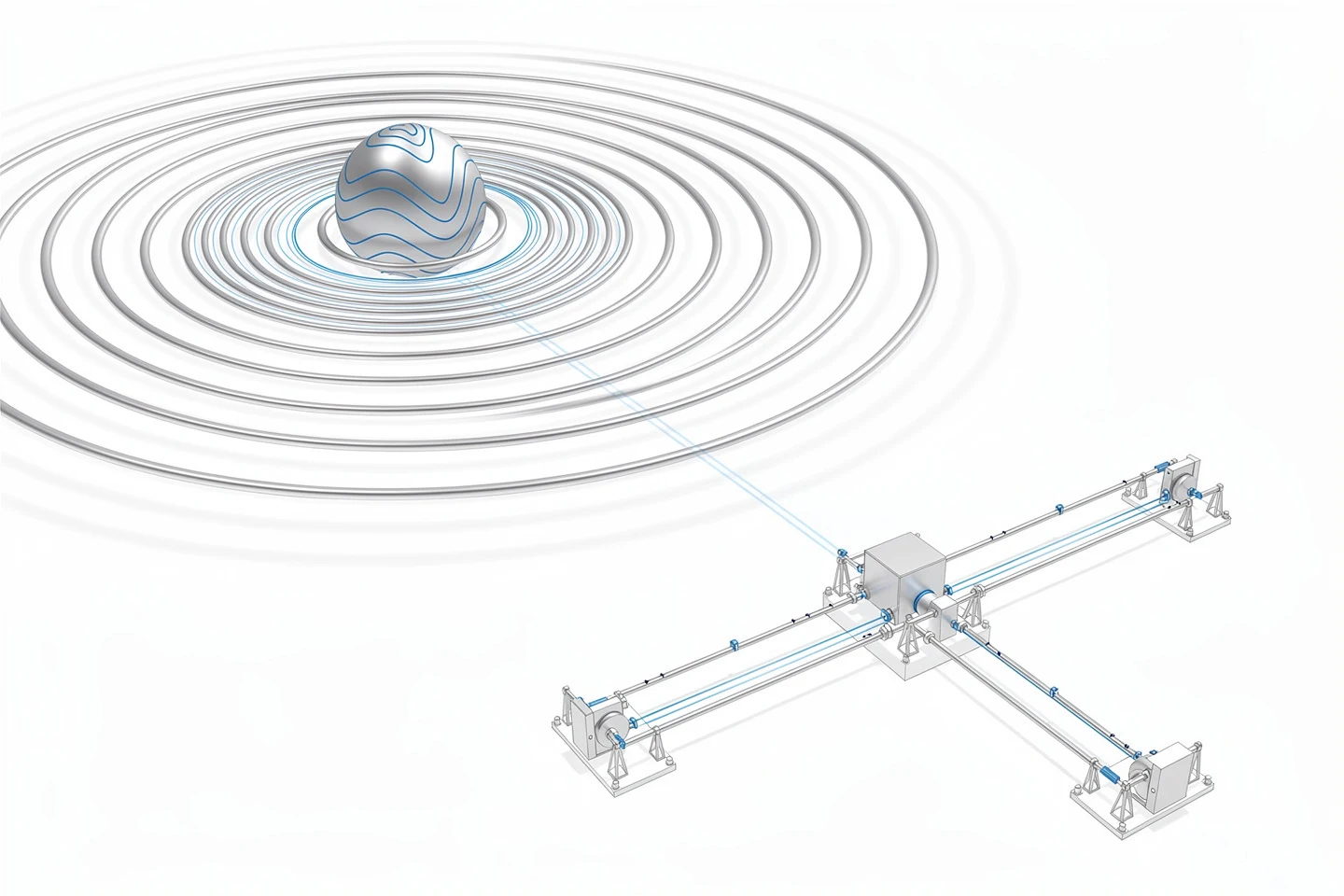
A neutron star is a super-dense remnant of a supernova explosion, where a teaspoon of matter weighs a billion tons. Many of them, as discovered back in 1967 by Jocelyn Bell Burnell, become pulsars — cosmic lighthouses that regularly flash in the radio band. But what if inside this extreme object lurks something even more elusive — dark matter? As early as the 1930s, Fritz Zwicky noticed that clusters of galaxies move as if bound by an invisible mass. Today, physicists search for it everywhere, even inside neutron stars. And gravitational waves could become the very tool to feel it out.
The idea is simple but bold: Dark matter, settling inside a neutron star, doesn't just add mass — it can accumulate asymmetrically, forming 'dark mountains.' These invisible clumps of higher density break the axial symmetry of the star, creating a quadrupole deformation. And a rotating non-spherical body, as taught by Rainer Weiss and his colleagues, inevitably emits gravitational waves — a low hum of a giant tuning fork, sounding at twice the rotation frequency. That's exactly the signal the LIGO detectors are hunting. In the new work, scientists built a two-fluid model of ordinary and dark matter, calculated how particle self-interaction affects the shape of the mountains, and computed the expected wave amplitude. An elegant formula: $h_0$ = (4π^2 G / $c^4$) (ε $I_{zz}$ $f_{GW}^2$ / d) links the dimensionless deformation ε, moment of inertia $I_{zz}$, and distance d to the quantity that instruments can register.
Comparing theoretical predictions with real data from the third observing run of LIGO (O3), the researchers delivered a verdict of silence. If neutron stars with captured dark matter were common, continuous gravitational waves would already have sounded in our orchestra. The unheard signal allowed, for the first time, to rule out entire parameter regions: for particles with masses of 0.1–10 GeV and coupling constants greater than about 10^−5.5 (under optimistic assumptions of a deformation of one part in ten million), such objects would have been detected. It's as if silence in a concert hall told about the absence of an entire class of instruments. So nature doesn't indulge us with such combinations — either dark matter behaves differently, or the mountains are too low.
This is not just a negative result — it's a powerful filter, cutting off unrealistic models. Moreover, a new observational niche has been opened: gravitational-wave astronomy has for the first time acted as a direct probe of the dark sector on the scale of individual stars, complementing the classical methods pioneered by Fritz Zwicky in studying galaxy clusters. And with the commissioning of next-generation detectors — Einstein Telescope, Cosmic Explorer — sensitivity will increase by orders of magnitude, and we will be able to listen to neutron stars within a radius of up to 10 kiloparsecs, ruling out or confirming even weak interactions with a coupling constant down to 10^−6. In this silence, the future symphony of discoveries is already sounding.
And perhaps the faintest hum will tell us what the invisible fabric of the cosmos is woven from.
If a 'dark mountain' on a neutron star were visible, it would be a bump less than a millimeter high, yet containing a mass comparable to the Himalayas.