Dark mountains of neutron stars: gravitational waves probe dark matter ✛ ✦
Context
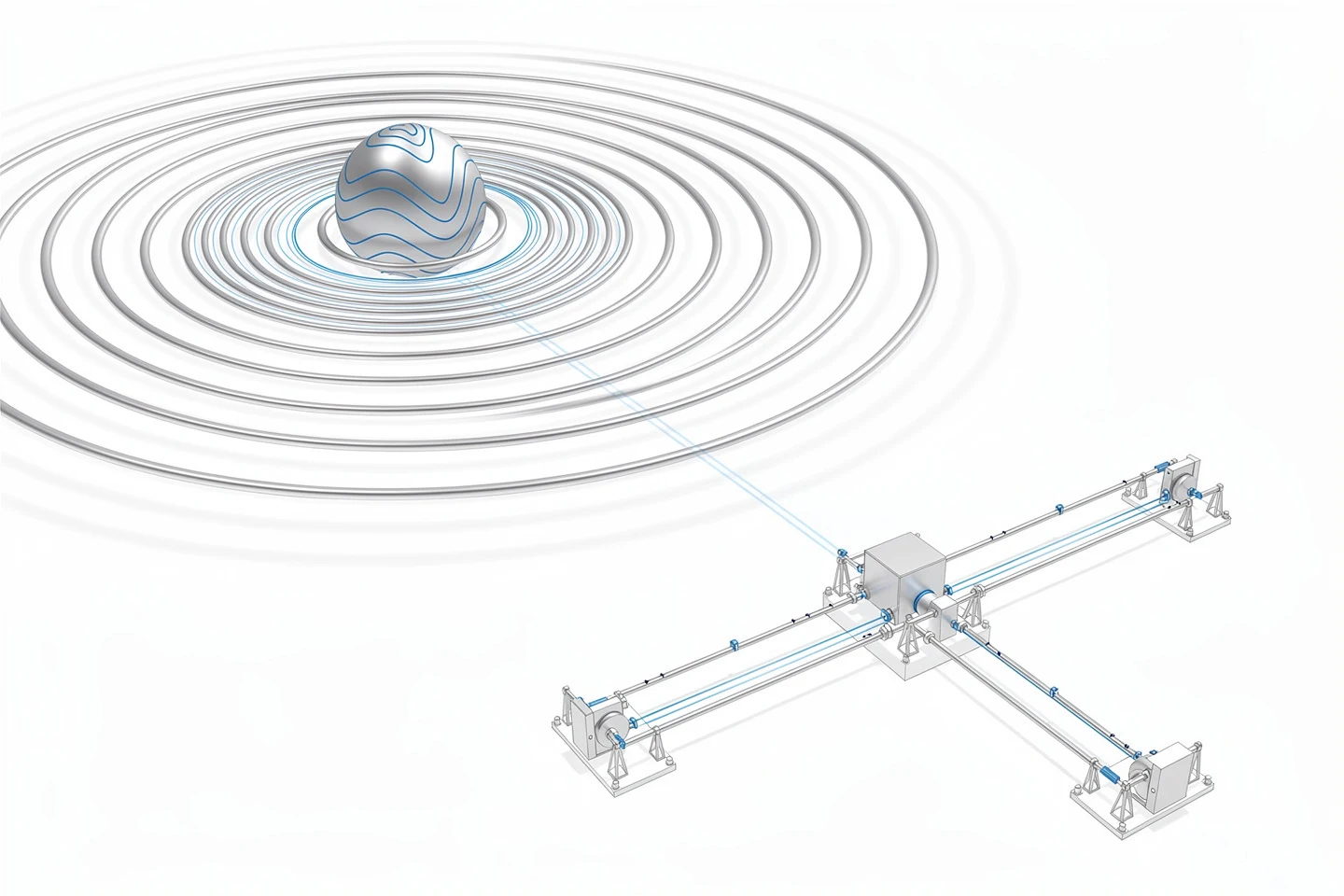
The hunt for continuous gravitational waves from spinning neutron stars, often seen as pulsars, is a cornerstone of modern astrophysics. Since Jocelyn Bell Burnell's 1967 discovery, these objects have been extreme-physics laboratories. Despite decades of effort, faint signals remain elusive, but even their absence sets strict limits on compact-object structure. If dark matter lurks inside a neutron star, its mass and density profile can alter the emitted gravitational waves, offering a unique stellar-scale probe of the dark sector.
Methods
Researchers modeled a two-fluid neutron star with baryonic matter and fermionic self-interacting dark matter, captured during the progenitor's collapse in a supernova or over the star's lifetime. They computed how dark matter shifts the moment of inertia and how anisotropic distributions spawn 'dark mountains'—quadrupole deformations radiating continuous gravitational waves. Theoretical predictions were then confronted with upper limits from LIGO's third observing run (O3). This approach, rooted in the pioneering work of Rainer Weiss and others, provided the first constraints on dark matter self-interactions.
Results
O3 data showed that for dark matter with rest masses of 0.1–10 GeV and coupling constants above roughly 10^−5.5 (in the most optimistic scenario—ellipticity 10^−7 at 1 kpc), such neutron stars would have been detected, so these parameter regions are excluded. Under less favorable assumptions (lower ellipticity, larger distances), only couplings stronger than 10^−4 are ruled out. The maximum allowed ellipticity from gravitational-wave observations is far tighter for dark-matter-laden stars than for ordinary ones, due to the enhanced moment of inertia.
Implications
This work is the first to show that continuous gravitational-wave searches can directly test dark matter hypotheses on single-neutron star scales, complementing classic astrophysical constraints like galaxy cluster observations pioneered by Fritz Zwicky in the 1930s.
Future development
With next-generation detectors like the Einstein Telescope and Cosmic Explorer, probing dark matter via continuous waves will gain orders of magnitude in reach. Projected sensitivities will test models with coupling constants down to 10^−6 for neutron stars up to ~10 kpc away, vastly expanding the parameter space.
Impact
The findings will influence dark matter particle physics, nuclear astrophysics of neutron stars, and gravitational-wave astronomy.
Next steps
Immediate next steps include folding in data from the fourth observing run of LIGO–Virgo–KAGRA and refining models of dark matter capture in neutron stars with realistic equations of state.
Key open problems
This study addresses fundamental questions about dark matter's nature, the neutron star equation of state, and the formation of quadrupolar deformations. It helps crack the long-standing non-detection puzzle of continuous gravitational waves.
The knowledge machine's view
This section is addressed to the author of the paper and their colleagues. Neighbouring works were found by meaning-based search across our archive, not by word overlap. We do not review: we show the field around the work.
What the work does
The study combines a two-fluid model of a neutron star with fermionic self-interacting dark matter and uses the LIGO O3 upper limits on continuous gravitational waves to constrain dark matter parameters. It calculates changes in the moment of inertia and quadrupole deformations ("dark mountains") arising from the anisotropic distribution of dark matter. The work provides the first constraints on the masses and self-interaction constants of dark matter particles derived from gravitational-wave observational data.
Where its strength is
The strength of the work lies in opening a new channel for testing dark matter models through continuous gravitational waves, directly linking the microphysics of the dark sector to macroscopic deformations of neutron stars. This allows using already existing LIGO data to exclude parameter regions previously inaccessible to other methods.
Where it could go next
- It might be interesting to compare the obtained constraints with predictions for vector dark matter forming invisible stars: our archive contains a review of a model where self-interacting dark matter forms compact objects, and comparing parameters could reveal overlapping regions.based on: Triple Thread: How Vector Dark Matter Gives Birth to Invisible Stars arXiv:2607.18025v1
- Nearby lies the work on neutron skin thickness, which discusses the equation of state of dense matter; incorporating nuclear physics could refine how dark matter affects the moment of inertia and deformations and possibly extend the analysis to realistic equations of state.based on: How the Thickness of a Neutron Skin Reveals the Heart of Dead Stars arXiv:2604.26876
- The archive also discusses the unresolved hum of neutron stars related to the background from their ensemble; one could consider how the contribution of individual stars with dark mountains adds up to a stochastic background and what constraints this places on the prevalence of dark matter in neutron stars.based on: The Unheard Hum of Neutron Stars arXiv:2605.14728
Worth trying
- Check how the constraints change when using realistic equations of state from the work on neutron skin thickness.
- Estimate the contribution of a population of neutron stars with dark matter to the stochastic gravitational-wave background and compare it with the expected unresolved hum.
- Consider a scenario with vector dark matter forming its own compact objects and check whether it provides additional sources of continuous waves.
Why this may matter
If the proposed method is developed further, continuous gravitational waves could become a new tool for probing dark matter on the scale of individual neutron stars, complementing existing astrophysical and laboratory constraints. This is especially important for strongly self-interacting particles that are difficult to detect by other means, and it could be applied in future observations with next-generation detectors.
Nearby works in our archive
- Two Signals in the Universe's Noisesimilarity 0.66
- The Unheard Hum of Neutron Starssimilarity 0.66
- Gravitational Echo Will Reveal the Number of Primordial Black Holessimilarity 0.65
- How the Thickness of a Neutron Skin Reveals the Heart of Dead Starssimilarity 0.65
- Dark Matter at the Heart of a Neutron Starsimilarity 0.65
- Tiny black holes from cosmic collisionssimilarity 0.65
- Triple Thread: How Vector Dark Matter Gives Birth to Invisible Starssimilarity 0.65
The closest work in the archive sits at 0.66 by meaning — the usual level for our corpus.
Original abstract
as written by the authors arXiv:2606.05082v1
We investigate continuous gravitational-wave (CW) emission from rapidly rotating, non-axisymmetric, isolated neutron stars admixed with self-interacting fermionic dark matter (DM) and hosting DM-induced equatorial deformations (``dark mountains''). In particular, we develop a formalism that describes how DM accumulation inside the star changes its structure, how dark mountains arise from an anisotropic distribution of DM inside it, and how the star's moment of inertia and thus the amplitude of its GW emission is increased compared to that of an ordinary neutron star. Moreover, using results from all-sky searches for CWs from non-axisymmetric neutron stars performed with LIGO O3 data, we place the first constraints on the DM-induced ellipticities $$\varepsilon$$ of DM-admixed neutron stars across the full GW frequency range analyzed by LIGO and for a range of self-interaction strengths. With the same data, we also exclude portions of the DM-mass/self-interaction coupling strength parameter space that would have produced detectable GW signals in LIGO O3 data. We rule out at best (at worst) couplings $$g\gtrsim10^{-5.5}$$ ($$g\gtrsim 10^{-4}$$) for DM-admixed neutron stars with ellipticities $$\varepsilon=10^{-7}$$ ($$\varepsilon=10^{-9}$$) at distances $$d=1$$ ($$d=10$$) kpc away for DM masses of $$m_\chi\in[0.1,10]$$ GeV. Furthermore, we show that even larger regions of this parameter space will become accessible to next-generation detectors, such as Einstein Telescope and Cosmic Explorer, with exclusions as strong as $$g\gtrsim10^{-6}$$ for neutron stars located $$d=10$$ kpc away for $$\varepsilon=10^{-7}$$. Our results demonstrate that searches for CWs naturally provide a direct probe of dark mountains sustained by DM-admixed neutron stars.
If a 'dark mountain' on a neutron star were visible, it would be a bump less than a millimeter high but packing a mass comparable to the Himalayas.
Key numbers
- LIGO O3 minimum upper strain limit: 1.1×10⁻²⁵ at 111.5 Hz
- excluded coupling constant (optimistic scenario): g > 10⁻⁵·⁵
- dark matter mass range: 0.1–10 GeV
- distances: 1–10 kpc
- ellipticities: 10⁻⁹–10⁻⁷