How the Geometry of Electron Orbits Gives Rise to Superconductivity express
In a long corridor, a crowd of people tries to keep as far apart as possible. In a spacious hall, they would simply spread out, but here the walls squeeze them so tightly that they have to move single file, coordinating every step. Electrons in graphene layers twisted by a tiny angle behave in a similar way. Their motion is confined to nearly flat energy bands where strong interactions reign.
In such cramped conditions, electrons can organize in different ways. Sometimes they form a fractional insulator — a state where charge flows only along the edges, and inside, an order emerges reminiscent of a liquid of particles with fractional charge. But the authors of the new work discovered another participant: an anti-insulator, the mirror image of the former. Both states compete for electrons, yet their confrontation does not destroy the system; instead, it gives birth to something new. Two scattering channels, acting together, create an effective attraction between electrons, and the corridor suddenly turns into a superconductor — a material that transmits current with zero loss.
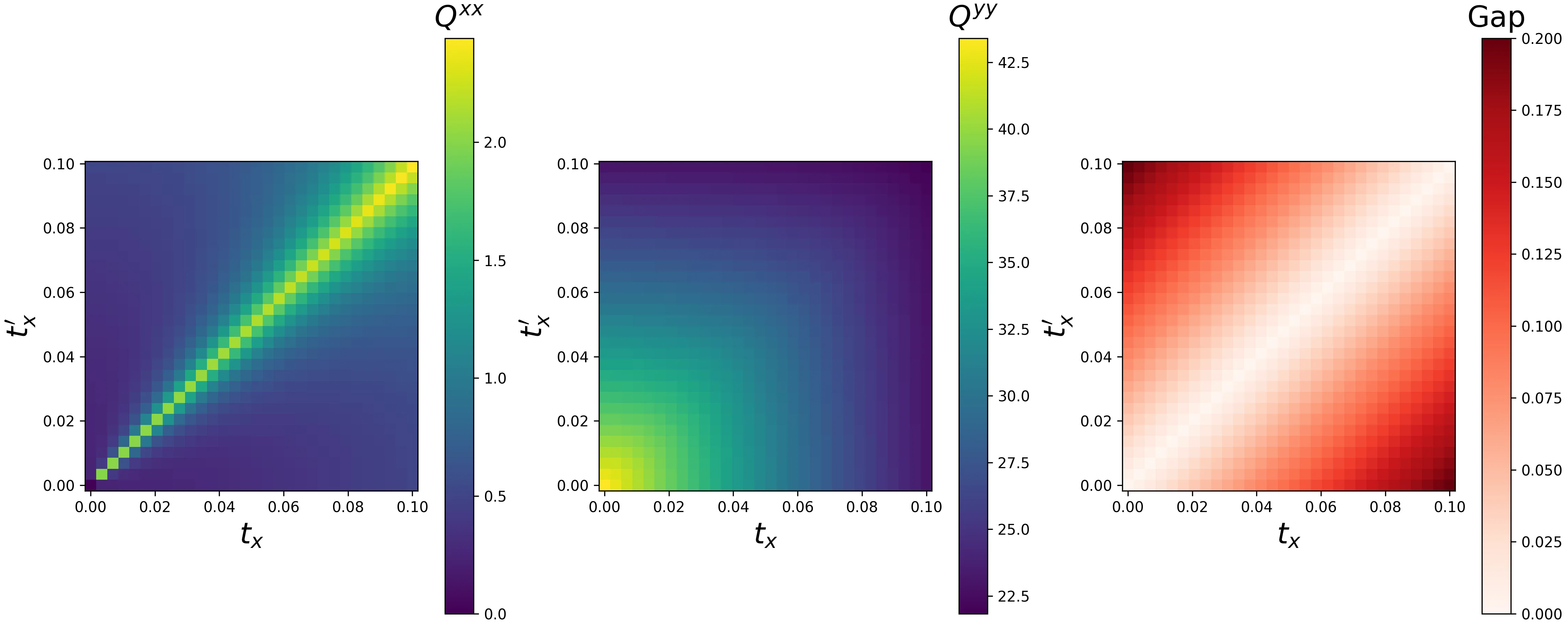
The researchers built a phase diagram — a map of states as a function of interaction strength and geometric parameters. Near the fractional insulator, they found a region of superconductivity, and at other settings, a charge density wave, where electrons gather into periodic clumps. Thus, geometry, usually staying behind the scenes, steps into the spotlight and dictates which collective behavior electrons will choose.
Original abstract
as written by the authors arXiv:2606.21166
Recent moir\'e experiments and numerical studies of interacting Chern bands have revealed fractional Chern insulators, charge-density-wave order, and superconductivity as proximate correlation-driven phases in topological systems. How these phases compete or intertwine, and how quantum geometry shapes their interplay, remain open questions. Here we present an analytic study of competing correlation-driven phases in a partially filled Chern band using a coupled-wire construction and bosonization. The key ingredient is the coexistence of interaction channels that favor, respectively, a fractional Chern insulator (FCI) and a closely related anti-FCI (aFCI) state. The aFCI channel is specific to lattice Chern bands and is enhanced by the quantum geometry of the underlying band structure. We show that when both FCI and aFCI scattering channels are present, their interplay generates an effective coupling that drives a superconducting instability near the FCI phase. The same mechanism can also favor a charge-density-wave phase, depending on microscopic parameters. Using a perturbative renormalization-group analysis, we obtain the phase diagram and identify a superconducting regime adjacent to the FCI phase. We further estimate the superconducting transition temperature and show that it is enhanced by quantum geometry. Our results establish quantum geometry as an organizing principle for the interplay among FCI, aFCI, and superconducting correlations.
Unlike conventional superconductors, where electrons pair up thanks to vibrations of the crystal lattice, here the 'glue' is created purely by electronic correlations — without the involvement of atomic cores.
In Peter Watts's novel 'Blindsight', alien creatures use quantum effects for instantaneous information processing — much like how the geometry of electronic states governs collective phases in these materials.