Quantumgeometry describes the distribution and delocalization of electron clouds within a material, independent of the physical arrangement of atoms in the crystal lattice. While the crystal structure defines where atomic nuclei sit, quantum geometry captures how the electrons' wavefunctions spread out and overlap in the space between them. This distinction matters because the electronic properties of a material — its conductivity, magnetism, optical response — depend far more on the shape of these quantum clouds than on the mere positions of atoms.
History
The concept of quantumgeometry emerged from the study of topological insulators and the Berry phase in the 1980s, with David Thouless and collaborators formalizing related ideas in the quantum Hall effect. The term 'quantum geometry' gained broader usage in the 2010s as researchers applied these geometric tools to understand superconductivity and correlated materials.
How it works
In quantum mechanics, electrons in a crystal are described by wavefunctions that extend across many atoms. Quantum geometry is the mathematical characterization of these extended states: their spatial extent, their phase relationships, and how they respond to external fields. It is often encoded in quantities like the quantum metric and Berry curvature, which measure how much the electron clouds 'twist' and 'stretch' as the electron's momentum changes. These geometric properties directly influence observable phenomena, such as how easily electrons hop between sites or how they interact with light.
In practice
Quantumgeometry is used to design materials with tailored electronic properties, such as topological insulators for spintronics and materials with enhanced nonlinear optical responses for photodetectors and sensors.
Fun fact
X-rays can reveal quantumgeometry because the way they scatter off electrons carries information about the shape of the electron clouds, not just the atomic positions.
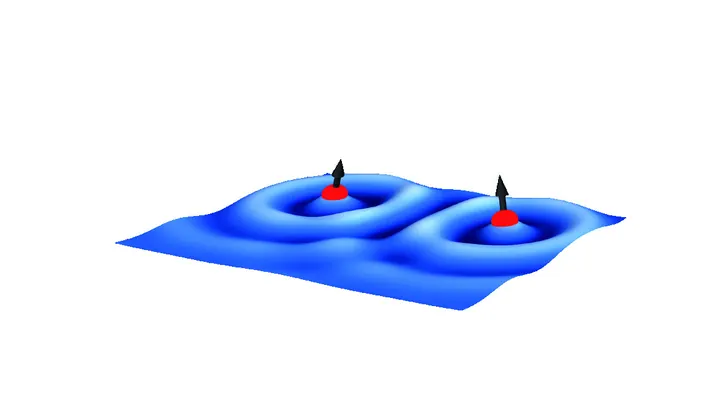
Take two thin sheets of a semiconductor. One is saturated with free electrons, like a packed café where every table is taken. The other, by contrast, is full of empty spots—'holes' eager to be filled. When these sheets are brought close together, a spark of attraction jumps between them: electrons and holes begin to feel each other across the thin gap.
Imagine a postal service where couriers suddenly stop moving. It would seem that letters would stop arriving and communication between cities would break down. But what if the envelopes themselves suddenly gained the ability to change shape and transmit messages through a shared web without moving an inch?
Inside a crystal, an invisible ballet unfolds: the magnetic moments of atoms, like dancers, sometimes align in unison, sometimes scatter in antiphase. The choreography is dictated by quantum exchange — music sensitive to the geometry of bonds.
Toss a handful of phosphorus into silicon, and at a certain impurity concentration the material suddenly starts conducting electricity. This is a metal-insulator phase transition, and it happens abruptly. But what exactly changes in the electron wave functions when an insulator becomes a metal?
Sunlight hits a silicon wafer, and a current flows in the circuit. That's the familiar work of a solar cell: light knocks out electrons, and a p–n junction (the boundary between two layers with different conductivities) forces them to move in one direction. But in some crystals, current arises differently — without any junctions, purely from the material's internal structure.
Among magnets, there are quiet masters of disguise. An ordinary magnet attracts paperclips and has two poles — north and south. But there are materials that are internally arranged like a magnetic chessboard: their atoms are aligned in a strict order, yet externally the material behaves neutrally, as if no magnet exists at all. Such substances are called altermagnets.
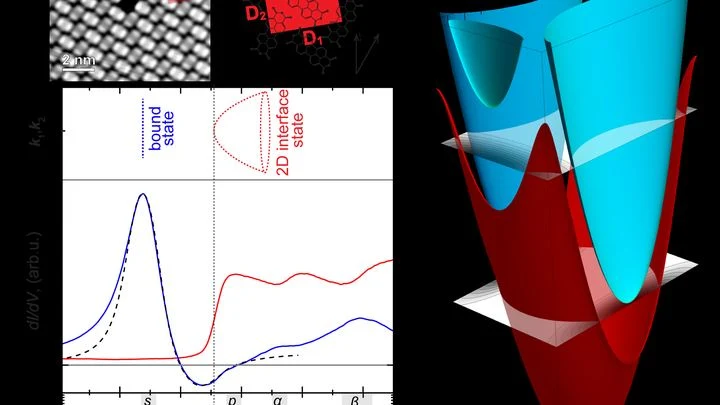
A wafer-thin film of organic molecules was grown on a silicon substrate. In this film, as if on a sheet of graph paper, tiny "pens"—artificial atoms — were laid out with the tip of a scanning tunneling microscope.
Imagine a city where streets are not straight but winding, with dead ends and hidden passages. A bike courier will take much longer to deliver a package than in a city with a regular grid of roads. Similarly, molecules inside living tissue: their path depends on how "tangled" the tissue structure is.
Scientists built a model that describes the movement of molecules in such a "tangled" environment.
A gold particle a few nanometers across looks like a tiny faceted diamond, but with five faces instead of the usual ones. Inside it hides a defect, like a crack in glass that can either heal or shatter the whole object. Scientists set out to discover what makes this defect move and disappear.
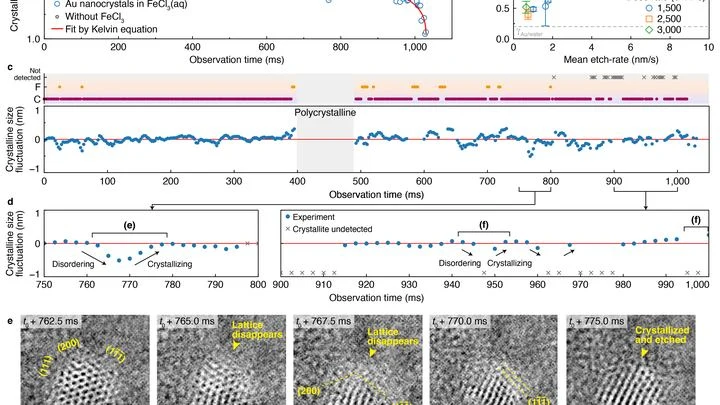
Gold nanoparticles in liquid are like tiny living creatures: they constantly change their internal structure, as if breathing. Scientists managed to peek into this process using an electron microscope that takes snapshots every millisecond, and a neural network that cleans the images from noise.
A chef tastes the soup to see how much salt is in the pot. Physicists did something similar with crystals: they aimed X-rays at them and, from how the rays scattered, calculated how 'spread out' the electrons are in chemical bonds.
In diamond, carbon atoms are held together by shared electrons, like two people sharing one blanket.