Quantum Swings: How Noise Gives Rise to Order
A forest fire that puts itself out and then relights itself: that is what a quantum limit cycle looks like. In a quantum system that constantly exchanges energy with its surroundings, periodic oscillations arise not in spite of noise but thanks to it. It is like a swing that rocks itself because it gets a push at just the right moment.
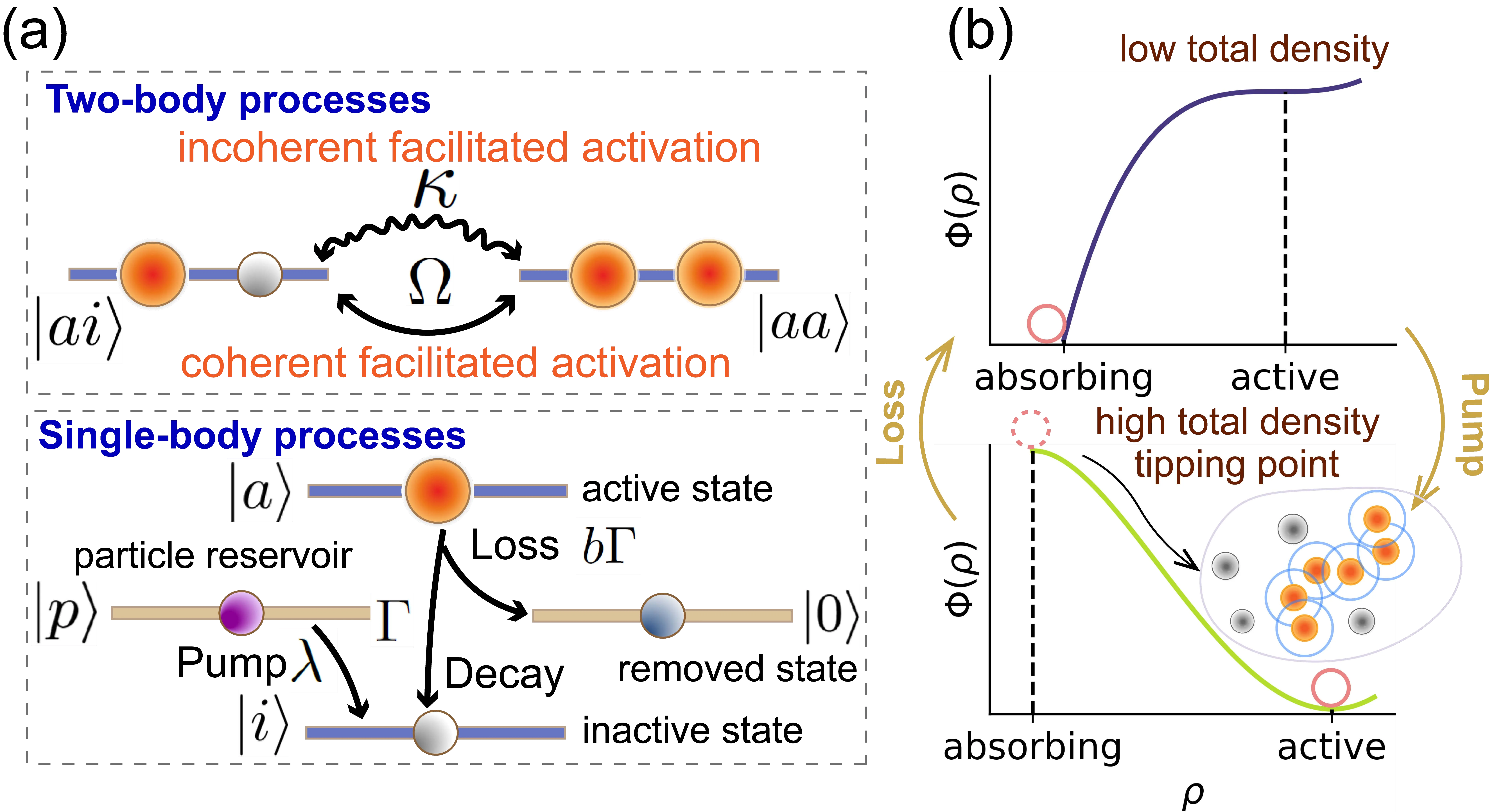
The authors studied a lattice of Rydberg atoms, particles whose electron is flung far from the nucleus and is therefore especially sensitive to its neighbors. In this model, active particles "infect" their neighbors, the way sparks set a forest alight. When activity peaks, a mechanism kicks in that quenches the fire: the system shifts into a quiet state where all particles are inactive. But then slow feedback raises the density again, and the cycle repeats.
Until now it was unclear whether self-sustaining oscillations could arise in quantum systems without static order. It has now been shown that the limit cycle emerges from repeated passage through the point where the system is ready to switch. This could help build quantum generators of periodic signals and provide early warning of critical transitions. The forest fire that puts itself out and relights itself turns out to be an accurate description of how noise gives rise to order.
Near the bifurcation point, a single active particle can trigger a chain reaction of activations reminiscent of a forest fire: the system transitions from an almost empty state to a fully active one in a short time.
The idea of self-organized oscillations in quantum systems echoes the concept of 'quantum consciousness' in Greg Egan's novel Schild's Ladder, where collective quantum states give rise to new forms of order.