A positive feedback loop is a process in which an initial change triggers a chain of events that amplifies the original change, often leading to a runaway effect. In physics and other sciences, this mechanism explains how small perturbations can lead to dramatic, self-sustaining states, from the collapse of a star to the synchronization of fireflies. It is a fundamental concept in systems theory, describing how systems can move away from equilibrium and become locked into new configurations.
History
The concept has roots in the mid-20th century with the development of cybernetics, particularly through the work of Norbert Wiener and others who formalized feedback mechanisms. However, the idea of self-amplifying processes has been recognized in various forms for centuries.
How it works
The mechanism is straightforward: an output of a system feeds back into the input, increasing the output further. For example, in a microphone-speaker setup, sound from the speaker is picked up by the microphone, amplified, and emitted again, creating a louder and louder screech. In natural systems, this can be seen in cloud formation: more clouds reflect more sunlight, cooling the Earth, which leads to more clouds, and so on.
In practice
Positive feedback loops are used in electronics to create oscillators and in laser technology to amplify light. In climate science, they are crucial for understanding tipping points, such as the melting of polar ice.
Fun fact
In the human body, the release of oxytocin during childbirth is a positive feedback loop: contractionsstimulate more oxytocin release, which causes stronger contractions, until the baby is born.
Light falling on matter usually scatters off it or heats it up. But when there are many photons and they are very energetic, two quanta of light can collide and vanish, leaving two particles in their place: an electron and its antimatter twin, the positron. This process, predicted back in 1934, has never been reproduced in the lab with real photons.
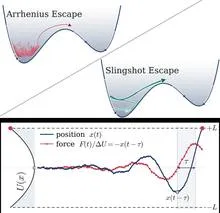
A particle sits in an energy pit like a pea in a dimple. To get out, it needs to go over the barrier, and usually this is rare: the higher the barrier, the longer the wait. The Arrhenius law says the waiting time grows exponentially, meaning doubling the barrier height increases the time by hundreds of times.
Picture a flock of birds gathering around a feeder that no one built. Each bird searches for food on its own, yet they all end up together. Usually, such behavior is explained by social instinct: birds want to be near their kin. But what if the flock is simply a side effect of greed?
Imagine an interferometer as a giant ear listening to the radio whisper of a distant galaxy. Three antennas spread across continents capture the signal, and the difference in their phases combines into a quantity that is immune to atmospheric jitter. This quantity is called the closure phase.
Imagine a huge puzzle where each piece is a quantum particle. To complete the picture, you don't just fit the pieces together: you need to entangle them in a special way. Usually, this is done by carefully applying operations one after another, like assembling the puzzle strictly by the instructions, row by row.
Hot water sometimes freezes faster than warm water: this odd fact is known as the Mpemba effect. Now something similar has been found in the quantum world: a state with weak entanglement (a special quantum connection between particles) can beat a more entangled one to the finish line.
The quantum vacuum is not a dead void but a boiling cauldron of probabilities. In some theories, our Universe is frozen in a metastable state: like superheated water, it's ready to explode into steam at the slightest nudge.
A person reaches out to a stranger across town. That stranger will never return the favor: they'll never meet. So why help? Biologists call this indirect reciprocity: kindness comes back not from the person you helped, but from someone else, down the line.
In a new study, two variants of this idea were pitted against each other.
A handful of rice thrown into a glass of water scatters — the grains spread apart. Now imagine each grain propels itself forward with stubborn persistence and bounces off softly upon collision. Such particles are called active: they spend their own energy to move, like bacteria or microscopic robots.
A colony of cells is like a city that grows from its outskirts: new houses appear where there's more space. Inside, it's crowded, and construction stalls. Similarly, cells divide more often at the edge, where neighbors squeeze them less. Scientists modeled this without any chemical commands — only mechanics.
In the model, each cell is a ball that presses on others.
A Network That Decides When to Stop
A crowd grows: each new person joins the group with a probability that depends on how large the group already is. If the group is small, joining is easy; if it is huge, people start to hesitate, and growth slows down. This mechanism, called feedback, changes the entire behavior of the network.
A quiet tube with a heated grid inside. The voltage on the grid is suddenly raised, and the tube starts to hum, sustaining itself. This is not a malfunction but a transition to another stable state, like a ball rolling over a hill into a neighboring hollow.