Quantum Limit Cycle: How Noise Gives Birth to Order
Context
Limit cycles, meaning self-sustained oscillations, are well known in classical systems: from the Belousov-Zhabotinsky chemical reaction to population dynamics. In the quantum world, their analogue is continuous time crystals, where periodicity arises spontaneously. However, in spatially extended systems, synchronous oscillations usually require long-range order, and how to obtain oscillations without it remained an open question. This work stands apart: nearby there are only a few studies on quantum bifurcation points and time crystals, but no direct predecessors. The authors fill the gap by showing that periodic correlations can arise from repeated crossing of a bifurcation point rather than from static order.
Methods
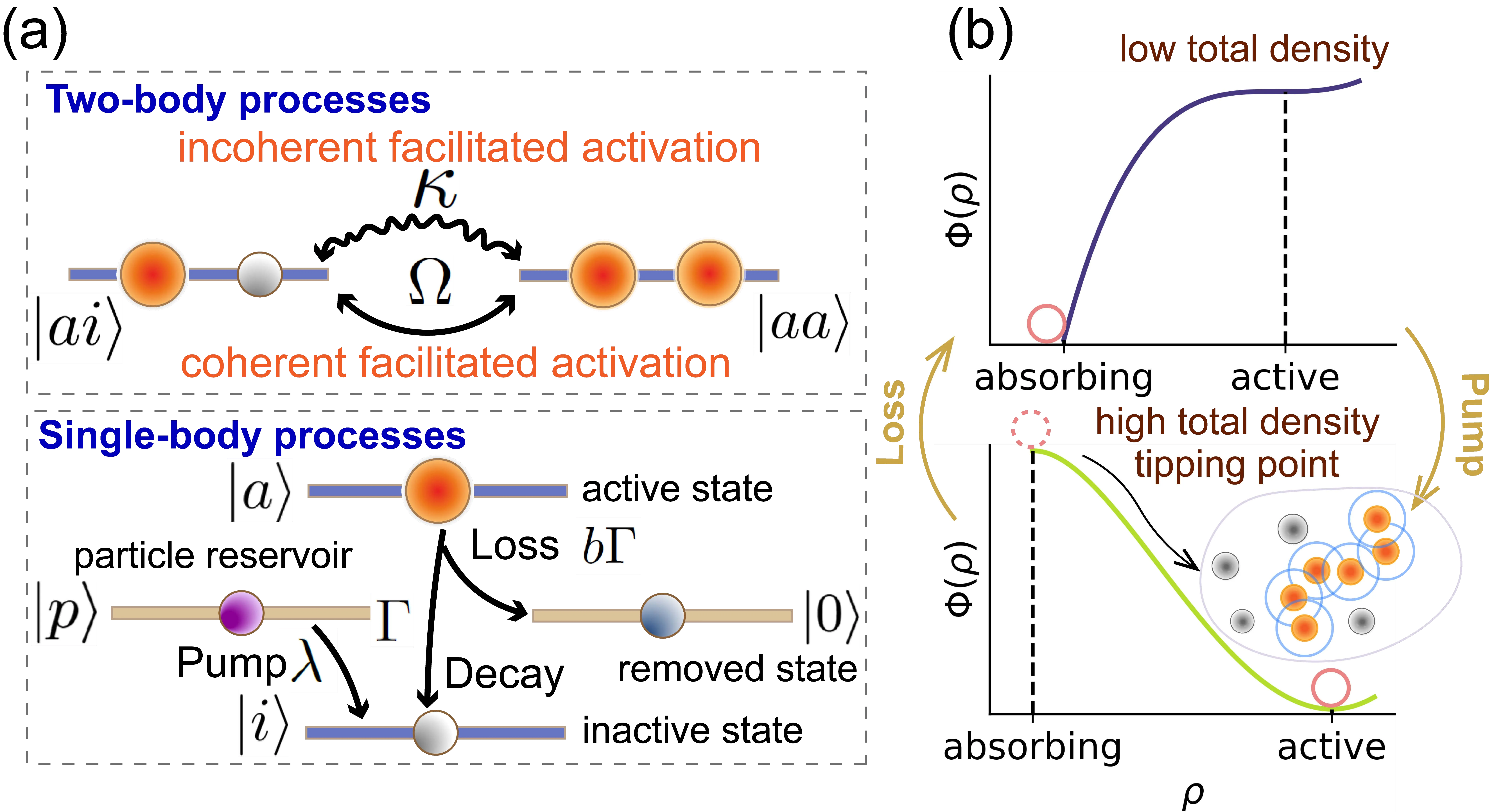
The authors considered a model of a quantum contact process on a lattice of emitters, where inactive particles are activated only near active neighbors, as in an epidemic. The transition between the absorbing state (all inactive) and the active state is a first-order transition: the active density changes abruptly at a critical total density. To obtain a limit cycle, they introduced slow feedback: the total density changes slowly due to losses and pumping, while the fast dynamics of the active density follows it. This leads to self-organized bistability, so the system cycles along a hysteresis loop. For the analysis they used the functional integral method and Langevin equations, and numerically solved stochastic differential equations using an operator splitting scheme.
Results
In the quantum limit cycle regime, the active density periodically switches between zero and a finite value. Near the bifurcation point, where the absorbing state loses stability, the susceptibility of the system rises sharply: even a single active particle triggers an avalanche of activations that spreads through the system like a forest fire. This is reflected in a peak of the correlation function and a burst in the rate of entropy production. The accumulated entropy grows in steps: it barely changes in the absorbing phase and jumps at each transition. It is shown numerically that the cycle is stable: the Floquet multiplier for the zero mode is negative, and correlations remain finite. Long-range correlations arise only at the moment of transition and disappear after it.
Implications
The work demonstrates for the first time that in quantum systems with strong interactions and dissipation one can obtain a limit cycle where long-range correlations are generated not by static order but by dynamic passage through a bifurcation point. This differs from neighboring studies that focused on static phase transitions or time crystals with spatial periodicity. The authors link quantum bistability to a self-organized spatiotemporal structure and show that the bifurcation point serves as an early warning of the transition. This extends the concept of critical thresholds to far-from-equilibrium quantum systems.
Future development
The topic may develop toward experimental realization on cold Rydberg gases, where absorbing phase transitions have already been observed. Further research can test the stability of the limit cycle in finite systems and in the presence of additional noise. It is possible to study the influence of dimensionality: the authors suggest that in two dimensions the cycle may be less stable. It is also interesting to investigate the connection between entropy production and correlations in more general nonequilibrium quantum systems.
Impact
The results may influence quantum optics and ultracold atom physics by providing a new way to generate periodic signals in open quantum systems. They are also important for understanding early warning signals in complex systems, from ecology to climate.
Next steps
The next step will be experimental verification of the predictions on Rydberg atoms, where the model parameters can be controlled. It is also worth investigating the behavior of the system near a tricritical point, where the transition changes from first to second order.
Key open problems
The work touches on the fundamental problem of the emergence of temporal order in nonequilibrium quantum systems without breaking spatial symmetry. It is also related to the question of how dissipation and noise can stabilize coherent oscillations, which is important for quantum technologies.
Near the bifurcation point, a single active particle can trigger a chain reaction of activations reminiscent of a forest fire: the system transitions from an almost empty state to a fully active one in a short time.
The idea of self-organized oscillations in quantum systems echoes the concept of 'quantum consciousness' in Greg Egan's novel Schild's Ladder, where collective quantum states give rise to new forms of order.
Key numbers
- Critical pumping rate: λ_c ≈ 3.2×10⁻³ (in units of Γ)
- Limit cycle period: on the order of 10⁴/Γ (estimated from the relaxation time)
- System size in simulation: L = 64 (linear lattice size)
- Spontaneous activation rate: τ = 10⁻⁷ (in units of Γ)
- Loss rate: b = 10⁻² (in units of Γ)