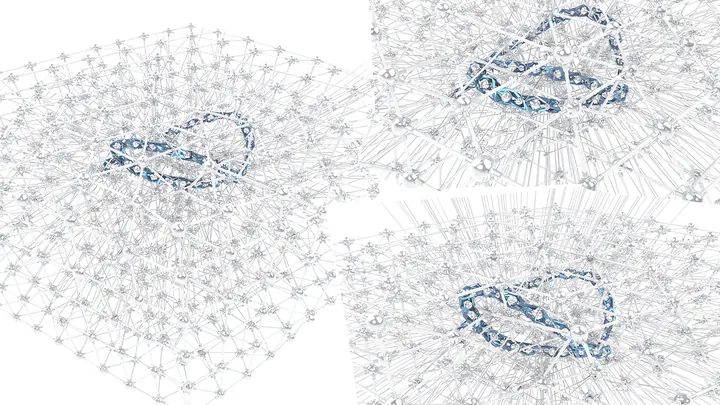
A time crystal is a phase of matter where the atoms exhibit periodic motion in their ground state — the lowest-energy state of the system. Unlike ordinary crystals, which have repeating patterns in space, time crystals repeat in time, 'ticking' forever without any external energy input. This violates our everyday intuition that perpetual motion is impossible, but quantum mechanics allows it because the system is in its ground state, so it cannot lose energy. Time crystals are a new state of matter that challenges our understanding of equilibrium and symmetry breaking.
History
Frank Wilczek first proposed the concept of time crystals in 2012. The first experimental realization was reported in 2016 by two independent groups (led by Christopher Monroe at the University of Maryland and Mikhail Lukin at Harvard), using chains of trapped ions and nitrogen-vacancy centers in diamond, respectively.
How it works
In a normal crystal, atoms arrange themselves in a repeating spatial pattern, breaking the symmetry of space. A time crystal breaks the symmetry of time: the system's properties oscillate with a period that is a multiple of the driving period. This is achieved by periodically 'kicking' the system (e.g., with laser pulses) in a way that the atoms respond at a different, stable frequency. The key is that this oscillation is protected by many-body interactions — the atoms collectively lock into a rhythm that is robust against perturbations, even though the system is in its ground state.
In practice
Time crystals are being explored as ultra-stable oscillators for precision timekeeping and as components for quantum sensors. They could also serve as a platform for studying non-equilibrium quantum phases and potentially for quantum memory storage.
Fun fact
The oscillation of a time crystal is so stable that it can serve as a 'quantum clock' that would lose only one second in about 10 billion years — far more accurate than the best atomic clocks today.
A translator who has memorized all the lines in advance responds instantly — no need to listen to the whole conversation again. That's how the new model works: instead of running atoms through a computer for hours, it immediately outputs the crystal's free energy at any temperature and pressure.
Moiré patterns are familiar to everyone. Two combs with different spacing, placed on top of each other, show dark fringes. Something similar has emerged in time. Physicists took a cloud of Rydberg atoms, particles with unusually large electron orbits, and illuminated it with two lasers.
In the world of two-dimensional materials, states sometimes emerge that are as extraordinary as they are fragile. One of them — the fractional anomalous Hall crystal (FAHC)—is like a quantum centaur: half ordered lattice, half topological liquid.
Crystals fascinate us with their perfect spatial order: atoms frozen at lattice points, like beads on an invisible string. But what if the same symmetry unfolds in time? Time crystals are systems that, without any external cue, start repeating their states cyclically — clocks wound by nature itself. Inside this tireless rhythm, disorder seems to have no place.
Diamond is a symbol of perfection, but its true magic is revealed through flaws. Perfect lattice purity gives transparency and hardness, while defects, such as color centers, open a portal to the quantum world, becoming the foundation for quantum computers and quantum sensors.
A time crystal resembles an eternal clock: its atoms spontaneously perform rhythmic movements. In ordinary clocks, a pendulum is driven by a spring or battery, but here the motion arises without an energy supply — the system simply returns to its initial state at regular intervals. This idea was proposed by Frank Wilczek in 2012.
Two quantum particles are linked by an invisible thread: one loses energy, the other gains it, but the total remains unchanged. If you watch only the first, its oscillations don't fade — the rhythm is steady, like that of a cosmic pulsar, even though it seems that entropy and chaos are increasing.
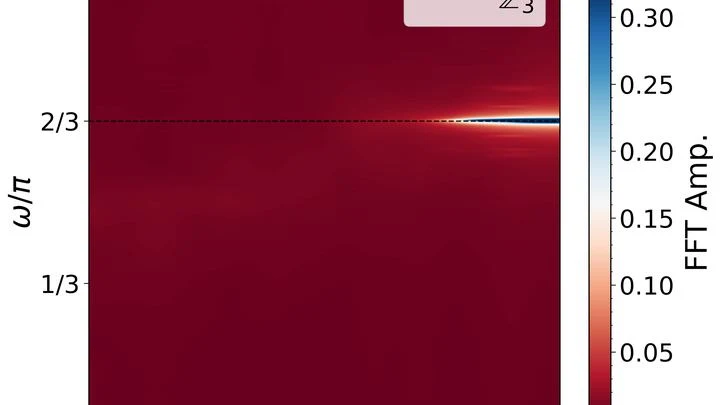
An ordinary pendulum swings at the same frequency as the push it receives. But in the quantum world, you can create a system that responds to a push two, three, or more times slower, as if it has its own rhythm. Such systems are called discrete time crystals.
A ball on a slope with two pits usually rolls into the nearest one and comes to rest. But if the slope is slightly deformed and 'remembers' recent nudges, the ball can hang around halfway for a long time — in a narrow spot it doesn't want to leave. That's exactly the trick physicists played with light.
Two thin sheets with honeycomb patterns were stacked and slightly rotated, creating a new pattern — a moiré, like the shimmer of silk. The electrons in the experiment behaved similarly: they arranged themselves into two layers, with one layer rotated exactly 30 degrees relative to the other.
A struck tuning fork fades: its vibrations leak into the air. But there are systems where the oscillation does not decay, even though there are plenty of free waves around, ready to carry energy away. Physicists call such 'captured' states bound states in the continuum (BIC).
A quantum system can possess a property called magic. It's not about tricks: it's a measure of how hard it is to reproduce its behavior on a classical computer. Ordinary states, known as stabilizer states, are easy for a computer to handle. But states with magic leave it stumped.
Conventional atomic clocks are essentially optical counters: they rely on spectroscopy — a method for measuring the frequency of radiation with high precision as electrons jump between energy levels.
A pendulum receives a kick but returns to its starting position not after one period, but after two. That is how a discrete time crystal behaves: a phase of matter that spontaneously breaks discrete time-translation symmetry and oscillates with a period that is a multiple of the driving period.