An open quantum system is a quantum object that is not perfectly isolated but interacts with its surrounding environment. This interaction causes decoherence — the loss of quantum superposition — and dissipation, where energy leaks out. The environment acts as a 'bath' that continuously measures the system, effectively collapsing quantum states and turning quantum behavior into classical behavior. This is why macroscopic objects don't exhibit quantum effects.
History
The modern formulation was developed in the 1970s by Gorini, Kossakowski, Sudarshan, and Lindblad, who derived the general form of the master equation.
How it works
The system and environment together evolve unitarily, but since we only track the system, we trace out the environment's degrees of freedom. This yields a master equation describing the system's reduced density matrix, which includes terms for damping and noise. The environment's many degrees of freedom act as a source of random fluctuations that drive the system toward thermal equilibrium.
A quantum detector is like a sensitive pendulum suspended in empty space. If a sharp gravitational wave passes by, you might expect the pendulum to swing. But the calculation shows otherwise: the wave doesn't swing it: it damps any existing oscillations.
Two massive bodies frozen in a quantum superposition resemble a pair of dancers trying to keep a single rhythm while an orchestra blares around them. Each gravitational wave is a musician throwing them off beat.
A choir where every singer hits the notes precisely sounds louder than you'd expect from a simple sum of voices. A hundred singers aren't just a hundred times louder than one: they're ten thousand times louder. In the world of atoms, something similar happens. In collective behavior discovered by Robert H.
The quantum world is full of surprises. In a Kerr parametric oscillator, a device where light is trapped in a ring and driven by an external field, researchers recently noticed something strange: pairs of energy levels merge in an embrace. Physicists have dubbed this a "spectral kiss" spectroscopy.
In an orchestra, one musician plays so quietly that their sound is almost inaudible in the overall chorus. In the quantum world, such 'quiet' states are called dark: their energy barely escapes, like light in a darkened room. But if there are many musicians, their mutual influence can unexpectedly awaken even the most silent one.
Water in a glass settles down once you stop stirring it. Oil in an engine dampens vibrations. It seems viscosity is always about damping. But in some flows, it's the opposite: add friction, and waves start to grow as if from nowhere.
Physicists have found a simple explanation.
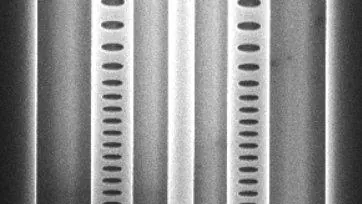
In the world of microchips, where streams of photons, quanta of light, carry information, a fundamental problem arises: light passing through matter inevitably heats it. This heating spawns thermal fluctuations — chaotic, unpredictable jostling of atoms that disrupts precise device operation.
Heat flow usually evens everything out: hot things cool down, cold things warm up, and in the end you are left with a uniform warm swamp. The same holds in the quantum world: the environment, whether a crystal lattice or a gas of photons, tends to destroy the fragile entanglement between particles.
Five superconducting qubits on a chip: the stage for a performance of quantum chaos. Four qubits form the system, and the fifth acts as the environment, introducing dissipation. After a short evolution, the environment is discarded, leaving the system with an open quantum map, an operator that transforms the system's state.