Quantum Limit Cycle: How Noise Gives Birth to Order
A forest fire that puts itself out and then relights itself: that is what a quantum limit cycle, discovered in a new theoretical model, looks like. In an open quantum system, where particles constantly exchange energy with their surroundings, periodic oscillations arise not in spite of noise but because of it. It is a bit like a pendulum that gets pushed at just the right moment, except here the pushes are generated by the system itself.
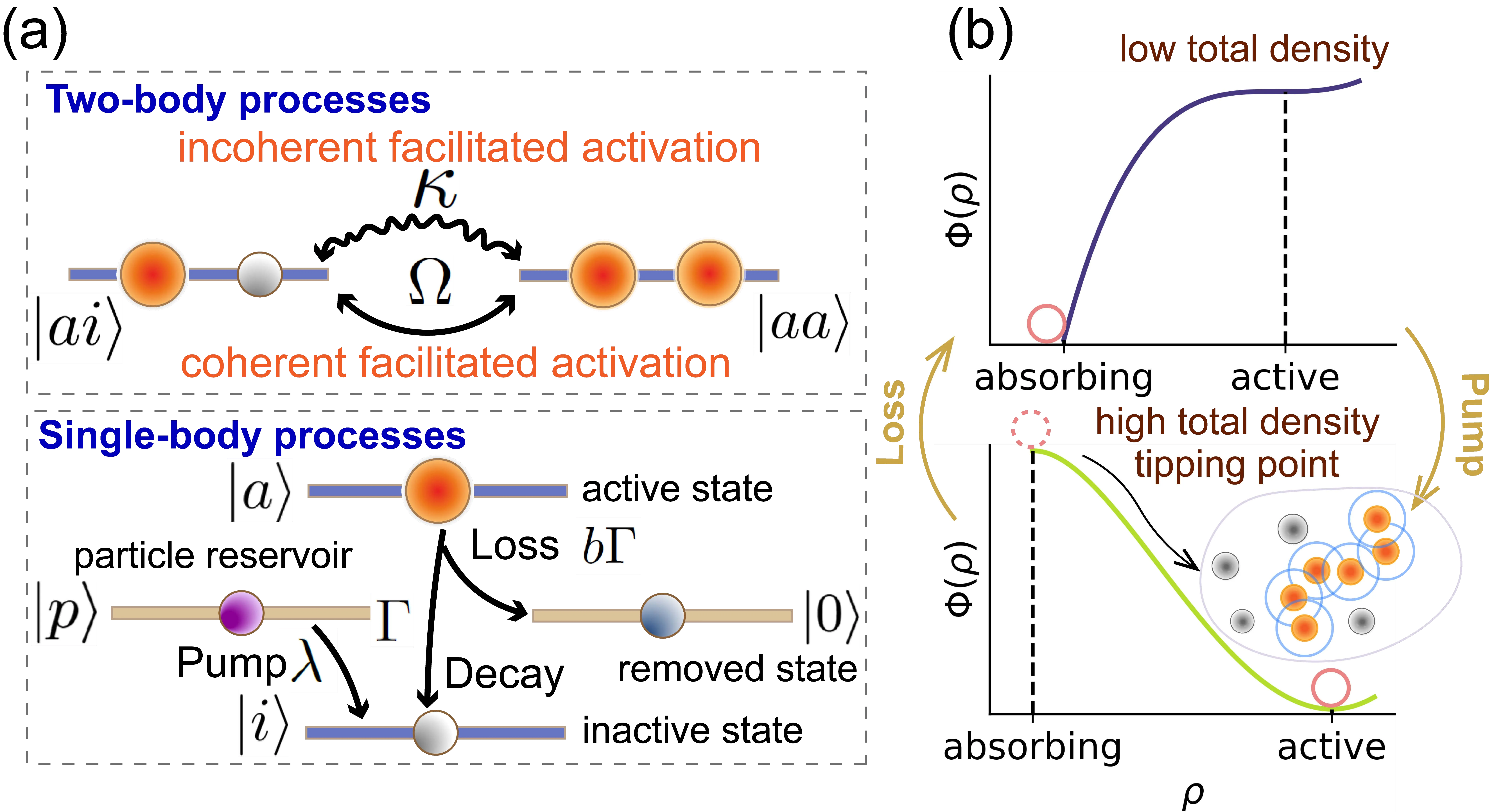
The authors studied a lattice of Rydberg atoms, particles whose electron is kicked far from the nucleus and is therefore especially sensitive to its neighbors. In this model, active particles "infect" their neighbors, the way sparks set a forest alight. When activity peaks, a mechanism kicks in that puts out the fire: the system shifts into an absorbing state, where all particles are inactive. But then slow feedback raises the density again, and the cycle repeats.
Numerical simulations showed that the cycle is stable: the Floquet multiplier for the zero mode is negative, and correlations remain finite. Long-range correlations appear only at the moment of transition and vanish afterward. Entropy production, a measure of the process's irreversibility, grows in steps: it barely changes in the absorbing phase and jumps upward at each transition.
Previously it was unclear whether open quantum systems could host self-sustained oscillations with long-range correlations but no static spatial order. Now it has been shown that the limit cycle arises from repeated passage through a bifurcation point, where susceptibility diverges, generating bursts of correlations and entropy. The authors built a model with slow feedback on the total density, which forces the system to cycle through a first-order hysteresis loop.
Practical applications could include building quantum generators of periodic signals and providing early warning of critical transitions in nonequilibrium quantum systems. A forest fire that puts itself out and then relights itself turns out to be not just a pretty metaphor but an accurate description of how noise gives birth to order.
Near the bifurcation point, a single active particle can trigger a chain reaction of activations reminiscent of a forest fire: the system transitions from an almost empty state to a fully active one in a short time.
The idea of self-organized oscillations in quantum systems echoes the concept of 'quantum consciousness' in Greg Egan's novel Schild's Ladder, where collective quantum states give rise to new forms of order.