An avalanche, in physics, is a rapid, self-amplifying cascade of events in a system of many coupled elements. The term is borrowed from snow avalanches, where a small disturbance triggers a chain reaction that releases a massive amount of energy. In physics, avalanches occur in diverse systems: electron avalanches in gases (as in lightning or Geiger counters), magnetic avalanches in materials, and even in biological systems like cell division. The key feature is that a local event can trigger neighboring events, which in turn trigger more, leading to a power-law distribution of sizes — a hallmark of critical phenomena.
History
The concept of avalanches in physics was popularized by Per Bak, Chao Tang, and Kurt Wiesenfeld in 1987 with their theory of self-organized criticality, which used sandpile models to explain how avalanches emerge naturally in complex systems.
How it works
The mechanism involves a threshold and a coupling. Each element in the system can be in a stable or metastable state. When an element crosses a threshold (due to an external drive or a neighbor's event), it 'fires' and transfers energy or stress to its neighbors. If the coupling is strong enough, the neighbors also cross their thresholds, creating a chain reaction. The avalanche stops when the system reaches a state where no element is above threshold. In systems at self-organized criticality, avalanches occur at all scales, and their size distribution follows a power law, meaning there is no characteristic size.
In practice
Avalanche photodiodes use the avalanche effect to amplify weak light signals in fiber-optic communications; understanding avalanche dynamics is also crucial for predicting material failures and in neuroscience for studying neural avalanches.
Fun fact
In a sandpile model, the size of avalanches follows a power-law distribution, meaning that a giant avalanche is just as likely (in a statistical sense) as a tiny one, relative to their scale.
Water droplets shoot out of a nozzle one after another, like cyclists on a narrow track. The faster ones catch up with the slower ones and merge into larger drops. This simple mechanism is called ballistic aggregation, and until now it had only been observed on cosmic scales: this is how dust particles stick together to form planets.
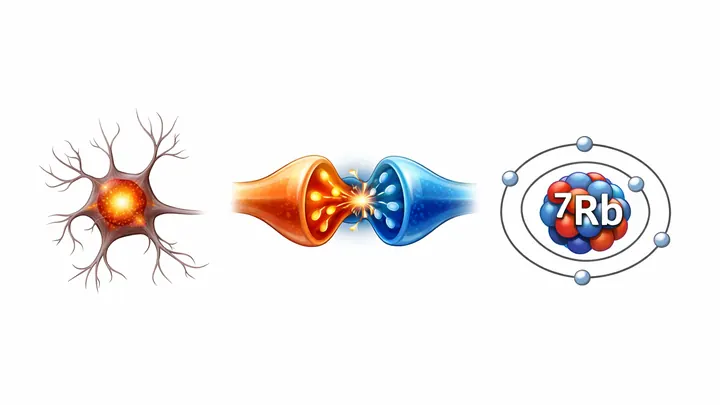
A cloud of atoms cooled to near absolute zero suddenly starts behaving like a brain. One excited atom triggers a chain reaction — neighbors light up in turn, and an avalanche of activity sweeps through the gas. Physicists call this Rydberg facilitation: atoms are easier to excite when an excited one is nearby.
A lump of plasticine, when kneaded, behaves like an amorphous solid — not a crystal, but not a liquid either. Inside such a material, avalanches can occur: one tiny rearrangement triggers neighboring ones, and a wave sweeps through the entire sample.
A lightning strike splits the sky in a fraction of a second, leaving a branched trail. At the same moment, in a tiny superconducting crystal cooled to near absolute zero, an avalanche of magnetic field rushes through — thin fingers of magnetization piercing the material.
A landscape cut by roads or rivers into isolated patches resembles a shared apartment after partitions are installed: residents no longer bump into each other in the common hallway. Species that once competed for the same food or space now live apart. Competition weakens, and those that would have lost to pushier neighbors in a continuous landscape now survive.
Toss a handful of sand on the floor: there are few large grains, many medium ones, and even more tiny ones. This skew, where small events are common and large ones are rare, is described by a power law. It shows up in city sizes, earthquake magnitudes, and citation counts of scientific papers.
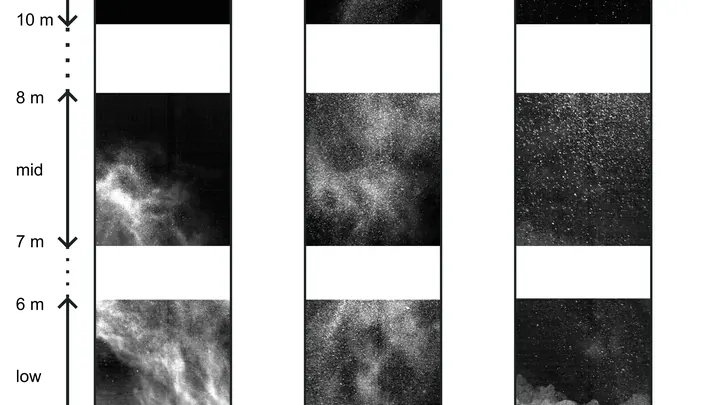
A powder avalanche isn't just a pile of snow sliding down a mountain. It's a cloud racing downhill at car speed. Inside, snow doesn't lie still: it flies: thousands of tiny particles are caught up in air vortices. Until now, no one had seen what actually happens to each snowflake in this chaos. Now scientists have the first footage.
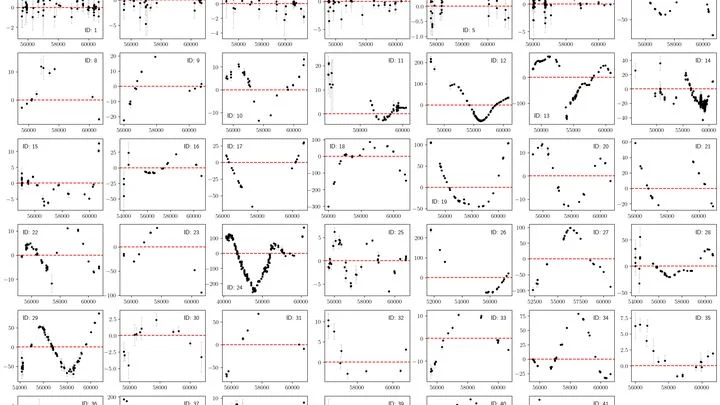
Eclipses in binary stars are like clockwork: a white dwarf (the dense remnant of a star) regularly passes in front of its companion, and the light briefly dims. But for most such pairs, the clock runs fast or slow by seconds over years. Astronomers measured these glitches in 43 systems and found a pattern.
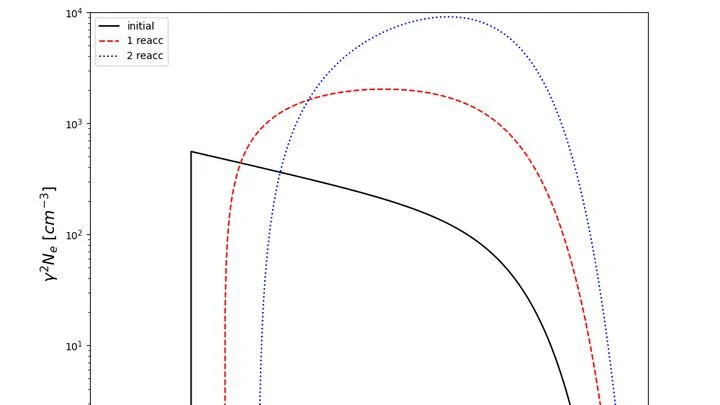
A blazar is a distant galaxy with a plasma jet shooting from its center, aimed almost directly at us. Inside this jet, particles are accelerated to near-light speeds and emit powerful radiation.
Every few years, the Pacific Ocean off the coast of Peru warms up, and then fields dry out in Australia while deserts in Chile get drenched. This phenomenon is called El Niño.