A tipping point is the threshold in a complex system where a small perturbation can push the system into a new, often dramatically different, state. This state is frequently hard to reverse, meaning that once crossed, the system does not easily return to its previous condition. The concept is central to understanding why some changes appear gradual and others abrupt, and why systems can seem stable right up until the moment they are not.
History
The term was popularized in the 2000s by Malcolm Gladwell's book 'The Tipping Point', but the underlying concept has roots in earlier work on critical phenomena in physics and catastrophe theory by René Thom in the 1960s and 1970s.
How it works
In many systems, feedback loops can amplify a small change. When a system is near a tipping point, its ability to absorb disturbances weakens, so a minor event can trigger a cascade of effects that push it over the edge. This is often modeled mathematically as a bifurcation, where a system's equilibrium point suddenly disappears or becomes unstable, forcing it to jump to a different state.
In practice
Tipping point analysis is used in climate science to predict abrupt shifts like the collapse of the Atlantic Meridional Overturning Circulation, and in engineering to design power grids that avoid cascading blackouts.
Fun fact
In some quantum magnetic systems, a tipping point can occur at absolute zero temperature, driven purely by quantum fluctuations rather than thermal energy.
One hundred milliseconds. In that time, after a lightning strike or a short circuit, the power system either returns to normal operation or loses stability. A new-generation Neural Network Oscillations learns to sense this moment, like an experienced tightrope walker anticipating a gust of wind.
A long chain of atoms, each a tiny magnet. They talk to each other and to a common field, like musicians in an orchestra who hear both the conductor and their neighbors. When the external field changes, the orchestra either plays out of sync or all instruments come in together: that's a quantum phase transition.
A vast hall with a thousand doors, and only one leads to the stars. The rest are locked, and the keys aren't just hidden: they're wrapped in other keys and tangled into a knot. That's the Great Filter in a new reading: not a chain of failures but a tangled hierarchy where each step depends on the previous one nonlinearly.
A quiet tube with a heated grid inside. The voltage on the grid is suddenly raised, and the tube starts to hum, sustaining itself. This is not a malfunction but a transition to another stable state, like a ball rolling over a hill into a neighboring hollow.
A uranium crystal the size of a grain of rice was cooled to one-fiftieth of a degree above absolute zero. At such temperatures, heat is not transported chaotically but strictly according to the rules of the quantum world.
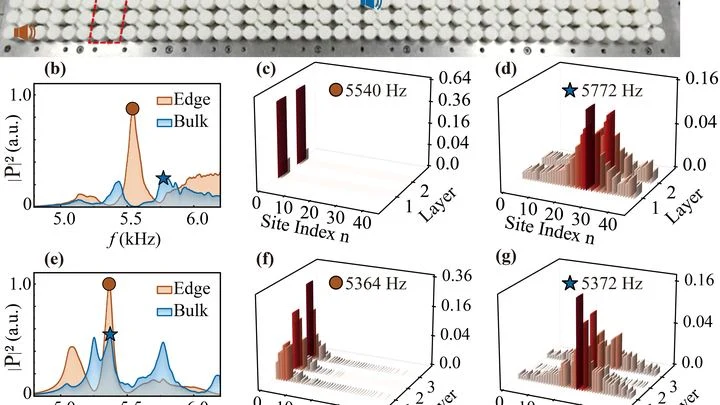
A stack of identical pancakes on a plate is just a stack. But if you arrange them with a certain order, something new suddenly appears: for example, a pattern that was not visible in each pancake individually. Physicists have performed a similar trick with thin layers of materials.
Glaciers don't just darken from soot. Their surfaces host tiny algae that, as temperatures rise, bloom and turn the ice dark. Dark ice absorbs more sunlight, melts faster, and further warms the planet. It's like how a black t-shirt in the sun gets hotter than a white one.
The second player in overheating is forests.
Imagine a bridge with its middle ripped out: cars on the other side would be a surprise. That's how astronomers long viewed black holes with masses from 50 to 130 solar masses: the stars that could produce them explode as pair-instability supernovae.
Imagine a house of cards where each card supports the others. One wobbles, and the neighbors start to lean. Earth's climate system works similarly: ice sheets, ocean currents, tropical forests, all are connected. If one element crosses a threshold, it can drag the rest down with it.
In 1988, the surface temperature of the Pacific Ocean began to change long before meteorologists declared the onset of El Niño. Points on the map scattered along the equator started behaving in concert: if water warmed in one place, it did so in a neighboring one too.