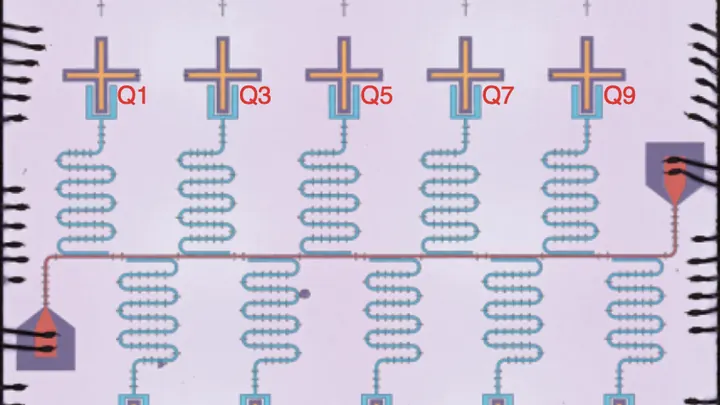
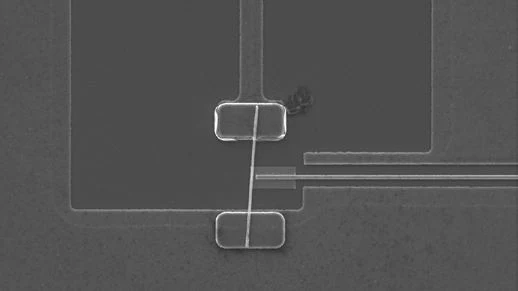
Qubitlifetime, often called T1, is the average time a quantum bit (qubit) retains its excited state before relaxing to the ground state due to energy loss. It is a fundamental measure of a qubit's quality: longer lifetimes mean more time to perform quantum operations before errors accumulate. In quantum computing, qubits are fragile; they interact with their environment, causing decoherence. T1 specifically captures energy relaxation, while another timescale, T2, captures phase decoherence. Together, they define the practical window for quantum computation.
History
The concept of relaxation time in quantum systems dates back to early nuclear magnetic resonance (NMR) studies in the 1940s, where T1 was introduced by Felix Bloch. It was later adapted to qubits in the 1990s as quantum computing developed.
How it works
A qubit is a two-level quantum system, like an atom or a superconducting circuit. When excited, it holds energy. Over time, interactions with the environment — such as thermal fluctuations, electromagnetic noise, or material defects — cause the qubit to spontaneously emit a photon or phonon and drop to the ground state. The lifetime T1 is the exponential decay constant of this process. Improving T1 involves isolating the qubit from its environment, cooling it to millikelvin temperatures, and engineering materials with fewer loss channels.
Modern superconducting qubits have T1 times of hundreds of microseconds, which is about a billion times longer than the time it takes to perform a single quantum gate operation.
An interpreter in a crowded room tries to make out one person's speech but hears the murmur of hundreds of voices. A molecule storing quantum information in its spin finds itself in a similar situation: its spin is surrounded by the thermal jitter of atoms, and it is this jitter that gradually erases memory.
A quantum computer is like an orchestra where each instrument is a qubit and the conductor is the control processor. The conductor must not only set the tempo but also change the score on the fly if a soloist plays something unexpected.
A cup of hot coffee sometimes freezes faster than cold tap water. This paradox, known as the Mpemba effect, has long been considered a curiosity of classical physics. Now its quantum counterpart has helped test and tune quantum processors — devices that may one day power supercomputers.
A superconducting qubit is like a finicky musical instrument: until you tune it, you won't get a clean note. But even after tuning, the pitch drifts. The culprits are tiny defects in the material that physicists call two-level systems. They're like invisible cracks that appear and disappear, throwing off the processor's rhythm.
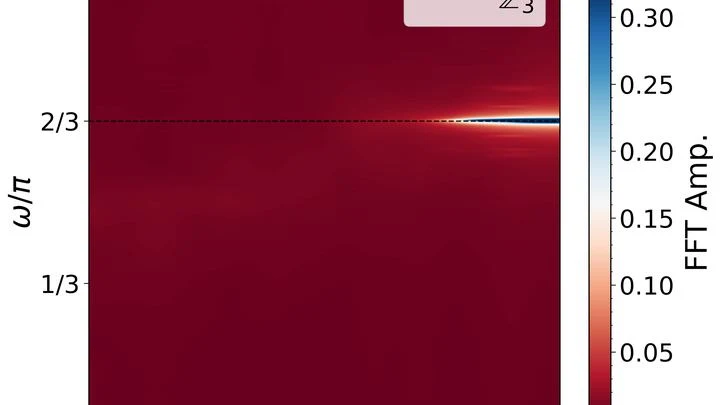
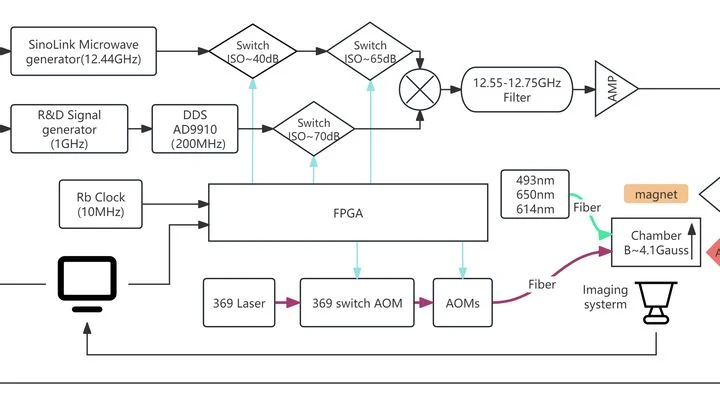
An orchestra of billions of cesium atoms struck a single note, and it sounded for 17 hours without fading. That’s no exaggeration: Chinese physicists created a continuous time crystal with a record-breaking lifespan. A time crystal is a system that breaks time symmetry, spontaneously pulsating in an unchanging rhythm.
The quantum vacuum is not a dead void but a boiling cauldron of probabilities. In some theories, our Universe is frozen in a metastable state: like superheated water, it's ready to explode into steam at the slightest nudge.
The heart doesn't beat like a metronome: its rhythm dances to the time of day. Each of us has a moment when our pulse hits its peak. This peak is like the hand of an internal clock, and it shifts from person to person.
But what moves that hand? Researchers gave people smartwatches and tracked them for nearly a month.
In boiling water you can see a prototype of a quantum trick: if part of the liquid turns into long-lived vapor bubbles, the main mass cools down. This is exactly what happens when you sharply jolt a system of interacting electrons: doublons flare up — pairs of particles that absorb excess energy and don’t decay for an astonishingly long time.
A single camera shot stores both a normal picture and a hidden map of how light rippled through the scene. Quantum entanglement makes this possible. Pairs of linked photons are generated: one visits the object, its twin takes a detour. Later, measuring the twin one way pulls out the brightness information.
A quantum computer measures a molecule's energy much like an old tape measure that only has markings every meter. If the actual length of a table is 2.37 meters, the tape shows “two and a bit,” and you can't do better. Physicists call this resolution: the step of the grid, finer than which you cannot go.
The authors of the new work turn this flaw into an advantage.
A swing can rock strongly or barely move. Usually, if left alone, it stays in its chosen mode. But in the microworld, things are different: a tiny membrane, oscillating under the action of a laser beam, can spontaneously jump from one amplitude to another.
If you carry a cup of coffee slowly and steadily around a room and then return to the same spot, nothing happens to the drink. But in the quantum world, things are different: a particle that makes such a loop comes back not quite the same. It picks up an elusive 'extra'—the geometric phase, which physicists call the Berry phase.
An ordinary pendulum swings at the same frequency as the push it receives. But in the quantum world, you can create a system that responds to a push two, three, or more times slower, as if it has its own rhythm. Such systems are called discrete time crystals.
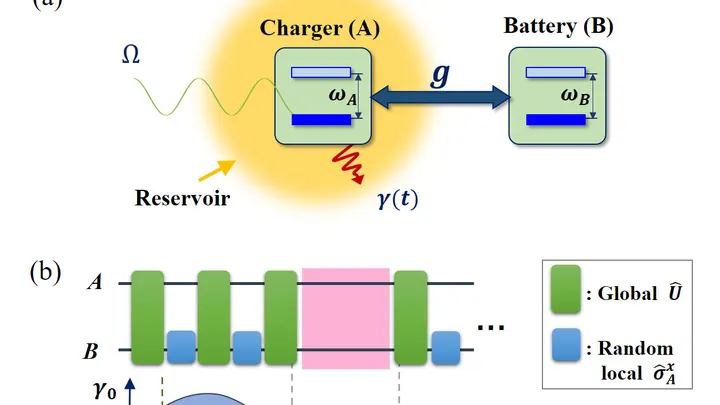
A quantum battery is not a box of chemicals but a chain of tiny magnets (spins) capable of storing energy. Its main trick: charge many particles at once, using their quantum entanglement. But there's a catch — not all entanglement works.
An eight-kilogram rhesus macaque can live up to forty years. A cat of the same weight rarely sees its twentieth birthday. This difference is no accident: across all primates, from tiny marmosets to gorillas, lifespan is markedly longer than in other mammals of similar body mass. Standard models linking lifespan to metabolic rate fall short here.
Qubits in a superconducting quantum computer are like tightly stretched strings. When a particle from space or from a radioactive decay flies by, it strikes these strings and they start to vibrate. This vibration disrupts the fragile quantum states, and computations go awry.
Atomic clocks are pendulums that tick at the frequency of light. Inside a trap, an aluminum ion hangs, and a laser probes it like a tuning fork. If the laser's frequency matches the atom's natural frequency, the atom responds. The clock's rate is checked against this response.
Two identical cars roll off the same assembly line. Body, wheels, steering — everything matches. Only one has a regular gasoline engine, while the other has a hybrid engine that can be tuned to the road. And the hybrid stalls after a couple of kilometers, while the gasoline one runs for tens.
The light an atom emits is not just a flash. It carries an imprint of the atom's state at the moment of emission. Physicists took a superconducting qubit, an artificial atom the size of a microchip, and made it glow into an open waveguide, like a bulb in a long corridor.
A typical quantum bit is destroyed by the slightest disturbance — heat, magnetic fields. Physicists made a pair of atoms work together so that disorder wouldn't erase the record. Information was encoded not in each atom individually, but in the difference of their states — like the tension of a rope between two buoys.
A water molecule resembles a tiny dumbbell: two hydrogen atoms attach to an oxygen atom at an angle. This dumbbell doesn't stay still: it stretches, compresses, and rotates. Each such motion has its own energy, like steps on a ladder.
A glowing dot in a vacuum chamber refuses to go out, even though the light source has long been switched off. A single ytterbium ion, held by electric fields, is stuck in an excited state, as if the electron inside it has forgotten how to return to its usual place.
A quantum processor is like an orchestra where each musician (qubit) must play their part precisely in time. But in reality, the instruments go out of tune: qubits lose energy, and their interactions get distorted. To tune this orchestra, you first need to record how it sounds right now: that is, measure the noise parameters and couplings.
A quantum battery is a device that stores energy in the quantum states of particles. In the new work, the battery was modeled as a pair of qubits — the tiniest carriers of information that can be in a "zero" state, a "one" state, or a mixture of both.
A quantum computer is like an orchestra where every musician must play with precision down to a billionth of a second. If one instrument goes out of tune, the whole symphony collapses. So scientists spent a year watching 27 qubits — the simplest cells of quantum memory.
A regular wall clock runs smoothly, but quantum clocks are a different story. They tick at random moments, and each tick can have a different duration. On average, if you watch such a clock for a long time, it will show the correct time. But at any given moment, its hand might jump forward by an unexpected amount.
Hot water sometimes freezes faster than cold — this is the Mpemba effect. In the quantum world, it’s even more astonishing: a system bubbling with disorder (with high entropy) can settle incredibly faster than one that is almost calm.
The solution lies in islands of silence within any system — regions untouched by the destructive noise of the environment.
Everything tends toward equilibrium: tea cools, a pendulum swings to rest. The measure of this movement is entropy — growing disorder. But sometimes hot water freezes before warm. The Mpemba effect isn't just a curiosity: it shows up in the quantum world too. Scientists have devised a way to control this paradox.
Turning CO₂ into fuel is like finding the one perfect way to pack billions of items into a suitcase. A classical computer tries options one after another, taking decades, while a quantum computer sees all combinations at once.
The task resembles a giant maze with a single exit among billions of dead ends. A conventional computer checks each corridor step by step — taking centuries. A quantum processor launches a wave that seeps through all paths at once. The correct route echoes back, amplifying, and the answer is found in hours. That’s exactly how the “peak” circuits worked in the new experiment.
A quantum system, once born, does not forget it. Even after dozens of lifetimes, a trace of the initial state remains in its decay: a slowly decreasing power-law tail. For two fluorescent dyes, erythrosine B and eosin Y, this tail has been observed for the first time in two spectral channels simultaneously.
A tuning fork cut from a perfect metal rings at a single frequency. Its sound is as pure as a mathematical formula. But clamp it in a vise or dip it in a viscous liquid, and the tone smears, picks up noise, and loses its sharpness. The nucleus of scandium-45 behaves much the same way when placed in a crystal lattice.
Imagine a soloist trying to blend their voice with a choir. If the choir sings in unison, the soloist's voice stands out for a long time; but if the choir scatters across a wide range — from deep basses to ringing sopranos — the soloist dissolves almost instantly. In quantum physics, the role of such a choir is played by a thermal bath — a massive environment.
Strike a gong and the sound fades in layers: the low hum lingers longer, the high overtones vanish first, leaving silence behind. So too a qubit, living its quantum life, leaves not one but three echoes of its own past.
A postal money order doesn't arrive instantly but after a set delay, and the amount credited to the recipient's account ends up larger than what the sender deposited in cash. That's roughly how the new protocol, dubbed temporal quantum energy teleportation (TQET), works.
In ordinary quantum energy teleportation, two parties, Alice and Bob, share a common quantum state.