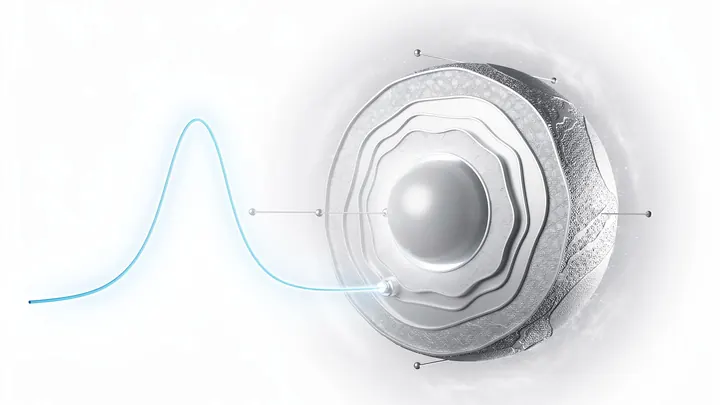
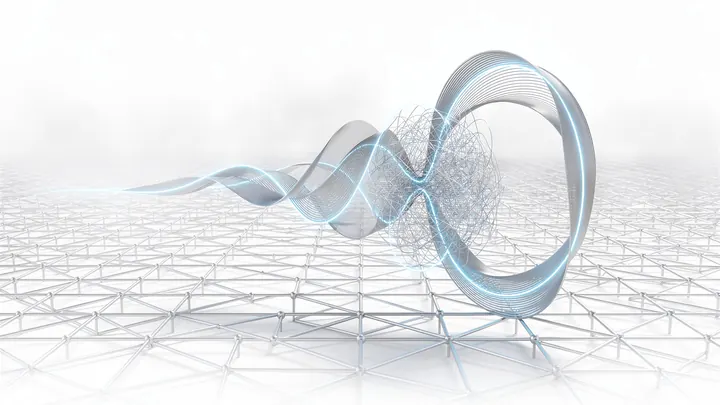
A nonadiabatic transition is a quantum mechanical process in which a system moves between energy levels when an external parameter changes rapidly compared to the system's natural timescale. In contrast to adiabatic transitions, where the system slowly follows a changing Hamiltonian and remains in the same instantaneous eigenstate, nonadiabatic transitions involve sudden changes that cause the system to jump to a different energy level. These transitions are fundamental to understanding how quantum systems respond to fast perturbations and are key to phenomena like Landau-Zener tunneling and avoided crossings.
History
The theoretical framework for nonadiabatic transitions was developed independently by Lev Landau and Clarence Zener in 1932, along with contributions from Ernst Stueckelberg. Their work laid the foundation for understanding quantum dynamics in rapidly changing environments.
How it works
When a parameter (such as an external magnetic field or molecular geometry) changes quickly, the system's state cannot adjust smoothly to remain in the same eigenstate. Instead, the wavefunction mixes with other eigenstates, leading to a probability of transitioning to a different energy level. The probability of such a transition is often described by the Landau-Zener formula, which depends on the speed of the parameter change and the energy gap between levels.
In practice
Nonadiabatic transitions are exploited in quantum control techniques, such as rapid adiabatic passage and stimulated Raman adiabatic passage, and are also relevant in molecular physics for understanding chemical reaction dynamics and in spintronics for manipulating electron spins.
Fun fact
The Landau-Zener formula, which describes nonadiabatic transitionprobabilities, is so general that it applies not only to quantum systems but also to classical wave propagation in slowly varying media, such as light passing through a chirped grating.
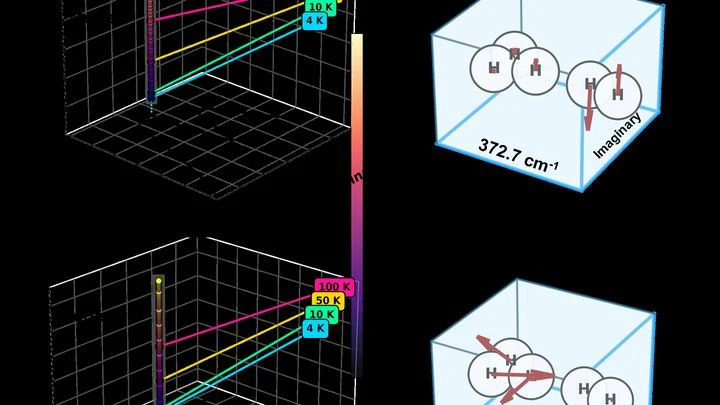
In a molecule, hydrogen sometimes resembles not a ball but a wave that can leak through an energy barrier, like a ghost through a wall. Chemists call this tunneling, and it underlies many processes, from enzyme function to charge transfer in materials. But how exactly does a molecule find its path for such a transition?
When a fluid flows around an obstacle, it spawns vortices and shock waves. Describing their behavior means solving a nonlinear equation in which the flow velocity depends on itself. Classical supercomputers spend days on this, while quantum computers have barely been used: their native language is linear operations, but fluids are inherently nonlinear.
At low temperatures, many materials become superconductors — current flows without resistance. But how exactly does this happen if electrons were initially trapped in an insulator? Half a century ago, Philip Anderson suggested that the answer lies in a special quantum dance of particles.
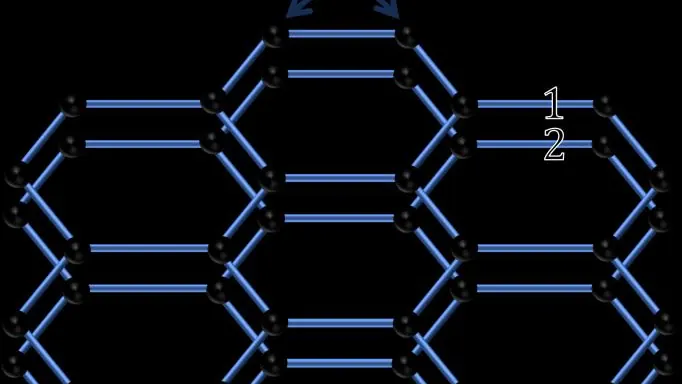
A honeycomb made not of wax but of atoms is graphene — a flat crystal just one atom thick. Electrons in it are like runners at an intersection: they speed up here, slow down there, but never get stuck at the edge. Physicists call such a sheet "topologically trivial," meaning its edges are perfectly ordinary, with no special properties.
Now, let's knock out a single atom from the honeycomb.
The Mpemba effect is a mystery where hot вода sometimes freezes faster than warm water. Usually this is attributed to how вода loses heat and энтропию (a measure of disorder). But in a glass of water, chaos prevents a precise model.
Physicists built a quantum model: a particle in a well with two depressions separated by a barrier.
The classical Mpemba paradox — hot water freezes faster than cold — has teased scientists for centuries. Only recently has nonequilibrium statistical mechanics explained it: it’s all about boundary conditions; the system seems to seek an excuse to “hit the wall” and speed up cooling.
A black hole is not a dead object. After a disturbance, such as merging with another hole, it rings like a bell. This ring is not just a sound but a complex set of damped oscillations called quasinormal modes. Their frequency and damping rate depend on the hole itself: its mass, charge, and spin.
Light passing near a massive body slightly changes its path — gravity pulls even on rays. In ordinary situations, a beam of light from a distant star is squeezed as if drawn together by an invisible rubber band. This property is called the null convergence condition: gravity makes light trajectories converge rather than diverge.
In the quantum world, particles can merge into a single liquid that flows without friction. One of its most mysterious forms is the fractional quantum Hall liquid. In it, electrons or atoms move as a single vortex, and their charge splits into fractions, like a pie cut into perfectly equal slices.
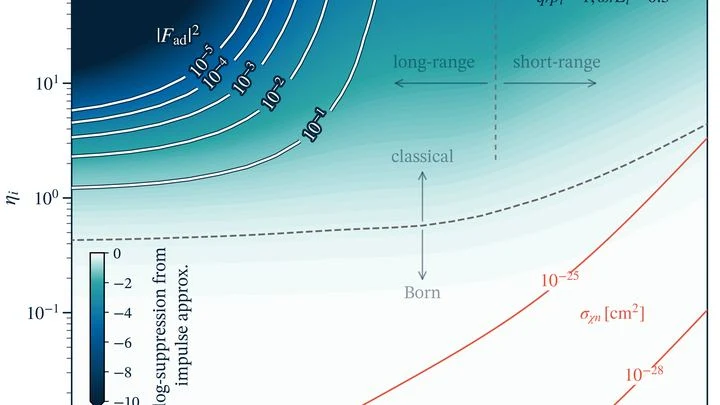
A billiard ball slams into another. Impact, and the balls scatter. But if the push is not sharp but very gentle, the balls just roll together without bouncing. An atom behaves much the same way when hit by a dark matter particle.
In the scorching heart of a dying star, an invisible stream is born — a neutrino gas. The particles race through matter almost without stopping, but when their density is enormous, they start to feel each other. Old calculations described this as a jostle in a crowd: each shove changes direction, but no connection arises between passersby.
Deep inside the atomic nucleus of thorium-229, there's a stiff lever. To flip it from one position to another, you need to apply force, and that usually takes time. This isotope has two very close energy levels, and the transition between them can be triggered by a laser pulse.
A compressed spring can sit for years without moving. It seems frozen forever, but inside the metal, atoms slowly rearrange, and one day the spring clicks, settling into a new, more relaxed position.
A long chain of atoms, each a tiny magnet. They talk to each other and to a common field, like musicians in an orchestra who hear both the conductor and their neighbors. When the external field changes, the orchestra either plays out of sync or all instruments come in together: that's a quantum phase transition.
A swing can rock strongly or barely move. Usually, if left alone, it stays in its chosen mode. But in the microworld, things are different: a tiny membrane, oscillating under the action of a laser beam, can spontaneously jump from one amplitude to another.
If you carry a cup of coffee slowly and steadily around a room and then return to the same spot, nothing happens to the drink. But in the quantum world, things are different: a particle that makes such a loop comes back not quite the same. It picks up an elusive 'extra'—the geometric phase, which physicists call the Berry phase.
A pot of soup forgotten on the stove cools to room temperature. It seems everything has come to rest. But if you look inside with a quantum magnifying glass, you'll find that water molecules haven't frozen: they continue their dance. It's just that now the dance is steady, not turbulent like when boiling.
The core of a neutron star can be likened to a taut string of super-nuclear density. Sound traveling along it is the oscillation of pressure, whose speed $$c_s$$ betrays the stiffness of matter. New research shows that this cosmic string does not hum monotonically.
At the heart of an active galaxy, where interstellar gas spirals into a dazzling accretion disk around a supermassive black hole, a boundary is born through which even sound cannot break. This acoustic horizon was long considered frozen ripples on water.
A stone falls into a pond, and ripples spread across the water. But if the stone is very small and the water is not quite ordinary, the ripples pass right through it, as if it weren't there.
A chemical reaction resembles passing through a turnstile: a crowd creates chaos and gets stuck, while an orderly line moves. In the quantum world, however, when the jostling subsides, the barrier can become ghostly — a particle passes through it as if the turnstile has vanished.
When you flip a switch, the light doesn't come on immediately — electrons in the wires need time to 'get going' and move together. In ordinary metals and semiconductors, current builds up gradually, like water in a hose when you first open the tap.
About 380,000 years after the Big Bang, the universe cooled enough for electrons and protons to finally combine into neutral hydrogen. Although this event is called recombination, it was actually their first meeting — the heat had kept them from sticking together until then.
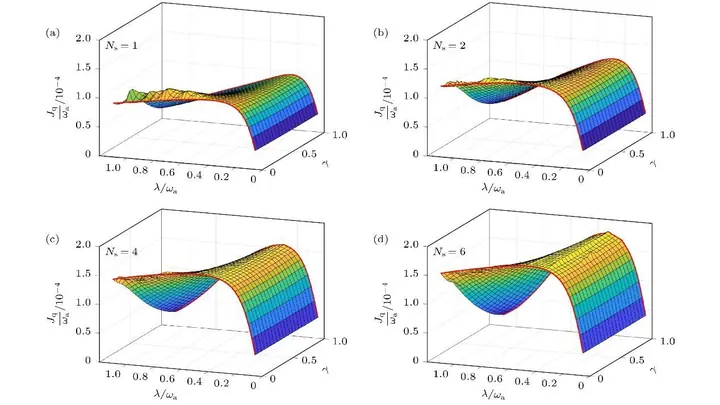
Light and atoms, like dancers, can move in sync or out of step. When their interaction is anisotropic (that is, direction-dependent) the dance gets trickier. In a new study, physicists considered a model where many atoms (qubits) collectively interact with an anisotropic light field, and each component is connected to a thermal reservoir.
In the quantum world, the path to calm sometimes resembles a paradoxical race: starting further from the finish, the system reaches equilibrium faster. This effect, a quantum analog of the Mpemba phenomenon, is due to the rapid growth of entropy — a measure of disorder.
A crowd of people moves freely across a square, but suddenly freezes in place without changing their positions. Everyone stays where they were, but motion stops. This is exactly what a symmetric mass generation transition looks like: the system gains rigidity, yet its symmetry remains untouched.
A chain of red phosphorus atoms is like a train where the cars are atoms and the couplers are chemical bonds. Sometimes the couplers are stronger, sometimes weaker, and that affects how electrons run through the train.
Electrons in a conductor behave like a crowd on an escalator: each one moves on its own, but together they create a flow. If you make them circle around a ring, their angular momentum (a measure of rotation) can couple to a magnetic field, like gears in a clock.
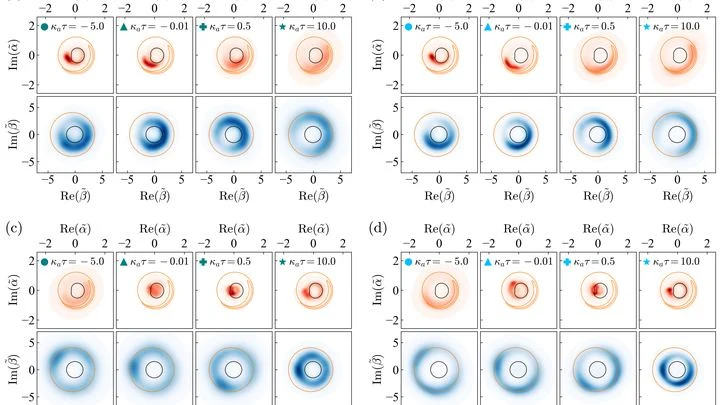
Light trapped in a tiny cavity is like a pendulum that gets pushed harder and harder. At first, it swings smoothly and predictably, like an ordinary clock. But if you push it hard enough, the motion becomes strange: the pendulum seems to be in two extreme positions at once.
Finding the largest group of strangers among a crowd is a challenge that pops up in logistics, chemistry, and scheduling. Ordinary computers hit a black hole here: not from lack of power, but because the problem's structure swallows any classical solution.
The new quantum algorithm sidesteps the trap.
Picture a chef flicking water onto a sizzling skillet. The droplets instantly hiss and evaporate, giving immediate feedback on the temperature — far quicker than any thermometer. This intuitive idea underpins a new approach in quantum thermometry.
Ice cubes in a glass melt, and the water mixes on its own. Many quantum systems behave this way: particles exchange energy, and after a while, order disappears. But if you add a spoonful of honey to the glass, mixing slows down, and in intense cold, the water freezes into glass — without a crystal lattice, but also without flow.
In the world of atoms, any external influence can turn a neat order into chaos. Usually, energy losses only increase entropy — a measure of disorder. But physicists discovered the opposite: sometimes losses help the system maintain stability.
Hot water sometimes freezes faster than cold — that's the classic Mpemba effect. In the quantum world, its counterpart is even more astonishing: tiny particles can reach equilibrium many times faster than expected, and what helps them is not forgetfulness, but memory.
Atoms, like strands in a braid, follow a strict rule: if one strand is 'charged', its neighbors must stay silent. This phenomenon, Rydberg blockade, allows stable quantum patterns to be woven.
In such patterns, topological order emerges: a structure where the overall weaving pattern matters more than individual loops.
Quantum walking is not a series of random steps, but a musical score where the piano of space sounds under the conductor's baton of the internal state. The coin sets the tone. Until now, it was believed that detuned keys (phase disorder) mute any melody, leading to Anderson localization — a ringing silence.
A crowd in a square. At first, everyone spins to their own rhythm, but suddenly the music changes, and they all start moving in sync, as one. That's roughly how electrons behave in some metals: they either cling to magnetic impurities or break away and form a collective order.