How Squeezing Rubber Gives Rise to Elusive Angles express
A sheet of rubber is squeezed from two sides. At first glance, it's just deformation. But inside, deep within the material, a hidden order awakens. This is not just wrinkles on the surface. It's the birth of special zones where vibrations become trapped, as if in a cage.
Previously, it was thought that such effects require intricate lattices and periodic structures. Now it turns out that a solid, homogeneous piece of hyperelastic material can do it on its own. The secret lies in strong and non-uniform compression. When the material is squeezed differently in different directions, a conflict arises between how it wants to deform and how it is forced to. This conflict gives rise to a complex stress pattern. It obeys equations similar to those describing the behavior of electrons in exotic materials.
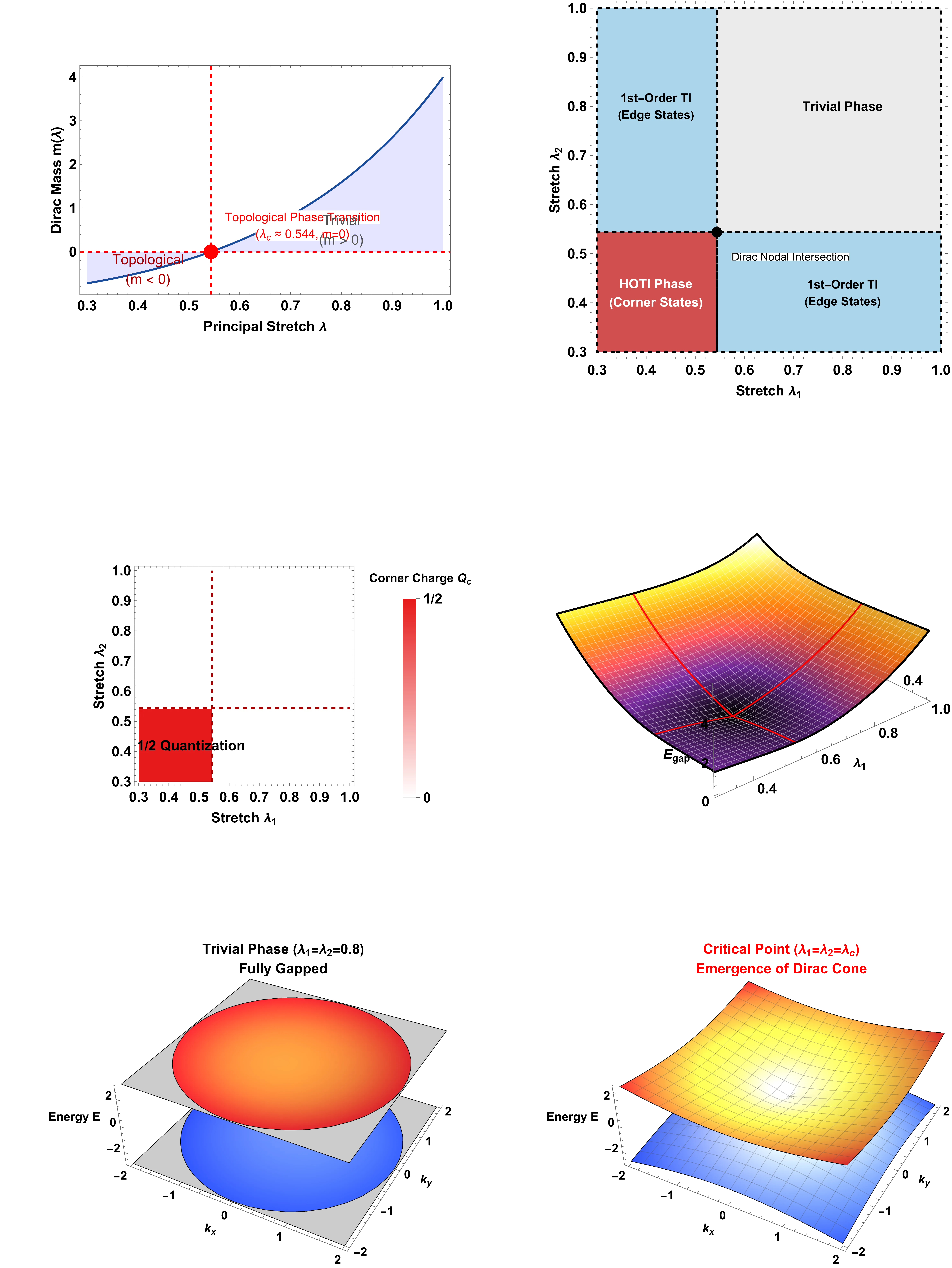
And here's the astonishing part. Under extreme compression, not just surface waves appear: that's the first order, known for a long time. Vibrations emerge that run only along edges — the second order. And finally, vibrations fully localized at corners, with zero energy — the third order. In solid rubber, invisible 'wires' and 'points' spontaneously arise where vibrations get stuck forever. The authors not only calculated this theoretically but also verified it through nested Wilson loops and fractional corner charges — mathematical tools that confirm the topological nature of the phenomenon.
So ordinary compression becomes a tool for creating ultra-sensitive sensors or signal-processing devices. The material remains intact, but its internal life becomes incredibly rich.
Original abstract
as written by the authors arXiv:2606.22710
Higher-order topological insulators (HOTIs) have revolutionized our understanding of wave localization, extending the bulk-boundary correspondence to lower-dimensional hinges and corners. Thus far, the realization of mechanical HOTIs has relied exclusively on discretely engineered metamaterials or periodic phononic lattices. Here, we report a fundamental paradigm shift by demonstrating that continuous, homogeneous hyperelastic manifolds undergoing finite multiaxial deformations naturally harbor intrinsic higher-order topological phases. By extending the generalized Stroh-Lie impedance formalism into a fully coupled 3D finite-strain framework, we map the highly nonlinear orthotropic geometric frustration onto a four-band effective Dirac Hamiltonian spanned by Clifford $$\Gamma$$-matrices. We reveal that macroscopic orthogonal stretches act precisely as competing Dirac mass terms, driving the continuous spatial transitions of topological domain walls and triggering a breakdown of $$C_{4v}$$ spatial symmetry. Remarkably, we analytically prove that beyond classical 2D surface wrinkling (1st-order topology), concurrent multiaxial extreme compression unconditionally triggers the emergence of 1D hinge states (2nd-order) and completely localized 0D zero-energy corner states (3rd-order). We further extend this static bifurcation framework into the elastodynamic regime, proving the existence of mid-gap localized vibrational modes. The theoretically derived topological phase diagram, nested Wilson loops, and fractional corner charges are comprehensively verified. Finally, we propose a concrete experimental realization using electro-active dielectric elastomers, enabling the dynamic programming of 0D topological singularities.
Topological protection makes vibrations at corners incredibly resistant to disturbances and defects — much like a tuning fork keeps ringing at a single note even if you scratch it.
In Charles Stross's novel 'Accelerando', 'topological quantum computers' are mentioned, where information is protected from errors precisely thanks to such exotic states.