How Squeezing Rubber Gives Rise to Elusive Angles express
A sheet of rubber is squeezed from two sides. At first glance, it's just deformation. But inside, deep within the material, a hidden order awakens. This is not just wrinkles on the surface. It's the birth of special zones where vibrations become trapped, as if in a cage.
Previously, it was thought that such effects require intricate lattices and periodic structures. Now it turns out that a solid, homogeneous piece of hyperelastic material can do it on its own. The secret lies in strong and non-uniform compression. When the material is squeezed differently in different directions, a conflict arises between how it wants to deform and how it is forced to. This conflict gives rise to a complex stress pattern. It obeys equations similar to those describing the behavior of electrons in exotic materials.
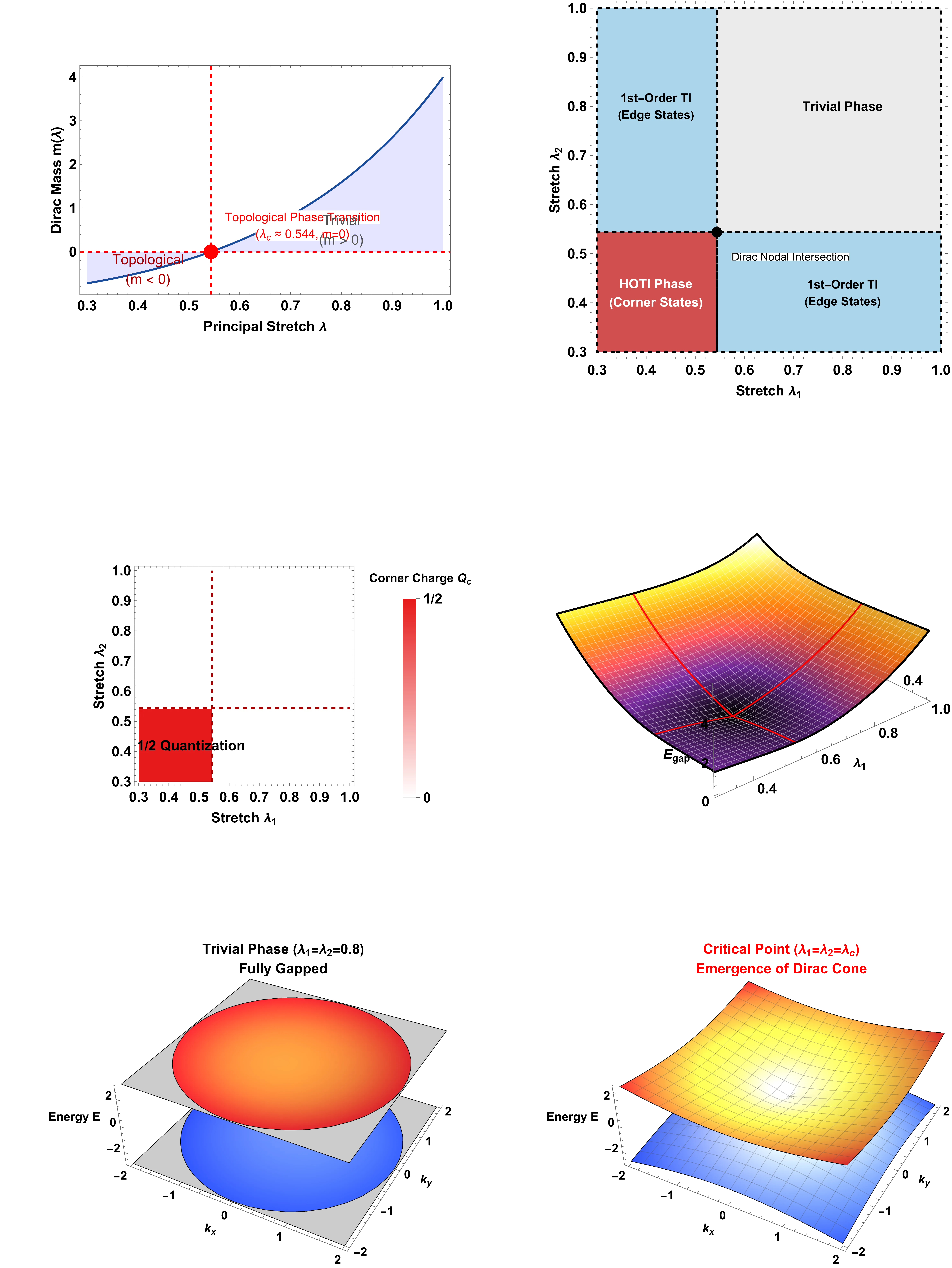
And here's the astonishing part. Under extreme compression, not just surface waves appear: that's the first order, known for a long time. Vibrations emerge that run only along edges — the second order. And finally, vibrations fully localized at corners, with zero energy — the third order. In solid rubber, invisible 'wires' and 'points' spontaneously arise where vibrations get stuck forever. The authors not only calculated this theoretically but also verified it through nested Wilson loops and fractional corner charges — mathematical tools that confirm the topological nature of the phenomenon.
So ordinary compression becomes a tool for creating ultra-sensitive sensors or signal-processing devices. The material remains intact, but its internal life becomes incredibly rich.
Topological protection makes vibrations at corners incredibly resistant to disturbances and defects — much like a tuning fork keeps ringing at a single note even if you scratch it.
In Charles Stross's novel 'Accelerando', 'topological quantum computers' are mentioned, where information is protected from errors precisely thanks to such exotic states.