A first-orderphase transition is a sudden, discontinuous change in a system's state at a specific threshold of temperature, pressure, or another external parameter. Unlike smooth, continuous transitions, first-order transitions involve an abrupt jump in properties like density, entropy, or magnetization, accompanied by the release or absorption of latent heat. Classic examples include boiling water, melting ice, and the sudden appearance of superconductivity in certain materials at their critical temperature.
History
The concept was formalized in the late 19th century by Paul Ehrenfest, who classified phase transitions by the order of discontinuity in thermodynamic derivatives. The term 'first-order' refers to the first derivative of the free energy (e.g., entropy or volume) being discontinuous.
How it works
During a first-ordertransition, the system passes through a mixed phase where regions of the old and new states coexist. The transition occurs when the free energy of the new phase becomes lower than that of the old phase, but a barrier prevents spontaneous conversion. The system must overcome this barrier via nucleation — small fluctuations create seeds of the new phase, which then grow if they exceed a critical size. This is why supercooled water can remain liquid below freezing until a disturbance triggers rapid crystallization.
In practice
First-ordertransitions are exploited in heat storage materials (phase-change materials), in shape-memory alloys used in actuators, and in understanding geological processes like magma crystallization. They also underpin the operation of many thermal switches and sensors.
Fun fact
In a first-ordertransition, the system can exhibit hysteresis — the transition temperature differs depending on whether you are heating or cooling, because the system gets 'stuck' in the metastable phase.
Graphene, a sheet of carbon just one atom thick, can change its magnetic properties the way water changes shape: sometimes flowing, sometimes freezing into ice. In a new study, physicists peered inside this process for the first time using a sensor the size of a needle tip.
When two atomic nuclei smash together, a tiny fireball is born. It lives for an instant, but inside, entire epochs pass: compression, heating, expansion. Physicists have learned to eavesdrop on this process, and their "microphone" is the pairs of electrons and positrons that fly out of the ball at different stages.
In the new work, two scenarios were compared.
In a binary star system, one star pulls matter from its companion. Over centuries, this material settles onto the surface of a neutron star — the ultra-dense remnant of a dead star. This process, called accretion, usually proceeds smoothly. Gravity behaves as general relativity predicts, without surprises.
Dark matter remains one of the greatest mysteries of modern physics. Back when Vera Rubin observed galaxy rotation, she proved that visible matter is insufficient to keep stars from flying apart.
Diamond is a symbol of perfection, but its true magic is revealed through flaws. Perfect lattice purity gives transparency and hardness, while defects, such as color centers, open a portal to the quantum world, becoming the foundation for quantum computers and quantum sensors.
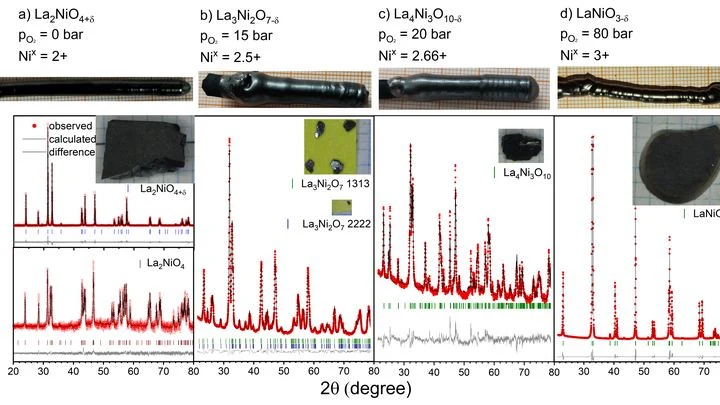
The nickelate family consists of layered crystals, like a stack of pancakes: nickel and oxygen layers alternate with lanthanum spacers. Two years ago, superconductivity was discovered in them — the ability to conduct electricity without resistance when cooled.
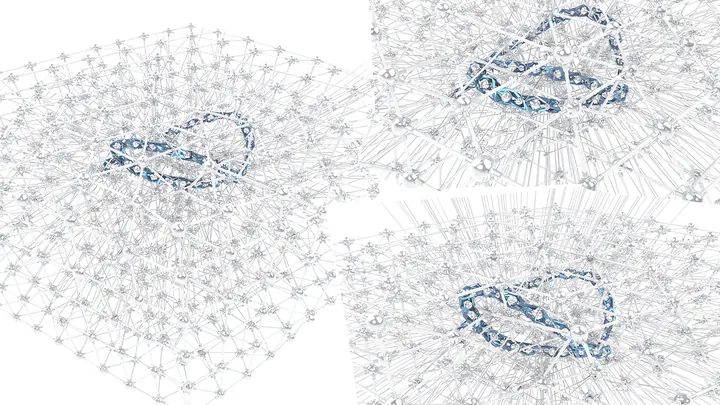
A sheet of rubber is squeezed from two sides. At first glance, it's just deformation. But inside, deep within the material, a hidden order awakens. This is not just wrinkles on the surface. It's the birth of special zones where vibrations become trapped, as if in a cage.
Previously, it was thought that such effects require intricate lattices and periodic structures.
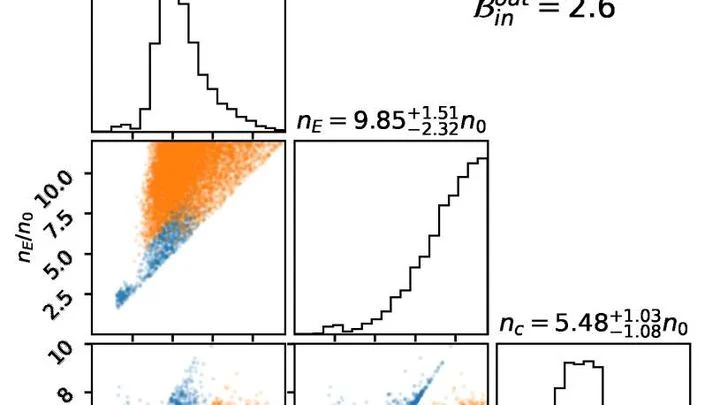
Neutron stars are cosmic 'ice cubes' of unimaginable density: a tablespoon of their material would outweigh Mount Everest. It was a mystery what lay in their cores: ordinary neutron matter (a giant atomic nucleus) or exotic quark matter, where particles are not bound into neutrons.
In the seething cauldron of the early universe, the vacuum, like a supercooled liquid, could boil with bubbles of a new phase. For a long time, physicists pinned their hopes on these bubbles as a source of primordial black holes (PBHs)—ideal candidates for dark matter.
Spread a handful of coins on the table. Each coin is a possible outcome: heads, tails, or something else. If we know how chaotic this set is (its entropy), which combinations of probabilities will we encounter more often? It turns out the answer depends on how much chaos we allow.
In a pot of boiling water, steam bubbles rise and pop. In the quantum world of a superfluid, bubbles behave differently: they can collide and give birth to vortices — tiny swirling flows, like whirlpools in a river.
Scientists modeled such a liquid using a holographic approach.
A pot of water sits on the stove. The temperature drops: plus one degree, zero, minus one — the water stays liquid. But at some point, a light breath is enough to make the whole mass instantly freeze into ice. Physicists call such jumps first-order phase transitions.
At the center of a black hole lies a singularity — a point where spacetime is crushed infinitely. Black holes can change state, much like water freezing or boiling. Usually, these transitions are noticed by observing the hole's surroundings.
The magnetic refrigerator of the future won't hum with a compressor. Instead, it will cool your groceries by exploiting a special material that heats up in a magnetic field and cools down when the field is removed. This cycle resembles the compression and expansion of gas in a conventional fridge, but here a magnet does the work of a piston.
Water in a pot, when heated, doesn't boil: it turns into ice. That's roughly how ultracold atoms behave in an optical lattice — a light-based crystalline grid that holds atoms in place. Scientists simulated this system on a computer to understand how order changes as temperature rises.
Water always flows downhill, and heat from hot to cold. That's what энтропия dictates. But the quantum world finds loopholes.
Physicists made light particles interact with hot and cold environments in an uncertain sequence — like a flipped coin that hasn't landed yet.
An orchestra without a conductor plays a complex piece. The listener hears the overall music but wants to understand who leads the melody and who merely echoes it in unison.