A second-orderphase transition is a continuous transition between phases of matter where the order parameter—a quantity that distinguishes the phases—goes to zero smoothly at the critical point. Unlike first-order transitions (like boiling water), there is no latent heat and no coexistence of phases. Instead, fluctuations of the order parameter become large and correlated over long distances, leading to universal behavior near the critical point. Examples include the ferromagnetic transition (where magnetization vanishes) and the superconducting transition in zero magnetic field.
History
The modern theory of second-orderphase transitions was developed in the 1960s and 1970s, with key contributions from Lev Landau (Landau theory), Kenneth Wilson (renormalization group), and Leo Kadanoff (scaling ideas). Wilson's work earned him the 1982 Nobel Prize in Physics.
How it works
As the system approaches the critical temperature, the free energy landscape flattens, so the order parameter can fluctuate strongly. These fluctuations have a characteristic length scale (correlation length) that diverges at the critical point. This divergence leads to scale invariance: the system looks the same at all length scales, which is why critical exponents are universal across very different systems. The transition is driven by the competition between energy (which favors order) and entropy (which favors disorder).
In practice
Second-ordertransitions are exploited in magnetic storage (where the transition temperature determines data stability), in superconducting magnets, and in understanding critical phenomena in diverse fields from cosmology to biology.
Fun fact
Near a second-orderphase transition, the system becomes so sensitive that its response to external fields (like magnetic susceptibility) can diverge to infinity, a phenomenon called critical opalescence in fluids.
Electrons in an ultra-clean gallium arsenide film behave like a crowd at a crossroads, where the tilt of the magnetic field sets the direction. At zero tilt, they form a compressible liquid of composite fermions, particles made of an electron and a pair of vortices.
A transparent film of bismuth tungstate sits on a substrate and does not conduct electricity. Three minutes in a cloud of nitrogen plasma, and it turns black, with resistance dropping by a factor of a billion.
Graphene, a sheet of carbon just one atom thick, can change its magnetic properties the way water changes shape: sometimes flowing, sometimes freezing into ice. In a new study, physicists peered inside this process for the first time using a sensor the size of a needle tip.
In a glass of water, oil gathers into droplets: that's equilibrium separation dictated by chemistry. But there are systems where order arises not from rest but from a constant flow of energy.
A sheet of rubber is squeezed from two sides. At first glance, it's just deformation. But inside, deep within the material, a hidden order awakens. This is not just wrinkles on the surface. It's the birth of special zones where vibrations become trapped, as if in a cage.
Previously, it was thought that such effects require intricate lattices and periodic structures.
If you squeeze water between two glass plates so that only two layers of molecules fit, it becomes something between a liquid and ice. At room temperature, molecules in such a trap still move but arrange themselves into a semblance of a crystal lattice.
If you check where an electron is every second, its quantum properties change. It's like a child playing hide-and-seek but constantly being called by name: they freeze and stop running. In the particle world, such a "caller" is a measurement. It prevents particles from freely forming a shared quantum state, or entanglement.
An orchestra without a conductor is playing, and suddenly, without any visible cue, the violins grow louder and the woodwinds shift slightly in time. From the outside, nothing seems to have changed, but inside the ensemble, a regrouping has occurred. This is roughly how small physical systems behave during so-called third-order pseudotransitions.
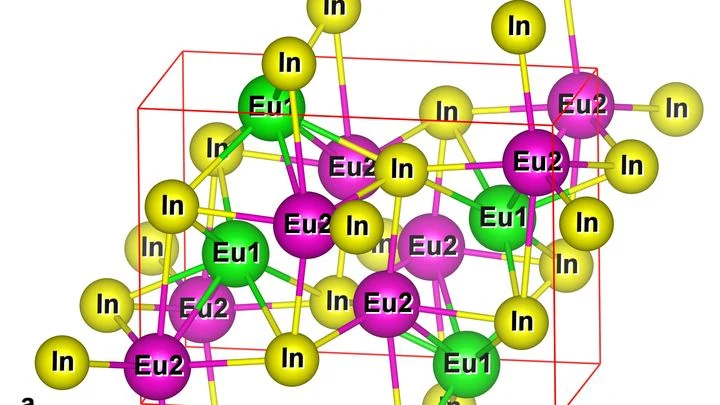
A piece of europium-indium alloy, when cooled in a magnetic field, behaves like water that does not freeze all at once but first in one corner of the glass, then in another.
A laser beam inside a special crystal spontaneously turns into a “Schrödinger’s cat”—a mixture of two states. Erwin Schrödinger dreamed up this paradox for an atom, but now physicists see it happen with an entire stream of photons.
Light is like a company of soldiers on a parade ground.
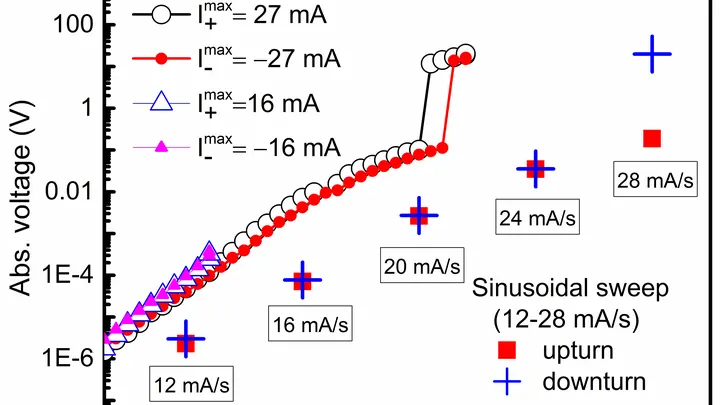
An ordinary conductor carries current equally in both directions, like a door that swings both inward and outward. A diode, by contrast, is a door with a self-closing hinge: it opens easily one way but pushes back the other.
A magnetic film divided into tiny arrow-shaped cells behaves like a crowd in a square. While it's cold, all arrows point in the same direction — perfect order. Heat the film, and the arrows start darting around like pedestrians who have lost their purpose. Somewhere between these extremes, there is a moment when the system stops being uniform but hasn't yet dissolved into random noise.
Inside a fuel cell, protons must race through a solid material like commuters through turnstiles at rush hour. If the turnstiles are sparse and narrow, the current is weak. In the past, to find a material with good proton conductivity, chemists had to screen compounds almost blindly, one by one.
The crystal CeRh₂As₂ behaves like a switch: cool it down and it becomes a superconductor, then bring a magnet close and it abruptly jumps to another superconducting state. Such behavior is rare: most superconductors have only one state, but here there are two, separated by a sharp boundary.
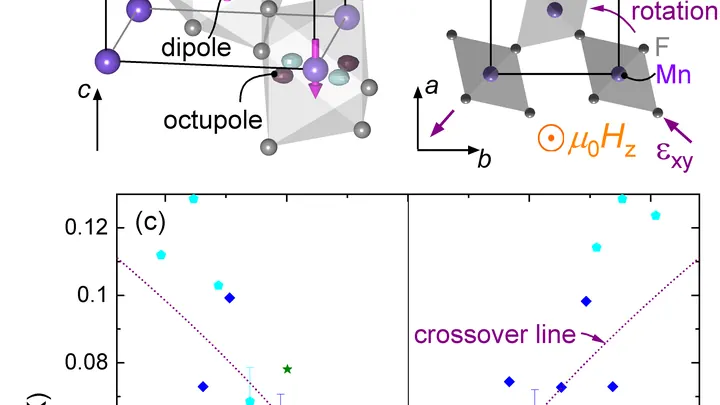
In a manganese fluoride crystal, atoms are lined up like soldiers in formation. But within this formation lies a hidden pattern: the magnetic moments of the atoms point in opposite directions, and the pattern itself changes when the crystal is rotated.
Ice cubes in a glass melt, and the water mixes on its own. Many quantum systems behave this way: particles exchange energy, and after a while, order disappears. But if you add a spoonful of honey to the glass, mixing slows down, and in intense cold, the water freezes into glass — without a crystal lattice, but also without flow.
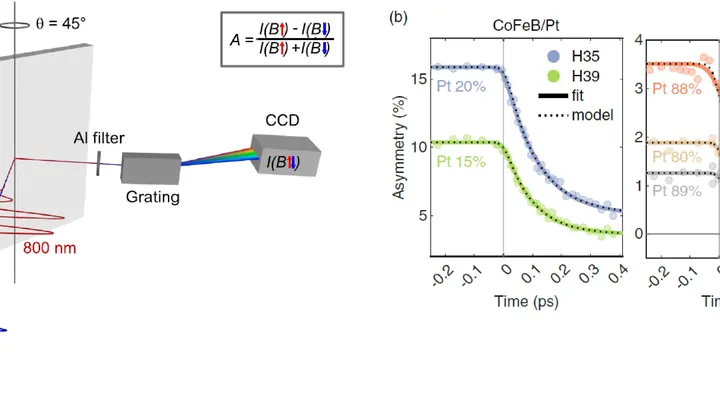
A fridge magnet holds on thanks to tiny internal arrows: each one like a miniature compass. If you hit the metal with an ultrashort flash of light, these arrows start to jitter chaotically, and magnetism melts away in a millionth of a billionth of a second. Previously, such 'melting' was too fast to observe.
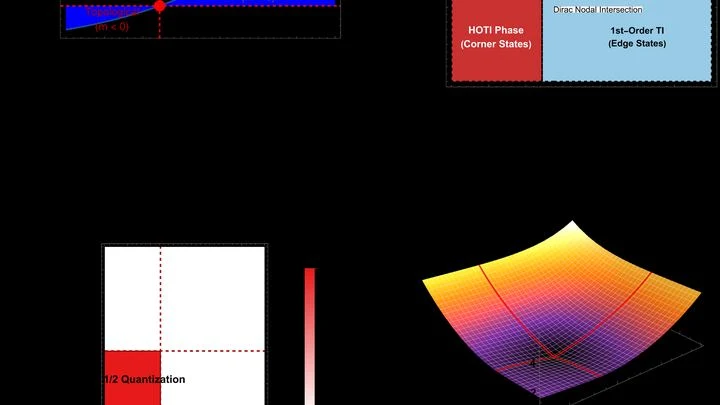
In a chain of cold spins stretched along a single line, order and disorder can intertwine into a pattern that defies the usual rules. Two states of matter, two kinds of "order," are separated by a crossroads where the roads do not converge but diverge.