Sailing a Solar Yacht Through Alien Worlds express
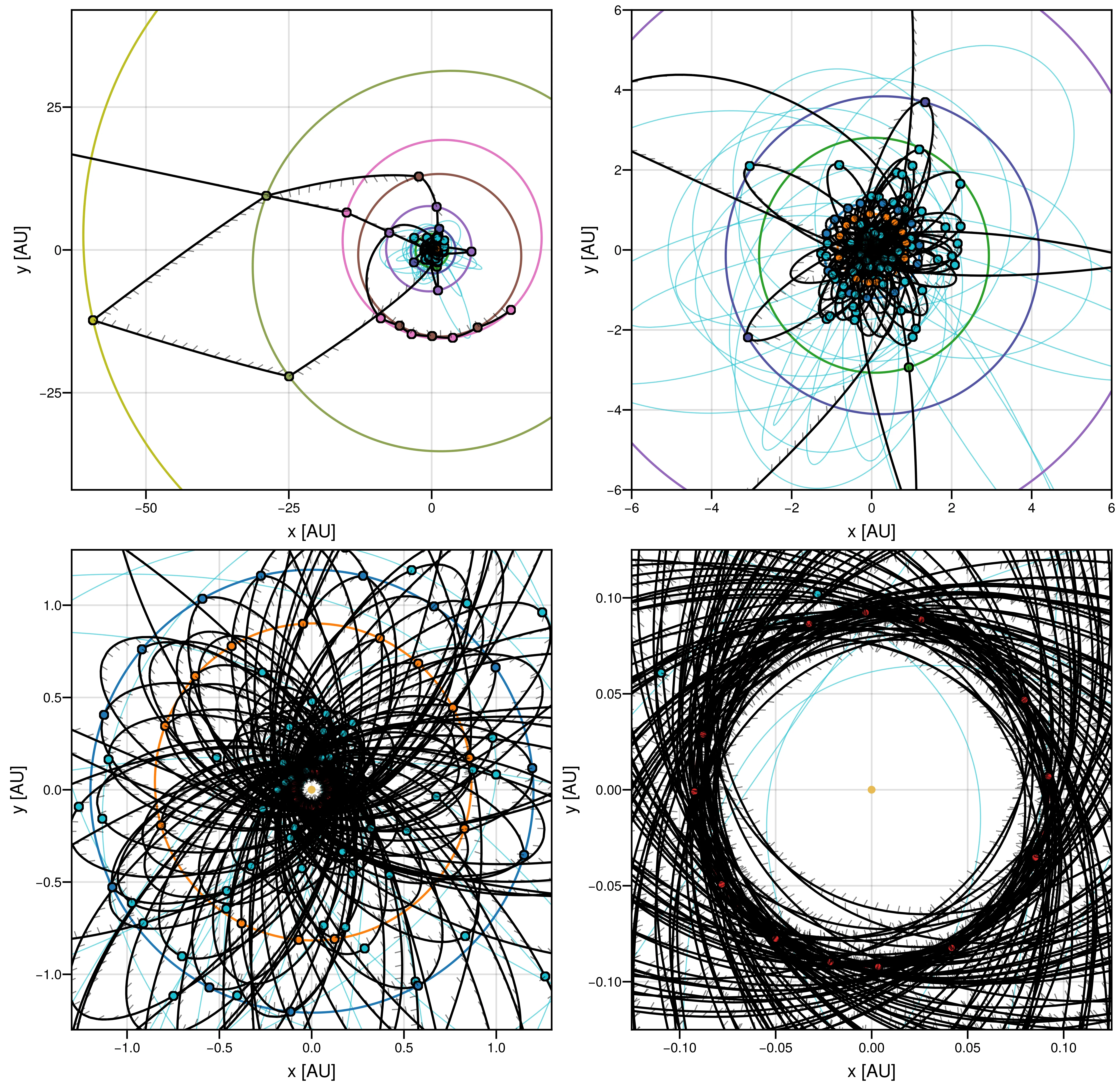
A solar sail doesn't move on water but in space, and it's pushed not by wind but by the pressure of sunlight. Such a spacecraft can fly for years without spending a drop of fuel. Steering it is like sailing a yacht across an ocean where the currents are planetary gravity and the gusts of wind are shifting sunlight. The task from a recent competition: fly through an entire planetary system, visiting a hundred different objects along the way, and bring back as much scientific data as possible.
Competitors, including TheAntipodes, broke the problem into stages. First, they sifted through thousands of entry options to find the most promising ones. Then, like in chess, they calculated chains of gravity assists many moves ahead. In such a maneuver, the sailcraft uses a planet's gravity to speed up or turn, like a slingshot. Finally, they refined the rough route to the smallest detail: simultaneously adjusting encounter times, angles, and sail orientation to squeeze out maximum scientific points. For this, they used a method that solves such puzzles without losing precision, even when there are hundreds of variables.
The final route included 133 flybys and earned 337,878 points — third place. The best solutions from different teams turned out to be similar, as if the system itself hinted at the optimal path. This experience shows that even seemingly fantastic journeys under solar sail can be planned with earthly mathematical rigor.
The pressure of sunlight at Earth's orbit is about 9 micronewtons per square meter: that's like the weight of a mosquito evenly spread over an A4 sheet of paper.
A similar plot appears in Arthur C. Clarke's novel "The Wind from the Sun," where solar-sail yachts race from Earth to the Moon.