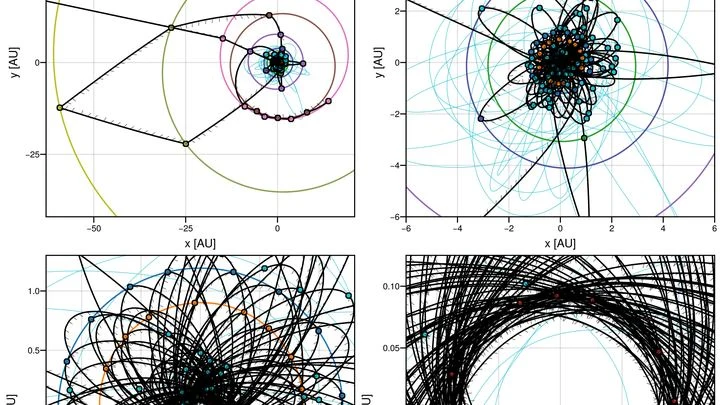
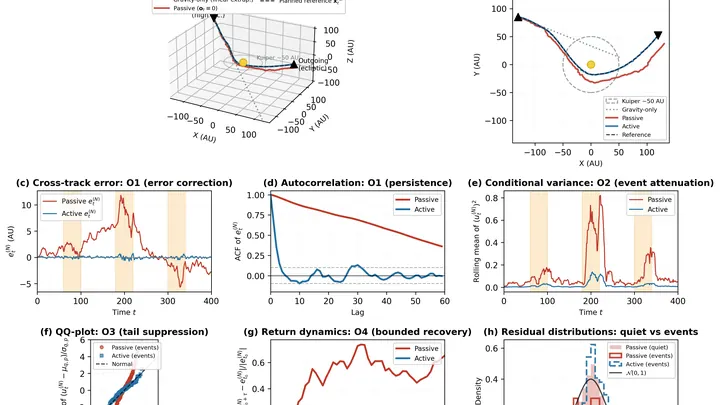
A flyby is a spacecrafttrajectory that swings close to a celestial body — a planet, moon, or asteroid — without entering orbit around it. The spacecraft uses the target's gravity to bend its path and change its speed, a technique called a gravity assist. Flybys are the workhorses of planetary exploration: they allow a single mission to visit multiple targets, or to reach distant destinations that would require too much fuel for a direct journey.
History
The concept of gravity assist was first proposed in the 1960s by Michael Minovitch, who calculated that a Jupiter flyby could accelerate a spacecraft enough to reach Saturn. The first successful planetary flyby was Mariner 2's pass of Venus in 1962.
How it works
As the spacecraft approaches the planet, it falls into the planet's gravitational well, gaining speed. It then swings around and exits, but because the planet is moving in its own orbit, the spacecraft's velocity relative to the Sun changes — it can gain or lose energy depending on the geometry. The spacecraft never touches the planet; it just uses its gravity as a slingshot. The key is precise timing: arriving too early or too late misses the window for the desired trajectory change.
In practice
Flybys are used in nearly every interplanetary mission — Voyager 1 and 2 used them to visit multiple outer planets, and New Horizons used a Jupiter flyby to reach Pluto. They are also essential for missions to Mercury, which requires multiple flybys to shed orbital energy.
Fun fact
A single Jupiter flyby can increase a spacecraft's speed by more than 10 kilometers per second — enough to cross the entire solar system in a few years instead of decades.
A solar sail doesn't move on water but in space, and it's pushed not by wind but by the pressure of sunlight. Such a spacecraft can fly for years without spending a drop of fuel. Steering it is like sailing a yacht across an ocean where the currents are planetary gravity and the gusts of wind are shifting sunlight.
Every civilization is born with a gravitational debt. The home planet's mass determines the loan amount, and the Tsiolkovsky equation is the interest rate applied to each kilogram of payload. To send a probe to the stars, you have to pay with fuel, and the debt grows exponentially.
A wormhole is a hypothetical tunnel in curved spacetime connecting two distant regions of the universe and potentially shortening the journey between them.
In July 1988, the automatic station Phobos 1 lifted off from Earth. Its target was Mars and its mysterious moon, Phobos. Two months after launch, an incorrect command was sent, communication was lost, and the probe fell silent forever. Since then, it was considered lost.
Decades later, astronomers spotted a strange object—1998 KY26.
Toss a handful of coins on a table: each one lands heads or tails on its own. Now imagine the coins start flipping over, nudging each other. That's roughly how neutrinos behave in a very dense environment.
A research probe is planned for the nearest black hole — a region of spacetime whose gravity traps even light. After a hundred years of flight, the spacecraft will enter orbit around the mysterious object to answer a key question: are we looking at a black hole or a neutron star — the ultra-dense remnant of a massive star, compressed to nuclear…
A handful of coins accelerates to one-fifth the speed of light. That's what Coracle interstellar probes will be like — tiny spacecraft weighing just a few grams, each with an ultrathin sail film. A powerful laser beam pushes them forward: light presses on the sail like wind fills a yacht's sails, except instead of air, it's a stream of photons.
An icy rock is flying through the Solar System on an open trajectory — coming in from interstellar space, swinging around the Sun, and heading back into the dark.
A comet hurtling through space is a mountain of ice and dust that carries itself across the Solar System. If you mount small engines on such a mountain, it becomes a ship with its own fuel: gas from the interior can be vented through nozzles to change course.
A hawk soars over a field, its wings tracing an intricate dance. Each flap, each tilt is not random but a combination of simple motions that can be broken down into components. Collective behavior in the air may seem intuitive, but behind it lies strict mechanics.
Scientists recorded the hawks' movements using cameras that track the position of every point on the wing and tail.
Space works like a billiard table. Massive outer planets, like heavy balls, transfer their energy to light inner worlds. Such a gravitational kick can fling a small planet out of the stellar system. It turns into a free-floating wanderer — a rogue exoplanet without a star.
Detecting these invisible bodies is hard: they neither emit nor reflect light.
Paraglider, hang glider, and glider — three different wings, but in the sky they behave the same. Pilots catch invisible warm air currents, rise on them, then glide to the next. Such flight is like a game of hopscotch: a jump upward, then a glide forward, and again a search for a place to jump.
Scientists analyzed thousands of real routes and found a common law.
Two stars, drawing together in a cosmic dance, experience an extra wobble — a consequence of spacetime curvature (an effect predicted by Einstein). A planet orbiting them also wobbles. Sometimes the rhythms align: the gravitational tugs from the stars fall in step with the planet’s orbit, like hands pushing a swing.