Why Are 'Little Red Dots' So Red? The Answer Lies in a Gas Curtain ✛
In 2023, the JWST telescope pointed its mirrors at a patch of sky and spotted hundreds of compact, reddish objects—'little red dots.' These are active galactic nuclei (black holes voraciously consuming matter). Their red hue had long been a puzzle.
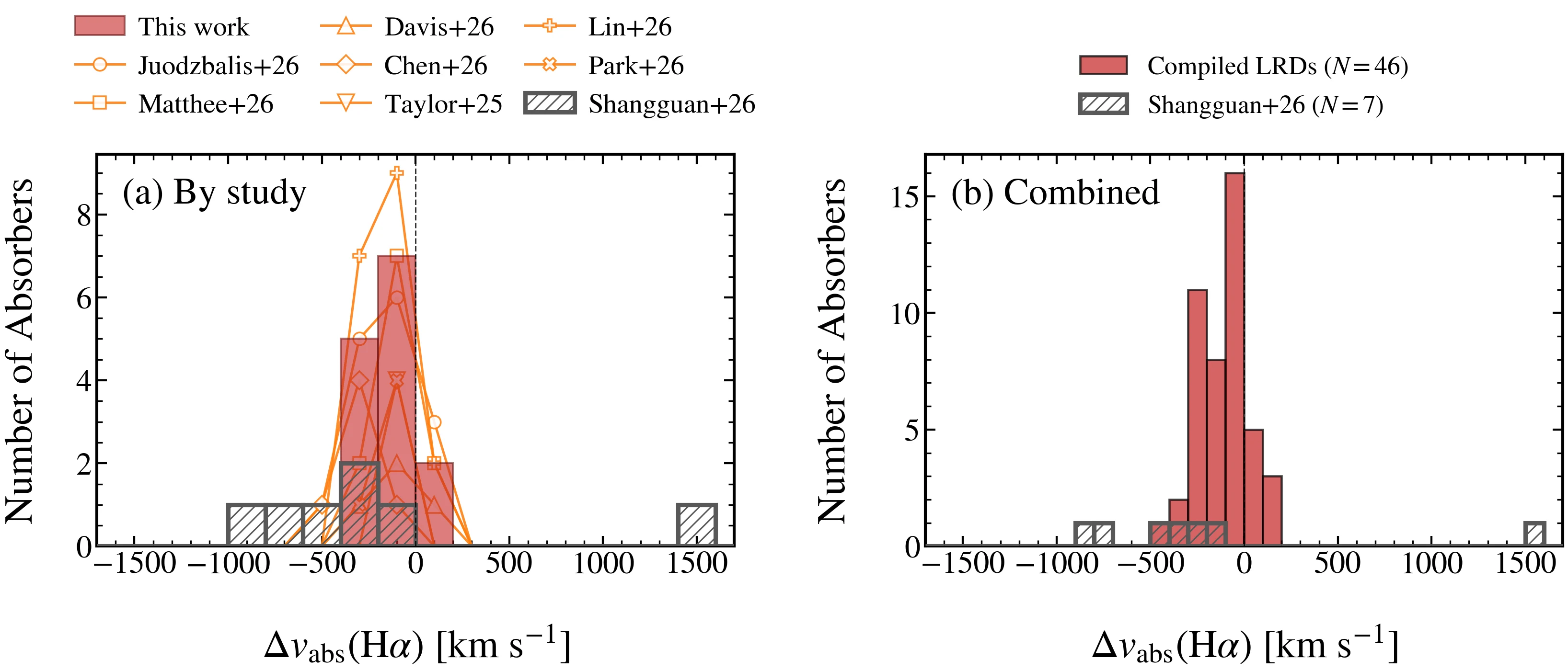
The breakthrough came when astronomers examined their spectra — the rainbow decomposition of light. In 14 out of 40 dots studied, dark absorption troughs appeared in hydrogen lines (the same ones that give pink color to nebulae). This is a hydrogen curtain: a gas cloud hanging directly in front of the hot nucleus. The gas is moving — almost always away from the black hole at hundreds of kilometers per second. In nearby active nuclei, such a curtain is rare — about one in 2,500. But here, it's every third one.
Why does the curtain matter? It is semitransparent and reprocesses the radiation, making the light redder. Moreover, by comparing outflow speed with the black hole's gravitational pull, scientists realized that for most of these clouds, radiation pressure is insufficient to escape. The gas billows out like a curtain in a draft, but stays by the window. Thus, the dense gas curtain not only explains the red color of distant dots but also reveals how quickly black holes grew in the young universe.
The term 'little red dots' arose from the visual similarity of these objects in JWST images — they look like point-like reddish sources, though in reality they are entire galaxies with an active nucleus.