A spectral line is a dark or bright feature in a spectrum, corresponding to the absorption or emission of light at a specific frequency. The linewidth is the range of frequencies over which this feature extends, typically measured at half its maximum intensity (full width at half maximum, FWHM). A narrow linewidth means the light is highly monochromatic, while a broad linewidth indicates a spread of frequencies. The linewidth is a fundamental property that encodes information about the physical conditions of the emitting or absorbing material, such as temperature, pressure, and velocity.
History
The concept of spectral linewidth was established in the late 19th and early 20th centuries with the development of high-resolution spectroscopy. Albert Michelson and others measured the fine structure of spectral lines, and the theoretical framework was later refined by Hendrik Lorentz and others.
How it works
The linewidth arises from several broadening mechanisms. Natural broadening is due to the finite lifetime of quantum states, as described by the Heisenberg uncertainty principle. Doppler broadening occurs because atoms or molecules in a gas move at different velocities, shifting the absorbed or emitted frequencies via the Doppler effect. Pressure (collisional) broadening results from interactions between particles that perturb energy levels. The observed line profile is a convolution of these effects, and measuring its shape and width allows physicists to infer the temperature, density, and motion of the source.
In practice
Linewidth is crucial in laser technology, where narrow linewidths enable precision measurements, optical clocks, and high-resolution spectroscopy. It is also used in astronomy to determine the composition, temperature, and velocity of celestial objects, as well as in telecommunications to increase the data capacity of optical fibers.
Fun fact
The narrowest spectral lines ever measured are in ultra-cold trapped ions, with linewidths of less than one hertz, corresponding to a frequency stability that would only drift by one second over the age of the universe.
Light passing through a glass of murky water dims — some of it is absorbed. That's how many liquid-analysis instruments work: they measure how much light was lost and infer the composition from that. But if the liquid is heterogeneous, like soup with chunks, a single number isn't enough: you need to know where exactly more absorption happened.
Forty reddish sparks frozen in the images from JWST. The telescope spotted them in the depths of space, at distances where the Universe was less than two billion years old. These objects are active galactic nuclei — very compact and unusually red. Their color earned them the nickname 'little red dots' (LRDs).
When a radio wave encounters a building in its path, it doesn't just reflect or get absorbed: it bends around it, much like ocean waves flowing around a rock, leaving calm water behind. In radiophysics, this phenomenon creates a radio shadow — a complex pattern of zones where the signal is amplified or attenuated, which scientists call a radio portrait.
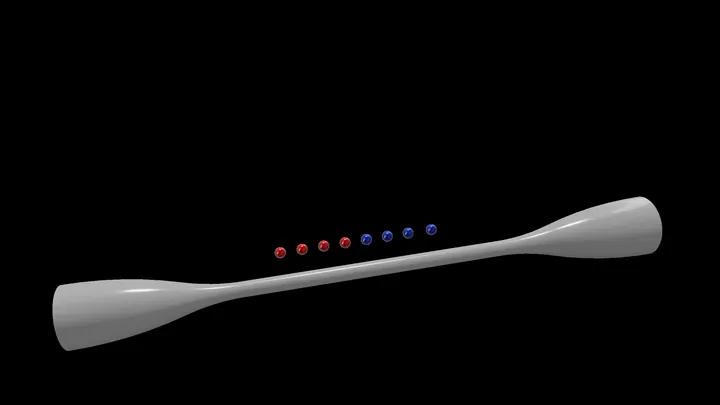
An orchestra without a conductor, where musicians hear each other through a shared wall. That's roughly how the new type of laser works: a few atoms (emitters) sit along a waveguide — a thin track for light on a chip. Light from each atom runs along this track and affects its neighbors.
In the center of almost every large galaxy lurks a supermassive black hole, whose gravitational abyss was first mathematically described by Karl Schwarzschild. When it swallows gas, a dazzling active nucleus is born — a quasar.
The James Webb Space Telescope peered into the era when the expansion of the Universe stretched the light of distant objects into the red, and found a scattering of strange sources — 'little red dots'. Their spectra broke the usual patterns: they are blue in the ultraviolet, but deep red in the optical, as if seen through a cherry veil.
A squad of soldiers marches across a parade ground. As long as everyone keeps in step, the movement remains sharp and coordinated. But if someone falls out of line, the order is lost. In the microworld, electrons play the role of such a squad: when their oscillations are synchronized, the substance emits a narrow, sharp line.
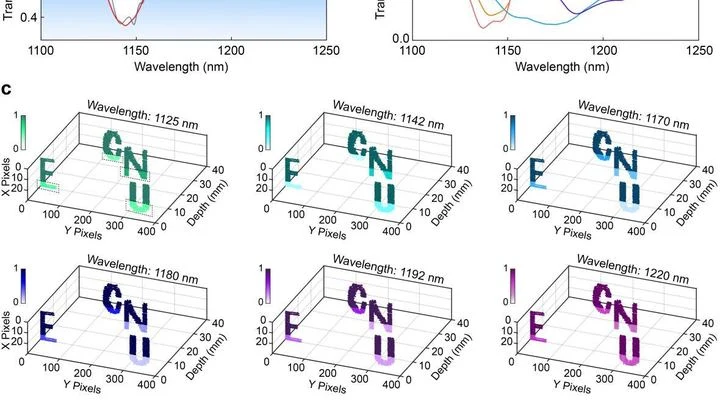
A conventional lidar is like an artist who paints a landscape but sees only gray shadows. It measures distances to each point accurately, but can't tell whether it's looking at rock, wood, or plastic. To learn the composition, you need a spectrometer — a separate device that works slowly and can't keep up with a fast scanner.
The new system takes a different approach.
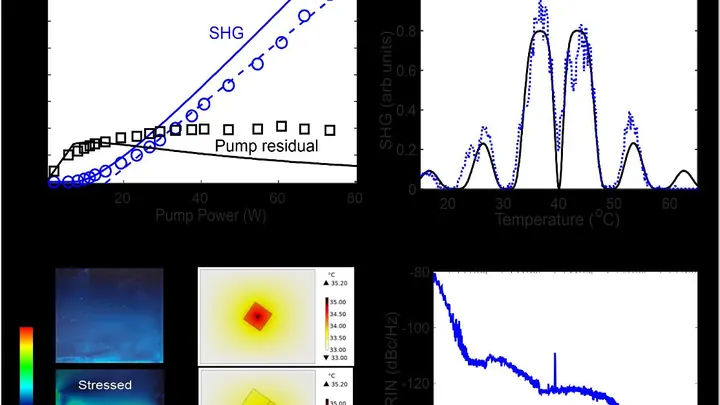
The laser based on diamond converts almost half of the pump energy into bright yellow light — an efficiency of 47.7%, a record for such devices. But the main advantage is not the power, but the exceptional purity of the color: the beam is so monochromatic that it can be compared to a musical instrument playing just one note without the slightest wavering.
Strike a tuning fork, and it rings with a single pure note. But if the fork is trembling and people are chattering nearby, the sound won't be perfect. Same with molecules: each one absorbs light of a specific color, but due to its own vibrations and the jostling of neighbors, that color gets smeared out.
The authors of the paper figured out how to show this to students without complex formulas.
A laser beam usually quivers slightly, like a plucked string. In optical clocks, that quiver turns into timing errors. Engineers swapped the shaky light for steady light, and rubidium vapor clocks started ticking five times more evenly.
Infrared light with a wavelength of about three micrometers is the working range for identifying molecules: each molecule absorbs light at its own characteristic frequencies, leaving behind "fingerprints." But until now, instruments for this range could not simultaneously provide broad frequency coverage, sufficient power, and…
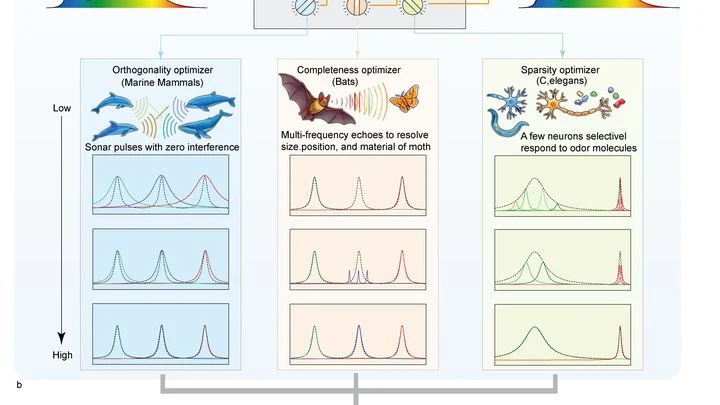
A conventional spectrometer is like a comb that untangles light and sorts it by wavelength. But a comb is rigid: one type of light needs one comb, another needs a different one. The new device works differently. It asks light a series of questions, changing its shape each time to glean more meaning from the answers.
Shine a flashlight through a narrow slit, and the beam doesn't stay a thin stripe; it spreads out sideways. Light has a habit of bending around obstacles, and because of that, the smallest spot you can get with an ordinary lens is no smaller than half a wavelength.